'North's cluster munitions developed 20 years ago — we have hundreds of rounds with twice the individual yield'
'OPCON transfer conditions don't cover full ROK military capability — will pursue without antagonizing US'
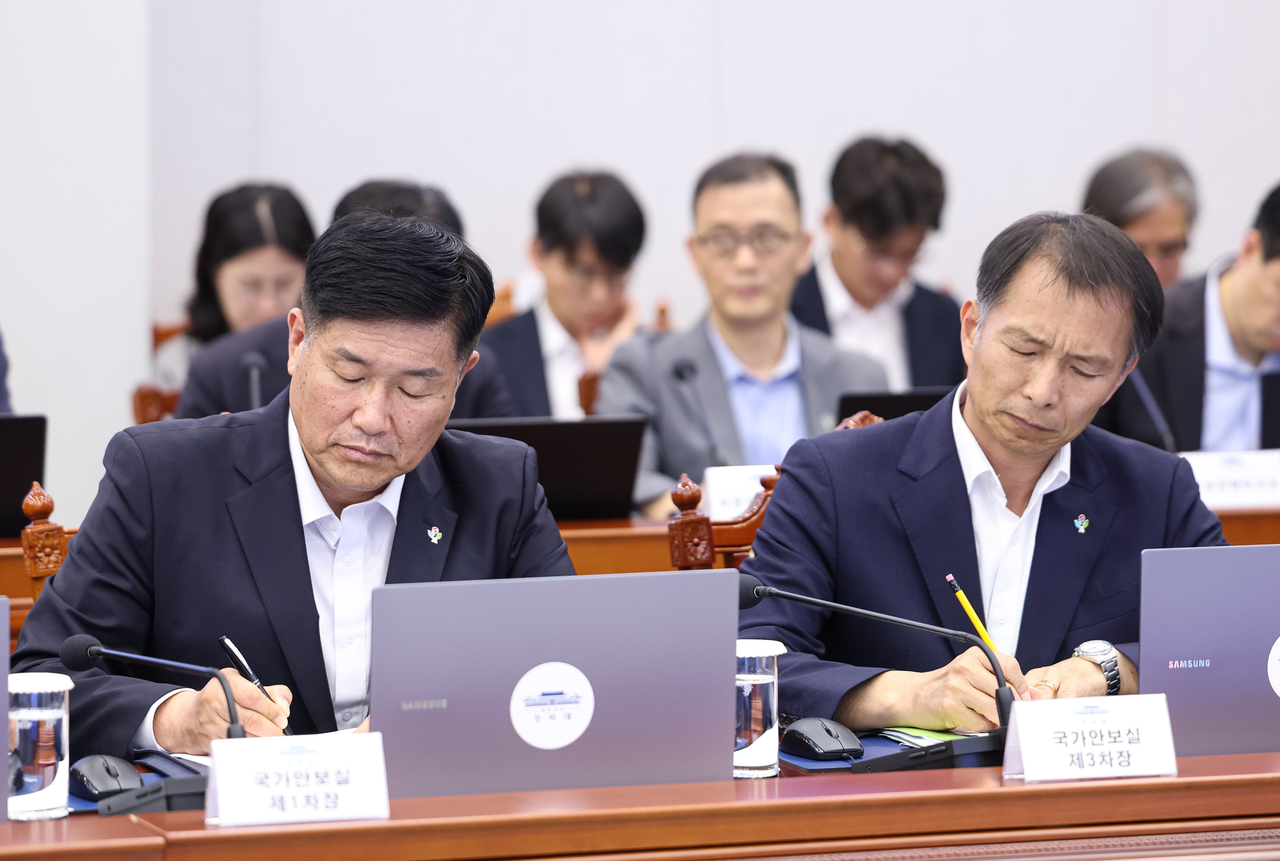
Kang Geon-jak, first deputy chief of the presidential National Security Office, said Tuesday that South Korea's military already has sufficient technical readiness to counter the conventional weapons threats posed by North Korea's recently unveiled cluster munitions and drones. Kang also said strategic consultations with Washington over the early transfer of wartime operational control would proceed smoothly on the basis of the alliance.
Speaking on SBS Radio's "Kim Tae-hyun's Politics Show" that morning, Kang addressed concerns raised in recent media editorials about North Korea's conventional military capabilities. "Conventional threats have always existed," he said. "Before North Korea developed nuclear weapons, conventional threats were actually the biggest concern. I find it somewhat regrettable that recent photos of their achievements are being run on the front pages of our newspapers, causing public anxiety."
On the cluster munitions North Korea displayed, Kang said South Korea had already developed comparable weapons more than 20 years ago. "We have hundreds of rounds ready whose individual yield is about twice that of what North Korea showed," he said. "This is not new technology at all — it is a system we have been fully prepared with for a long time." He added that cluster munitions are among the weapons banned internationally under the Oslo Convention, and that South Korea and the United States are among the countries that have not joined the treaty and retain the weapons because of immediate security threats. "There is some hesitation about openly boasting about them," he said.
On North Korea's hypersonic missile development, Kang said assessments suggest Pyongyang has not yet reached the stage of withstanding extreme heat to strike a final-stage target. On the recent controversy over a domestically developed drone that fell into the sea during a test, Kang denied any airframe defect. The drone had successfully completed more than 30 land-based tests, he said, before a problem with the launch canister occurred while it was being transported by ship for the maritime trial.
On the OPCON transfer, Kang dismissed security concerns and said the current bifurcated command structure needed to change. Next year's defense budget alone will reach 73 trillion won ($54.6 billion) — roughly the size of the entire national budget in the late 1990s — meaning the real capability gap with North Korea will only widen, he said. "In modern warfare, as seen in the Ukraine war and US operations against Iran, the line between wartime and peacetime has become blurred," Kang said. "Maintaining a binary command structure under those conditions carries significant instability."
On USFK's references to "new conditions" for the transfer, Kang said the existing conditions cover only about 5 percent of defense capability improvement costs and do not include core assets such as F-35 fighters, Aegis destroyers, submarines, K-9 self-propelled howitzers or K-2 tanks. "Since those conditions do not represent the full capability of the South Korean military, we can reach an agreement that goes beyond the stated conditions through strategic assessment with the United States," he said. Addressing concerns about a unilateral declaration, Kang said Seoul would demonstrate its capabilities to bring about a forward-looking US judgment rather than antagonize Washington. "The end state must also be grounded in the South Korea-US alliance," he said.
sunpine@heraldcorp.com