Korea Institute of Industrial Technology builds semiconductor environmental equipment open lab in Pyeongtaek
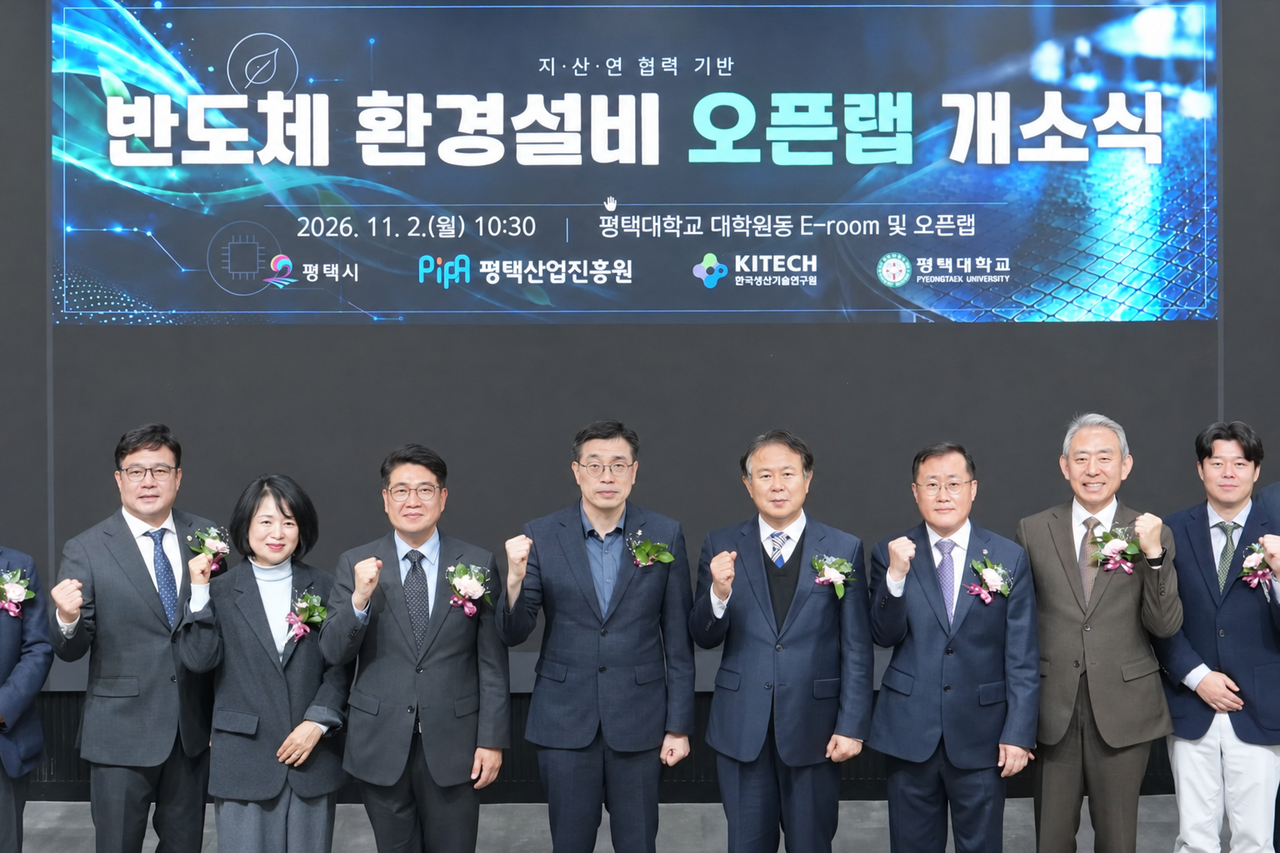
A testing facility where small and midsize companies can verify the performance of their semiconductor toxic gas reduction equipment under conditions that closely replicate actual manufacturing processes has opened in Pyeongtaek, Gyeonggi Province. The facility is expected to help those companies enter the semiconductor supply chain, as many have long struggled to validate their technologies and bring them to market due to a lack of in-house testing infrastructure.
The Korea Institute of Industrial Technology said Monday it held an opening ceremony for the "semiconductor environmental equipment open lab" at Pyeongtaek University, together with the city of Pyeongtaek and the Pyeongtaek Industry Promotion Agency.
Semiconductor manufacturing processes generate greenhouse gases and a range of toxic gases. Effectively managing these emissions requires environmental equipment that can reliably reduce pollutants and operate stably over extended periods.
Small and midsize companies developing such equipment have faced persistent difficulties verifying performance and securing reliability because they lacked facilities to test their technologies under conditions similar to actual semiconductor processes.
In response, the Korea Institute of Industrial Technology partnered with the city of Pyeongtaek, the Pyeongtaek Industry Promotion Agency and ISG to build a shared demonstration facility in Pyeongtaek, one of the country's largest semiconductor production hubs.
The newly opened lab reproduces an actual semiconductor process environment at pilot scale. It supports companies in testing their environmental equipment under process-like conditions and obtaining objective data on pollutant treatment efficiency and operational stability.
The facility is equipped with a wet scrubber, an electrostatic precipitator and an exhaust gas analyzer, enabling real-time measurement of the reduction effectiveness of toxic gases including nitrogen dioxide (NO₂).
A wet scrubber removes pollutants from exhaust gas using liquid, while an electrostatic precipitator captures fine particles through electrical force. Together, these systems allow companies to precisely verify the treatment performance of their equipment.
The Korea Institute of Industrial Technology also plans to connect companies with validated technologies to semiconductor end-users. The institute aims to develop the facility into a demonstration hub linking technology validation, commercialization and entry into the regional semiconductor supply chain — going well beyond simple performance testing.
nbgkoo@heraldcorp.com