
Jang Dong-hyeok says government is 'only scheming to hand out money'
Party to unveil '5 livelihood priorities' budget plan Tuesday
Ruling, opposition parties set for clash over future response fund
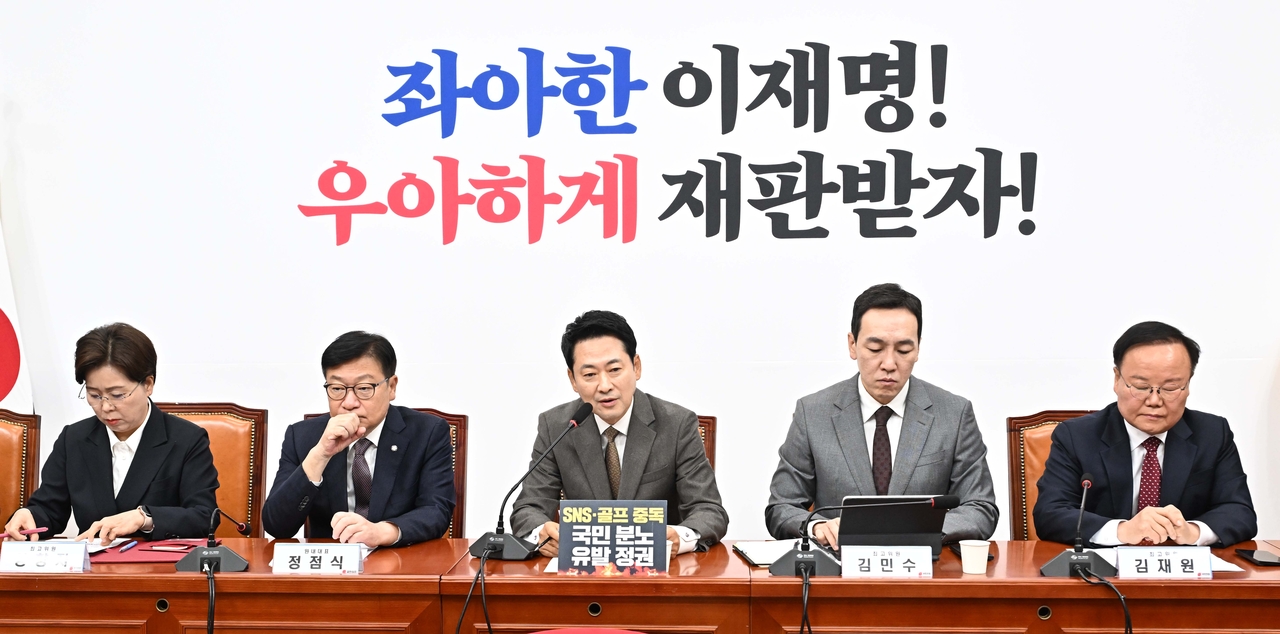
The battle for control over the review of the 2027 budget proposal — the largest in the country's history — has begun in earnest, with the People Power Party set to counter the government's plan with its own proposal centered on spending cuts, reinvestment and government bond repayment.
People Power Party leader Jang Dong-hyeok said at a supreme council meeting at the National Assembly on Monday that the government had put forward a record 821 trillion won ($614 billion) budget proposal while "only scheming to hand out money by banking on a semiconductor windfall." Jang said the ruling camp had "ruined Gyeonggi Province and is now set to ruin the Republic of Korea on an even grander scale," adding that the PPP had demanded the government cut 30 trillion won from 100 problem projects it had identified.
Jang said the party also believes 104 trillion won in surplus funds held in the future response fund should be used to repay government bonds. "We will protect the lives of the people and the future of this country with a genuine livelihood budget that the PPP has carefully prepared," Jang said.
The PPP plans to target 100 problem projects during the budget review process to reduce spending by 30 trillion won, while expanding what it calls a "five livelihood priorities" budget covering jobs, income, care services, public safety and youth. Jang is scheduled to announce the specific projects and scale of the five-priority budget plan on Tuesday.
A direct clash between the ruling and opposition parties is expected over the 162 trillion won future response fund during this round of budget deliberations. The PPP maintains that the 104.4 trillion won allocated as surplus within the fund should be cut entirely and redirected toward repaying national debt. The party argues this would save roughly 3 trillion won in interest costs, which could then be used to bring private university tuition down to the level charged at Seoul National University.
Policy committee chairperson Im Yi-ja took aim at the future response fund at the same meeting, saying the National Assembly Budget Office had projected that additional tax revenue tied to the semiconductor boom would fall to zero after 2029. "When that revenue dries up in two or three years, it will ultimately have to be filled by debt passed on to future generations — by taxpayer money," Im said. "This is not a future response fund. It is a future extinction fund."
Im added that the party could not stand by while "profligate budget management" was deepening the hardship of ordinary people through a bubble economy and rising prices. "Through rigorous scrutiny during the budget review process, we will correct the Lee Jae Myung administration's populist, slush-fund budget and safeguard taxpayers' money and the fiscal soundness of the Republic of Korea," Im said.
Meanwhile, both the ruling and opposition parties have voiced concern — particularly among local governments — over local allocation tax linked to the future response fund, and there is talk that the item could be adjusted during the review.
bigroot@heraldcorp.com
raining@heraldcorp.com




