
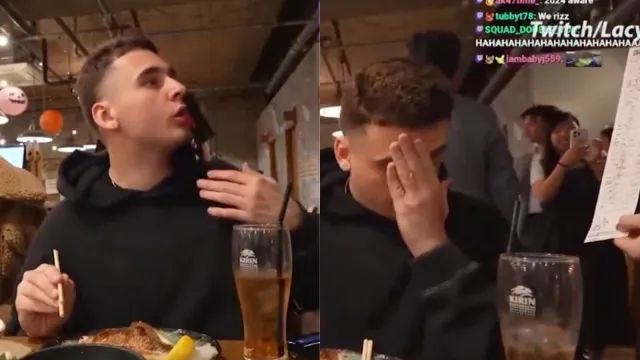
A popular American internet broadcaster was hit with roughly 16 million won ($12,000) in fraudulent food orders placed by viewers while streaming live from a restaurant in Japan.
According to foreign media including The Sun, Lacy, a US-based Twitch streamer with more than 3.5 million followers, was broadcasting live from a Japanese restaurant on Wednesday, dining with a companion.
During the roughly five-hour stream, a QR code for the restaurant's mobile ordering system appeared on screen, and some viewers used it to place large quantities of food orders.
When a restaurant employee approached the table to address the flood of incoming orders, Lacy explained that viewers appeared to have been ordering through the QR code and asked them to stop. The broadcast was then paused for a period.
When the stream resumed, Lacy said the prank had generated orders worth approximately 1.5 million to 1.6 million yen, equivalent to roughly 13.6 million to 16 million won, and that Lacy had been left to cover $12,000 in charges.
Lacy apologized to the restaurant, paid the full bill, and asked staff to distribute the food that had already been prepared to other customers rather than throw it away.
The incident drew widespread criticism online, with many condemning the viewers' irresponsible behavior. Some also questioned why the restaurant's system had failed to flag the abnormal volume of orders.
The restaurant, however, disputed Lacy's account. Zauo Shibuya in Tokyo acknowledged that a third party had placed unauthorized orders but said it had not charged the customer for any food not actually ordered.
According to the restaurant, staff cross-checked the orders with the customer and collected payment only for what was actually consumed. Some food had been prepared before the prank orders were identified, but any items the customer confirmed were not ordered were not served and were discarded.
"We went through the order history item by item with the customer and processed payment only for what was actually ordered and eaten," the restaurant said. "We did not charge the customer for any losses resulting from the prank orders." The restaurant also called on the public to stop making indiscriminate accusations based on misunderstandings or distorted information.
Lacy issued a correction on X on Thursday. Lacy said that due to the language barrier — including difficulty with Japanese — the initial understanding was that the full $12,000 would have to be paid. In fact, the amount Lacy was actually responsible for covered only the additional food that had already been cooked, not the total value of all the fraudulent orders.
bbo@heraldcorp.com




