As the eligibility age for the national pension is gradually raised, a structural income gap between the mandatory retirement age and the start of pension payments has widened to as long as three years.
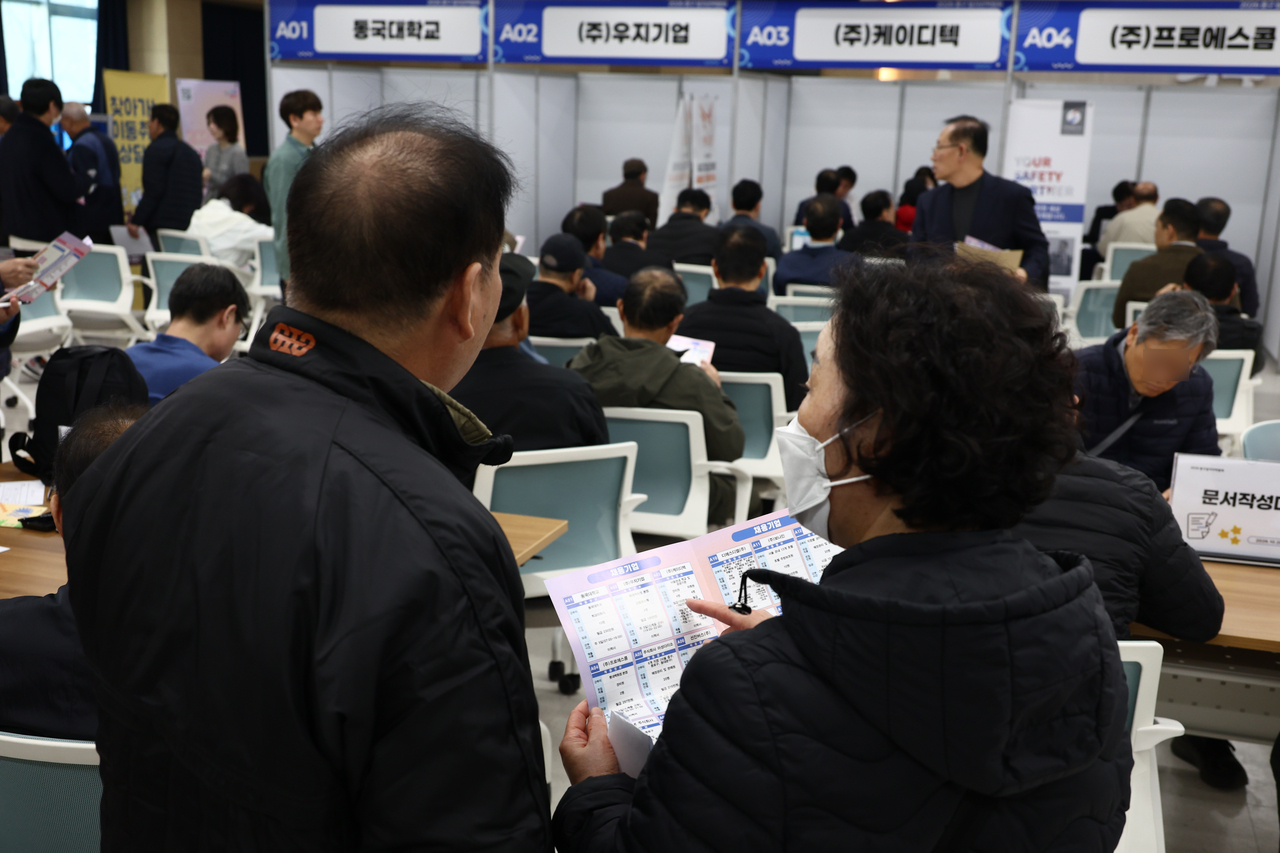
According to Yonhap, many middle-aged and older workers who have retired without bridging that gap are searching for work, but most are being pushed into low-quality part-time and temporary positions, left to shoulder their own living costs.
For vulnerable groups whose incomes have dropped sharply, even the most basic coping strategies — drawing on pension benefits early or liquidating assets — are failing, with seven in 10 such households falling into a budget deficit.
A research report released Monday by the Korea Institute for Health and Social Affairs, titled "Income Gaps Among Middle-Aged and Older Workers: Current Status and Policy Responses," found that the national pension eligibility age has been rising by one year every five years since 2013 — from 61 that year to a planned 65 by 2033 — following a 1998 reform.
The mandatory enrollment age for the national pension, however, remains capped at 59. As a result, those born between 1961 and 1964 — who become eligible for payments at 63 — face a three-year institutional blind spot from age 60 to 62 during which they can neither contribute to nor receive national pension benefits.
With the government creating this structural gap but providing no adequate buffer, the burden of making ends meet has fallen entirely on individuals. The labor force participation rate among those aged 60 to 64 jumped from 57.0 percent in 2011 to 66.7 percent in 2025, while the share of wage earners in that group rose steeply from 49.4 percent to 66.2 percent — reflecting a reality in which people have no choice but to keep working until pension payments begin.
While more older workers are employed, job quality has plummeted. The employment rate during the income-gap period for those born between 1961 and 1964 stood at 66.5 percent, down 7.3 percentage points from 73.8 percent before retirement age — a decline driven largely by departures from stable, full-time positions.
Among those who re-entered the workforce after age 60, temporary and daily workers accounted for 61.3 percent, while regular employees made up just 22.1 percent.
That is a sharp contrast to the 59.0 percent regular employment rate among those who remained in their existing jobs. Most newly obtained positions were contract or part-time roles, and reduced working hours kept many trapped in low-wage conditions.
Household finances have taken a direct hit as well. During the income-gap period, earned income from work and self-employment still accounted for 83.0 percent of household income, reflecting an overwhelming dependence on labor.
Yet when the primary earner lost a main job, spouses rarely increased their own work to compensate — the cushioning effect was almost entirely absent.
Households whose income fell to less than half the pre-retirement median during the gap period accounted for 15.6 to 17.2 percent across different age cohorts.
These hard-hit households cut discretionary spending — dining out, leisure and clothing — to roughly one-third the level of typical households, yet 70.2 to 72.5 percent of them still could not avoid running a household deficit.
Financial and pension mechanisms previously considered alternatives have also proven ineffective for low-income vulnerable groups. More than 70 percent of middle-aged and older households' assets are tied up in real estate such as housing, leaving little cash available for daily expenses. Nor has any statistically clear trend emerged of people selling their homes around age 60 to cover living costs.
The public pension system, too, has worked mainly in favor of those with long, stable employment histories. The early old-age pension — which allows reduced payments before the standard eligibility age — has in effect become an option reserved for those with substantial contribution records: more than 77 percent of eligible recipients had contributed for 20 years or more.
Households that maintained their income during the gap period received an average monthly pension of 1.92 million won ($1,440), while vulnerable households whose income fell to half or less received just 527,000 won a month. Occupational pension take-up rates among those aged 60 to 64 stood at just 1.4 percent as of 2023, putting such benefits out of reach for most ordinary workers.
In-depth interviews with retirees revealed similar hardship. "It was only when I watched my bank balance shrink that I truly felt the income cutoff," participants said. Men repeatedly hit barriers to re-employment due to age limits and mismatched career histories, while women said cutting spending was often their only option given physical limitations. Costs for caring for elderly parents, medical bills and rising food prices have pushed even reducible expenses to their limits, severing social ties in the process.
The researchers said tailored measures are urgently needed for vulnerable groups shut out of the resources and opportunities required to weather the gap created by the delayed pension age.
They recommended a phased extension of the mandatory retirement age in line with the rising pension eligibility age, the introduction of a rehiring system at small and medium-sized enterprises, and an extension of the upper age limit for national pension enrollment starting with workers aged 60 and older who still have income.
In addition, the researchers said the government should move quickly to build a tighter safety net — including a partial pension system allowing recipients to draw benefits in installments as needed, relaxed eligibility criteria for unemployment benefits, and an expansion of publicly funded bridge employment programs.
husn7@heraldcorp.com