
Trump rallies in Iowa and Kansas to shore up base; forecasters give Democrats 83% chance of retaking House
Democrats exposed by bitter progressive-moderate split in Michigan; early voting surpasses 53 million
Trump's every word moves global markets and economies. If keeping up with the flood of Trump news feels overwhelming, this daily briefing has you covered. The Herald Business international desk — on the move from 5 a.m. — delivers a fast digest of US market closes and the Trump developments most likely to shake global asset markets, all readable in under a minute. Whether you're commuting, eating alone, or winding down for the night — one minute a day keeps you ahead.
With the US midterm elections — widely seen as a referendum on Donald Trump — just two days away, Republicans are fighting to hold both chambers of Congress while Democrats push to reclaim them. Trump is set to visit two competitive Senate battlegrounds Sunday (local time) to rally his base, even as election forecasters warn that Democrats could flip not only the House but the Senate as well. The Democratic Party, meanwhile, faces a late-breaking crisis as a fierce internal clash between its progressive and moderate wings erupts in the final stretch of the campaign.
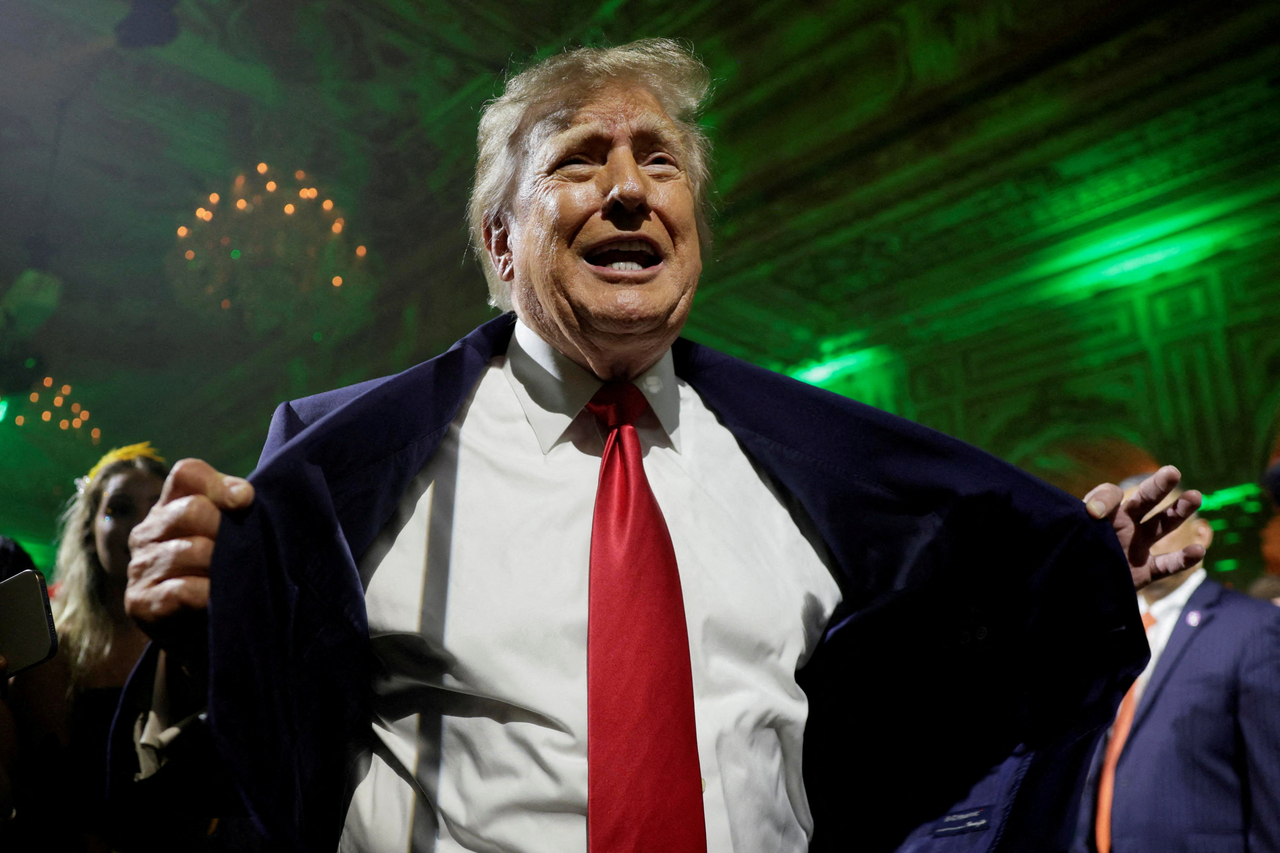
Trump is scheduled to hold campaign rallies in Iowa and Kansas on Sunday in support of Republican candidates. The visits had originally been canceled, but Trump reversed course after critics questioned whether the decision reflected concerns about the 80-year-old president's stamina.
Both Iowa and Kansas are competitive Senate battlegrounds. The results of their Senate races could erode the Republicans' slim majority in the chamber. The two states, where agriculture plays a major economic role, backed Trump by more than 10 percentage points in the 2024 presidential election, making them traditional Republican strongholds — but rising oil prices and fertilizer supply disruptions stemming from the war with Iran have allowed Democratic candidates to close the gap.
Sunday's rallies mark the end of Trump's nationwide campaign blitz.
Since last month, Trump has held 28 campaign rallies across the country — ranging from North Carolina, just outside Washington, D.C., to Alaska — urging voters to support Republican candidates. The tour even took Trump to deep-red states such as Alabama and Oklahoma, where Republican victories are expected but where Trump judged that base consolidation was necessary given the unusually competitive landscape that has turned several traditional strongholds into toss-ups.
Yet despite the 80-year-old president's relentless efforts, the electoral outlook remains unfavorable for Republicans.
Election forecaster Decision Desk HQ put the probability of Democrats retaking the House at 83 percent and the Senate at 63 percent. The Cook Political Report projected that Democrats could win as many as 240 House seats — their largest total since 2009. A majority requires 218 seats. The Wall Street Journal, aggregating forecasts from multiple election analysts, projected Democrats would secure 224 House seats, clearing the majority threshold.
Up to seven Senate seats are classified as competitive, and Democrats need to flip four of them to reclaim the majority. Six of the seven battleground seats are in states that have historically leaned Republican, making it pivotal whether those voters will stick with their party. National attention is focused in particular on whether Democrats could pull off a historic upset in states such as Texas and Kansas, which have sent only Republican senators to Washington for decades.
Despite the favorable forecasts, Democrats cannot afford complacency. A rift between the party's hard-left progressive and moderate factions — papered over during the primaries — has burst into the open in the final days of the campaign.
The original Democratic strategy for the last Sunday before Election Day was to have Michigan's hard-left Senate candidate Abdul El-Sayed and moderate Rep. Haley Stevens — who narrowly lost to El-Sayed in the primary — appear side by side at a church service in a show of unity. Rep. James Clyburn, a prominent figure among Black voters, was to accompany them to help El-Sayed court Black constituents.
The plan collapsed when El-Sayed and Stevens clashed publicly over US policy toward Israel, and El-Sayed called on Stevens to skip the church service, deepening the rift.
Stevens then publicly endorsed Republican candidate Mike Rogers, who has Trump's backing, in a direct rebuke of El-Sayed. What was meant to be a display of moderates embracing the progressive wing instead laid bare a party split so severe that one faction preferred backing Trump's candidate over accepting its own nominee.
Trump welcomed the Democratic infighting. "Wow, this is a great thing," Trump wrote on social media, praising Stevens for showing "tremendous and almost unprecedented loyalty to the people of Michigan. This is what courage looks like."
The tension between progressives and moderates is playing out most sharply in Michigan. If the Democratic-held Michigan Senate seat flips to Republicans amid the contest and the internal turmoil, it would be a serious blow to El-Sayed and the broader progressive movement — and is expected to have significant implications for the Democratic Party's 2028 presidential strategy.
Also drawing attention is a separate controversy in Alaska, another competitive Senate race, where allegations have emerged that Democrats fielded a candidate sharing the same name as the Republican nominee in an effort to split the vote — and whether that gambit will affect the final outcome.
Early voting in the midterms has already surpassed 53 million ballots cast, exceeding the previous record of about 46 million set in 2022. The surge has been driven largely by competitive districts. Among early voters, 43 percent identify as Democratic supporters, 31 percent as Republican and 25 percent as independents. Historically, Democrats tend to vote early in greater numbers, while Republicans turn out more heavily on Election Day itself.
yckim6452@heraldcorp.com




