
Site suspected of housing nuclear equipment and materials;
Trump vows it can be 'taken care of in 10 minutes'
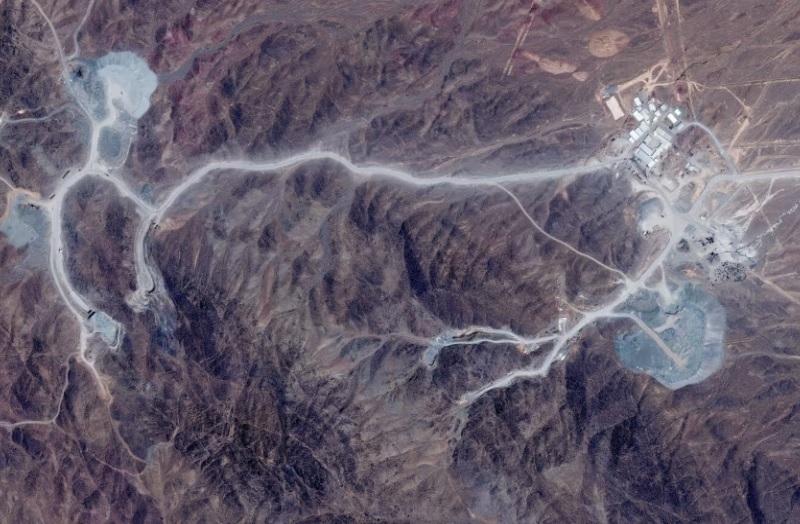
Curiosity is growing about Iran's Pickaxe Mountain — the site Donald Trump said he could "take care of in 10 minutes." The mountain is no ordinary peak. It is an underground tunnel complex located about 2 kilometers south of Natanz, Iran's largest uranium enrichment facility. Analysts have raised the possibility that it was built to conceal and protect nuclear-related equipment or materials, though its exact purpose and contents have not been confirmed.
Trump mentioned Pickaxe Mountain on Saturday (local time), naming it as one of "a place or two" in Iran that still needed to be "taken care of." The site has drawn renewed attention amid tensions over Iran's nuclear capabilities, as it remains among the nuclear-related targets that survived earlier US and Israeli strikes.
The mountain's Persian name is "Kuh-e Kolang Gaz Ra." Its Western nickname — Pickaxe Mountain — comes from its pickaxe-like shape and has become the widely used designation. Satellite imagery shows what appear to be tunnel entrances on both the eastern and western sides of the mountain, with two openings on each side for a total of four. The mountain stands at an elevation of about 1,608 meters, and some open-source analyses suggest the underground facility may lie 80 to 100 meters below the surface, though the internal structure and precise depth cannot be confirmed from satellite imagery alone.
The suspected trigger for Iran's construction at the site was a fire in 2020 that destroyed an above-ground centrifuge assembly facility at Natanz. At the time, the head of Iran's Atomic Energy Organization announced plans to build a larger, more modern facility in the mountainous area near Natanz. Iran has described Pickaxe Mountain as a site for the production and assembly of advanced centrifuges, and insists no uranium enrichment takes place there.
The reason the United States and Israel are watching the site closely is its defensive depth and the role it could potentially play in Iran's nuclear program. Placing centrifuges and nuclear-related equipment deep underground makes them difficult to destroy in an airstrike, and there are concerns that the site could eventually house an enrichment facility. Some have claimed that a portion of Iran's highly enriched uranium has been moved there, but that has not been confirmed.
The International Atomic Energy Agency estimated in 2025 that Iran held about 440 kilograms of uranium enriched to 60 percent — material that could be brought close to weapons grade through further enrichment. However, no public evidence has emerged that this stockpile is stored at Pickaxe Mountain. The Center for Strategic and International Studies, a Washington think tank, said in a recent satellite imagery analysis that it had observed ongoing construction and external reinforcement at the site, but found no evidence that the facility had reached a stage where enrichment operations could be conducted.
The geological and structural challenges make a strike difficult. Pickaxe Mountain is believed to consist of hard granite bedrock. The GBU-57, the United States' premier bunker-buster bomb, is described as capable of penetrating about 18 meters of concrete or about 61 meters of soil — figures that do not translate directly to a granite underground facility. The depth and internal layout of the site remain unclear, making it uncertain whether a single strike could neutralize the entire complex.
Experts say that targeting tunnel entrances, ventilation shafts, power and communications infrastructure, and access roads could paralyze operations without fully destroying the underground facility. That, however, is a different matter from eliminating whatever equipment or nuclear materials may be inside. With the site's actual purpose and internal conditions unconfirmed, the likely effectiveness of any strike remains difficult to assess.
Trump's repeated references to Pickaxe Mountain can be read as a signal that Washington will no longer tolerate Iran's nuclear capabilities, and as an attempt to present a symbolic target to support claims that earlier strikes neutralized the nuclear threat. Whether an actual attack will occur, and when, has not been determined. Pickaxe Mountain matters because of what it may contain — but based on what is publicly known, both its contents and the consequences of any strike remain deeply uncertain.
attom@heraldcorp.com




