
SK hynix's second buyback halved to 20 trillion won from 40 trillion won
Lower Kospi trading volume may amplify buyback impact
Samsung buyback effect on Kospi could be diluted if focused on preferred shares
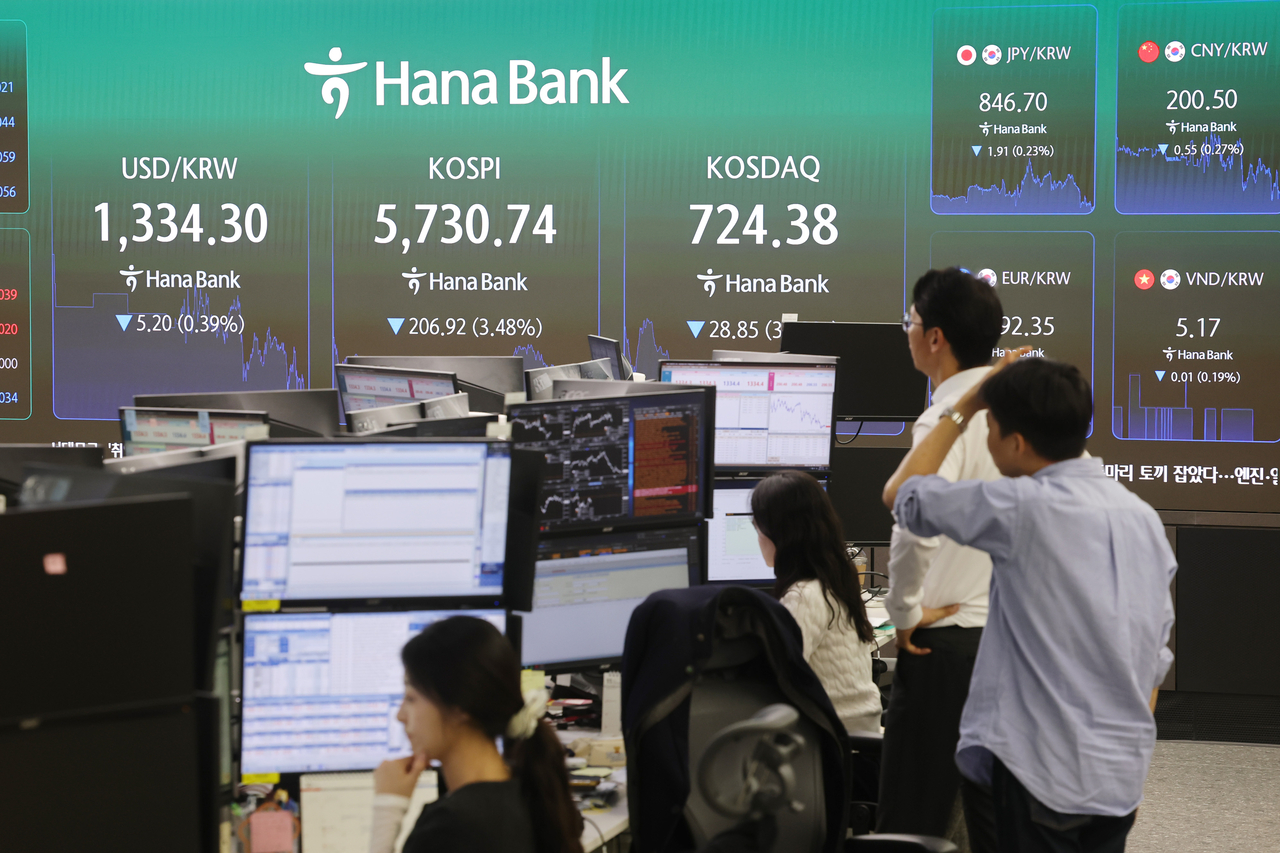
Samsung Electronics and SK hynix have announced shareholder return programs worth tens of trillions of won, fueling investor hopes for a share price rebound. Analysts caution, however, that whether the programs can actually arrest a market decline depends on how much each company spends on buybacks and over what period the purchases are carried out.
Even if the total shareholder return figures are large, the actual market impact will vary depending on how much capital flows directly into share purchases and how quickly it is deployed. Analysts expect the programs to provide a floor for the market but say it is premature to count on a sustained price recovery.
The financial investment community is closely watching the shareholder return plans that Samsung Electronics and SK hynix are set to roll out after both companies wrapped up record-breaking third-quarter earnings announcements. Attention is focused on whether SK hynix, which has already begun a new round of buybacks, will sustain its program, and on the specifics of Samsung Electronics' shareholder return plan, details of which are due in January.
Amid the Kospi's recent struggle to hold the 6,000 level and with individual investors' buying capacity shrinking, the market is once again pinning its hopes on the two companies' shareholder return policies. Investors view the buybacks — which have previously acted as a market buffer — as a positive factor supporting a price floor. Whether the purchases can generate enough sustained buying demand to lift the broader index, however, is a separate question that warrants careful analysis.
The key variables to examine are not the total shareholder return figure but the actual amount earmarked for buybacks and the pace of execution. The recent drop in Kospi daily trading volume to its lowest level of the year amplifies the potential impact of buybacks, but a separate concern is that SK hynix's daily purchase volume has fallen to roughly one-third of the 1 trillion won ($749 million) per day it maintained during its previous buyback program.
Another factor tempering expectations is that only half of SK hynix's newly announced 20 trillion won buyback is slated for cancellation. While the company has said it will purchase 20 trillion won worth of its own shares by Jan. 28, only 10 trillion won of that amount — designated for shareholder return purposes — is earmarked for full cancellation. The remaining 10 trillion won will be used for employee compensation. This contrasts with the earlier 40 trillion won buyback completed Oct. 21, all of which was cancelled.
On the positive side, the recent decline in market trading volume means buyback purchases could have a proportionally larger effect. SK hynix bought about 381.6 billion won worth of its own shares on Thursday, the first day of the new buyback — roughly one-third of the approximately 1 trillion won daily pace it maintained during the previous 40 trillion won program. This week, daily Kospi trading volume fell to as low as 12 trillion won, the lowest of the year, meaning even purchases in the hundreds of billions of won can move the market. On Wednesday, when a Kospi buy-side sidecar was triggered, foreign net purchases amounted to only about 770 billion won.
"To gauge the market-boosting effect of a buyback, you also need to look at the purchase period and what share of daily market trading volume the average daily purchase represents," said analyst Kang. "If the market secures enough liquidity to absorb buying and selling shocks, it will have a significant impact on share price volatility."
On the earnings front, the results confirmed a solid foundation to support continued buyback capacity. SK hynix's third-quarter profit rose 632 percent from a year earlier, and the company underscored the durability of its performance by expanding long-term supply agreements with 14 customers. The company has maintained a policy of returning more than 50 percent of free cash flow to shareholders.
"Even if cash accumulates from operating activities, spending on semiconductor factories and equipment could reduce the cash available for shareholder returns," Kang said. "Since SK hynix reaffirmed in this disclosure that it will return more than 50 percent of free cash flow to shareholders, if earnings improvement leads to higher free cash flow going forward, the capacity for shareholder returns should be maintained."
Samsung Electronics' shareholder return plan, the details of which will be revealed in January, may require a reassessment of the effective funding pool because of the preferred share variable. Analysts note that if buybacks are concentrated in preferred shares, the direct buying demand flowing into common shares — which carry greater weight in market capitalization — will be limited, reducing the program's contribution to a Kospi rebound.
Samsung Electronics announced Thursday a third-quarter cash dividend of 4,601 won per share, totaling about 30 trillion won. The remaining shareholder return pool is estimated at between 55 trillion won and 75 trillion won, but the company has not disclosed how much of that will be allocated to cash dividends versus share buyback and cancellation.
The shareholding stakes held by Samsung Life Insurance and Samsung Fire also complicate any common share buyback and cancellation. The two companies hold 8.51 percent and 1.49 percent of Samsung Electronics common shares, respectively, putting their combined stake close to the 10 percent ceiling under the Financial Industry Capital Act. If Samsung Electronics buys back and cancels common shares, the total number of issued shares shrinks, automatically pushing up the two affiliates' ownership ratios. After Samsung Electronics cancelled treasury shares in March, both companies sold shares through block deals — Samsung Life Insurance's stake fell from 8.51 percent to 8.41 percent, and Samsung Fire's from 1.49 percent to 1.47 percent. Samsung Electronics' indication that it would prioritize preferred shares in any buyback and cancellation process reflects this constraint.
"Even if Samsung Electronics carries out a large-scale shareholder return program, the extent to which it supports the Kospi will depend on how much of the funding is allocated to common share purchases," Kang said. "It would not be appropriate to treat the entire 55 trillion won to 75 trillion won remaining shareholder return pool as potential share-buying demand."
kacew@heraldcorp.com




