
Stalking warnings to be tracked from issuance on 'vulnerable-victim protection' platform

Police are moving to register stalking warning letters — written notices issued to perpetrators demanding they stop their behavior and warning of criminal penalties — in an internal database used to track crimes against vulnerable people, enabling centralized monitoring from the earliest intervention stage. The push comes after a series of stalking-related killings in which victims were murdered even after reporting their cases to police.
The Korean National Police Agency told the office of Democratic Party of Korea lawmaker Lee Sang-sik of the National Assembly's Public Administration and Security Committee on Saturday that it plans to use an upgrade of the Comprehensive Platform for Vulnerable-Victim Protection, known as SAN, starting next year to manage not only records of stalking warning letters issued but also the follow-up measures taken afterward. The platform, launched in April, is an internal police system that consolidates information on perpetrators of crimes targeting vulnerable people — including stalking, dating violence and domestic violence.
The integration will consolidate stalking warning records previously scattered across individual police stations, with the goal of systematically tracking cases before a formal investigation is opened to prevent escalation. Police plan to begin the integration project next year, aiming to complete it within the year. A Korean National Police Agency official said the system would allow police to "comprehensively assess the risk of escalation to serious violent crime or repeat offending based on accumulated data and factor that into our response," adding that it would "strengthen monitoring after the warning process."
A string of stalking-related killings across the country this month illustrates the stakes: in most cases, victims were killed even after reporting to police. A man in his 40s who killed a former girlfriend in Daejeon on Thursday had previously been reported for stalking, but the case was closed without referral to prosecutors after the victim indicated she did not wish to press charges. On Oct. 12, Kang Seong-eun, 61, stabbed and killed a woman in Jeju in retaliation for reporting him for stalking.
Lee, a former police officer, said relationship-based crimes "have a high likelihood of escalating into retaliatory violence if the initial response is delayed." Lee called for the integrated management of perpetrator histories before formal charges are filed, saying warning letters "must not remain mere administrative records" but should anchor a system capable of identifying warning signs, strengthening on-the-ground response and keeping victims safe.
Warning letters can deter perpetrators, but victim protection must continue after issuance
A stalking warning letter is an administrative measure police can take against a stalking perpetrator before opening a formal investigation. When an officer determines that a person's contact or approach constitutes excessive intrusion or poses a risk, the letter is issued in the name of the head of the relevant police station. It sets out the follow-up actions police may take and the potential legal penalties. The system was introduced in October 2021 to allow rapid intervention from the moment a victim seeks police help.
In relationship-based crimes such as stalking and dating violence, victims sometimes hesitate to pursue a case out of fear of retaliation. The risk is particularly acute because perpetrators already know the victim's personal details, and victims who must continue to have some contact with the perpetrator face heightened exposure to retaliation or secondary harm.
Warning letters have therefore become a tool for police to intervene before a case is formally opened. An official at a Seoul police station described the letter as "a police measure that notifies the stalker that police are aware of the situation and that the person may become the subject of an investigation."
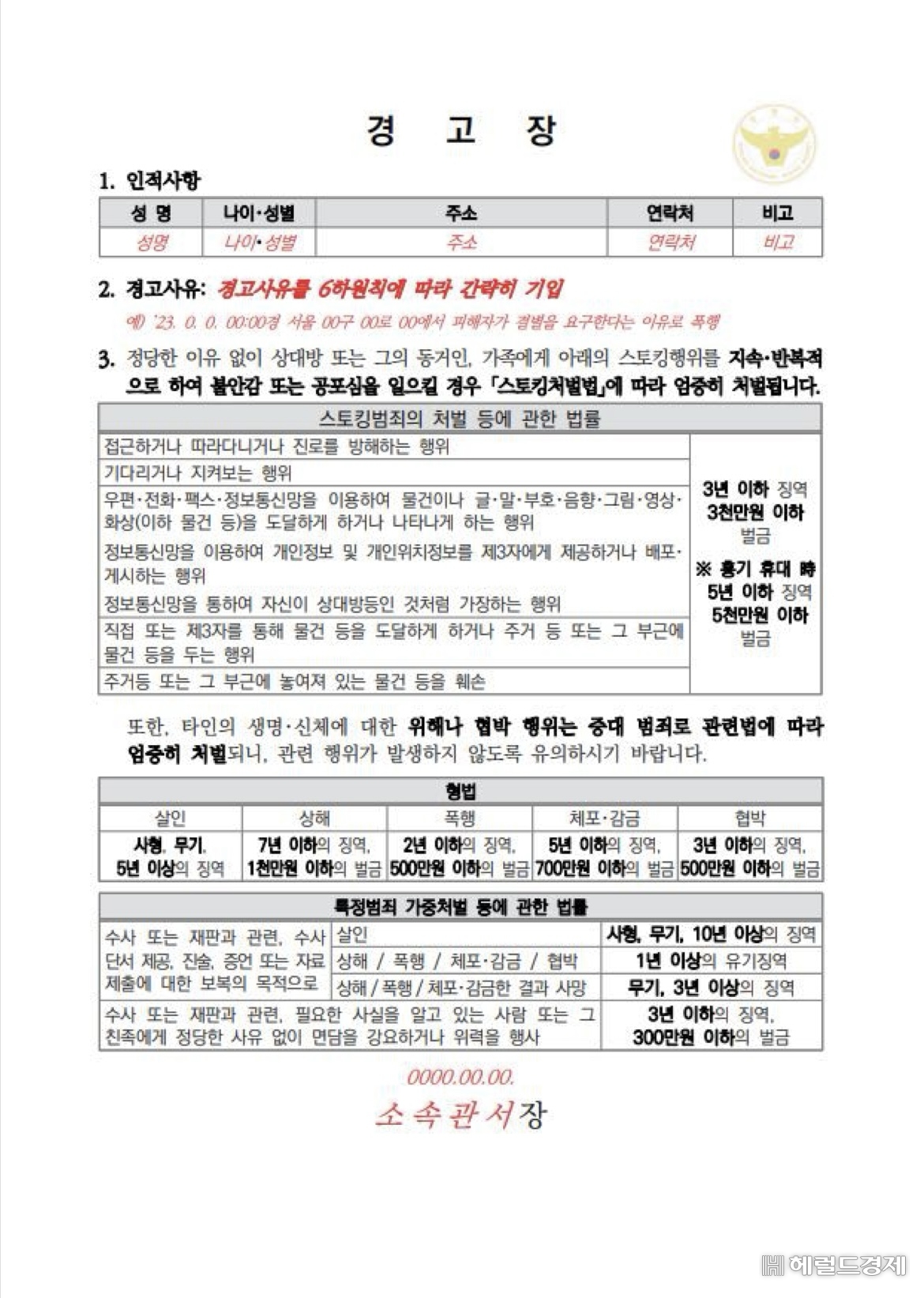
Practitioners generally view warning letters as at least partially effective in prompting perpetrators to stop their behavior.
Jeon Ji-hye, a standing director of the Korean Women Lawyers Association, said some victims need stalking to stop and want institutional protection but are reluctant to file a criminal complaint. In such cases, she said, "a strong police warning can halt the perpetrator's behavior in effect the same way as the exercise of state authority, and because the victim can achieve a deterrent effect without having to file a complaint, it is less of a burden."
Jeon cautioned, however, that if a warning provokes the perpetrator rather than deterring the person, "the victim, who cannot escape that relationship, may end up suffering even greater harm — so there needs to be discussion of ways to protect the victim's personal safety after a warning is issued."
Song Ran-hee, standing representative of the Korea Women's Hotline, warned of a potential side effect in which perpetrators pressure victims to declare they do not wish to press charges so that the matter ends with the warning letter alone. Song said the police principle of "accepting all stalking reports" must be upheld as fully as possible in the field.
arin@heraldcorp.com




