
Samsung Electronics delays shareholder return details to Q1 next year
SK hynix launches 20 trillion won buyback to support share price floor
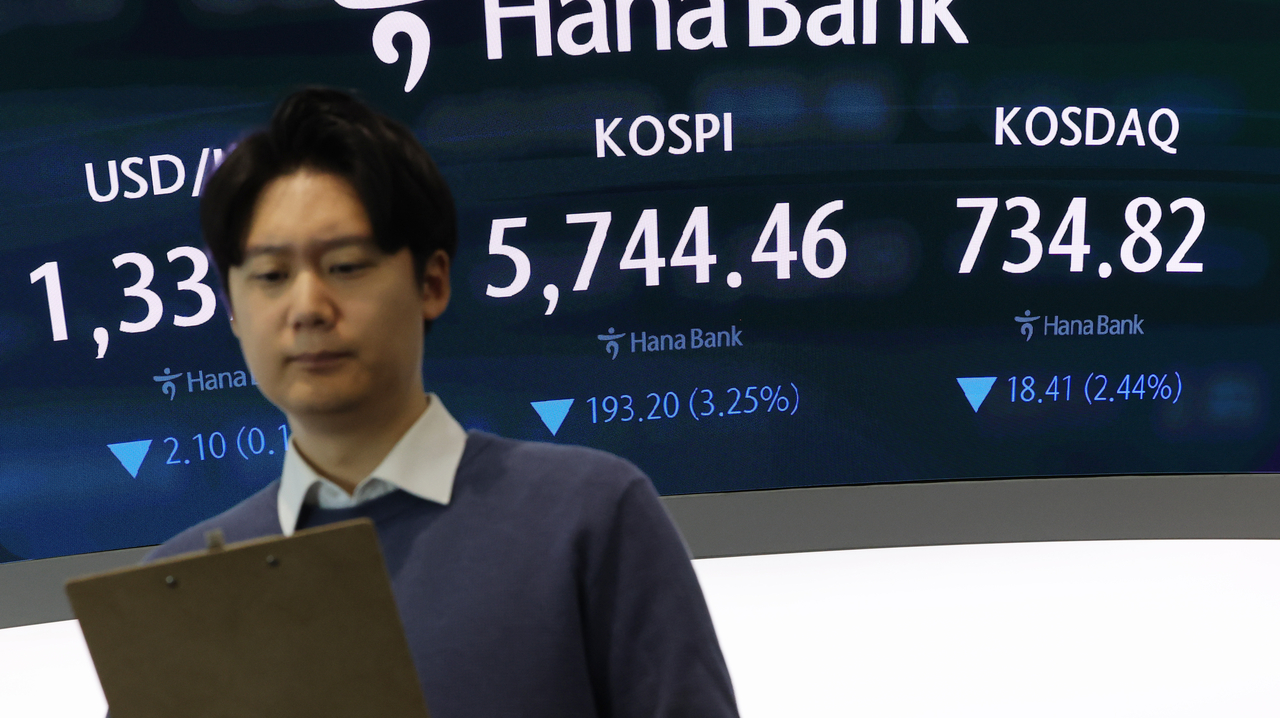
Shares of Samsung Electronics and SK hynix — both of which posted record earnings for the third quarter — are facing a fresh test. Market attention has shifted away from the widely anticipated results and toward the sustainability of profit growth and the credibility of shareholder return plans. In the near term, the specificity and execution of those plans will be the key variable; over the medium to long term, the trajectory of AI infrastructure investment and its effect on memory demand and prices will determine where the stocks go.
Samsung Electronics opened Friday's Kospi session down 3.7 percent at 223,500 won ($167), while SK hynix fell 5.4 percent to open at 1.444 million won.
Samsung Electronics had already dropped 4.13 percent on Thursday after releasing its third-quarter results, and extended those losses at Friday's open. SK hynix, which disclosed its third-quarter earnings and an additional share buyback plan on Wednesday, gained 2.62 percent on Thursday, only to give back those gains at Friday's open.
The near-term variable for Samsung Electronics is the specificity of its shareholder return plan. The company said Thursday that total shareholder returns for this year would reach 90 trillion to 110 trillion won, but it did not disclose details on the remaining 55 trillion to 75 trillion won beyond the 35 trillion won already planned or distributed.
The company's decision to finalize the deployment plan for the remaining funds at a board meeting in January fell short of market expectations for more immediate shareholder return commitments. Hopes that Samsung Electronics would follow SK hynix with a concrete buyback plan — which would have drawn buying interest to support the share price floor — were dashed.
"Investor sentiment has weakened because no concrete shareholder return plan was presented," said Lee Kyung-min, an analyst at Daishin Securities. "The total shareholder return for this year is expected to reach 90 trillion to 110 trillion won, but details on the remaining 55 trillion to 75 trillion won have not been disclosed." Analysts note that while the overall scale of this year's returns far exceeds the previous record of 20.3 trillion won set in 2020, the timing and method of execution have emerged as the key near-term variable for the stock.
Rising memory prices and an expanding supply of high-value products, however, underpin expectations for medium- to long-term earnings improvement. While near-term disappointment over the shareholder return plan is weighing on Samsung Electronics shares, analysts expect the memory business's earnings growth trajectory to provide support over the longer term.
According to Thursday's earnings disclosure, Samsung Electronics has signed long-term supply agreements with 10 major customers and is in negotiations with 10 more. HBM4 sales in the third quarter more than tripled from the previous quarter, accounting for 60 percent of total HBM revenue. The company is broadening its earnings base by securing long-term supply volumes while raising the share of high-value products in its revenue mix.
"Earnings improvement will continue as rising DRAM and NAND prices are compounded by expanding supply of high-value products such as HBM4, server DDR5, SOCAMM and enterprise SSD," said Kim Rok-ho, an analyst at Hana Securities. Baek Gil-hyun of Yuanta Securities Korea also flagged the possibility that a memory supply shortage could persist through 2028, noting that Samsung Electronics' HBM supply volume for 2027 has already been sold out at target price levels.
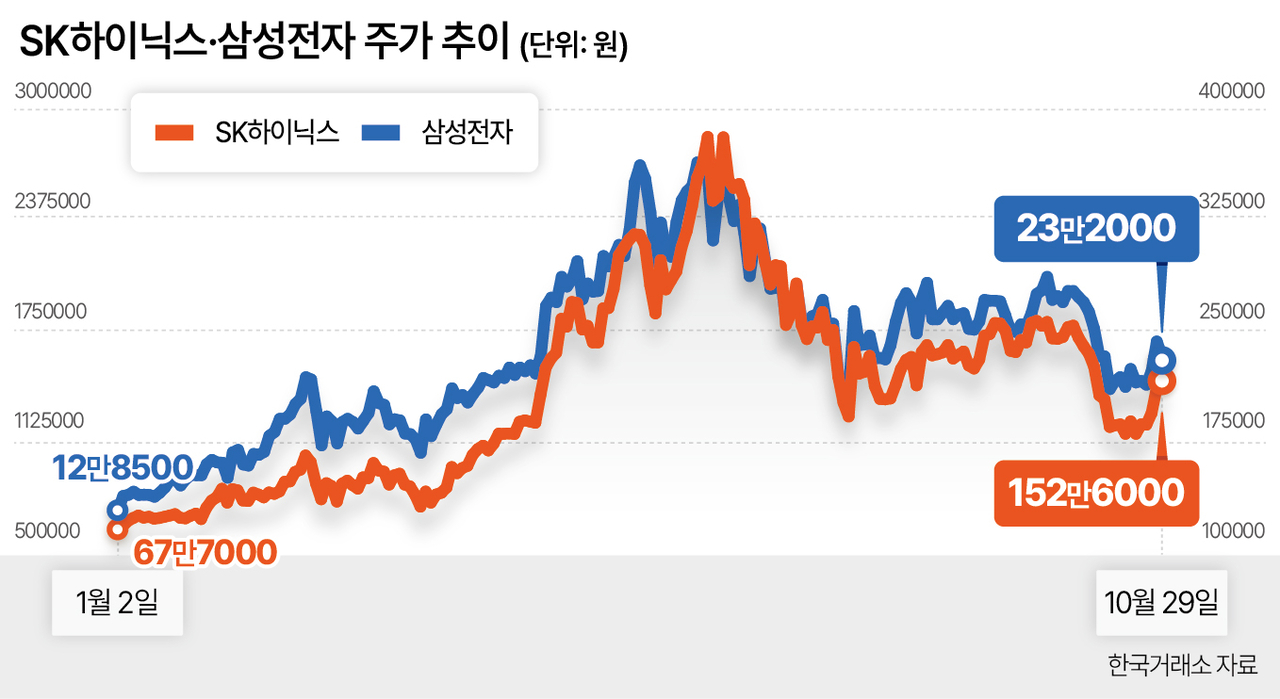
SK hynix, which has begun an additional share buyback, has a clearer case for a rebound, given that the buyback provides near-term support for the share price floor.
The company launched a buyback of approximately 20 trillion won worth of shares Thursday, running through Jan. 28 next year. Of that total, 10 trillion won worth of shares acquired for shareholder return purposes will be fully canceled, while the remainder will be used for employee compensation. The buyback creates actual buying demand in the market, and the reduction in share count through cancellation can enhance shareholder value.
"Large-scale share buybacks and cancellations, combined with cash dividends, can raise shareholder value and serve as a catalyst for resolving the stock's undervaluation," said Kim Dong-won, head of research at KB Securities, adding that a rerating of the company's value becomes possible when earnings growth and shareholder returns reinforce each other.
Sustained earnings growth remains the prerequisite for a share price rebound. With memory demand for HBM and server DRAM outpacing supply capacity, medium- to long-term earnings forecasts are being revised upward. "Demand for HBM and server DRAM will continue to exceed supply capacity, prolonging the memory shortage," said Han Dong-hee, an analyst at SK Securities. "Reflecting this, we have raised our 2027 operating profit forecast by 12 percent to 488 trillion won."
Expanding HBM4 supply and rising prices are also cited as earnings drivers. "Growth in the HBM business will continue as HBM4 supply ramps up in earnest," said Lee Jong-wook of Samsung Securities. "Average selling prices for HBM in 2027 are also expected to rise sharply."
Expanding long-term supply contracts is seen as a factor that improves earnings visibility. "It is worth noting that SK hynix has locked in more than half of its production capacity through long-term supply agreements through 2028 and has already secured buyers for its 2029 volumes," said Ryu Hyung-geun of Daishin Securities. "The expansion of long-term supply contracts will improve the visibility of future earnings."
kacew@heraldcorp.com




