Q3 container throughput hits 8.58 million TEU, up 8.5%
Busan, Gwangyang ports benefit from Chinese port congestion
Non-container cargo down 3.9% on weak petroleum product volumes
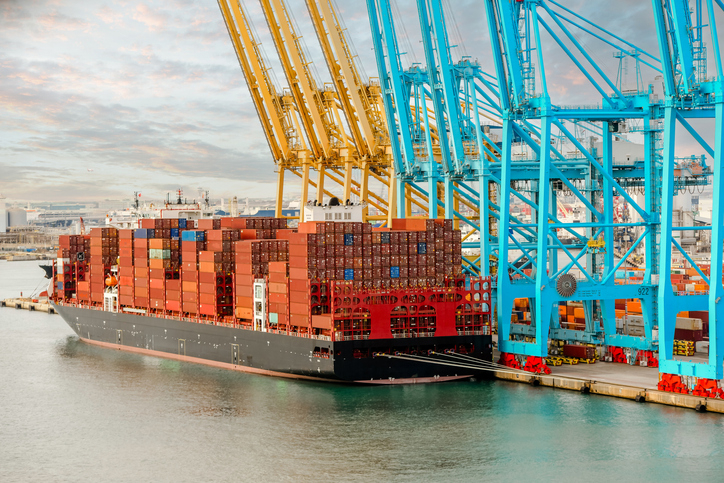
South Korea's ports saw import-export container volumes decline in the third quarter of this year, even as transshipment cargo — goods transferred from one vessel to another — surged more than 20 percent. Typhoon-driven congestion at Chinese ports pushed more vessels to call at Busan and Gwangyang instead. Non-container cargo, meanwhile, was weighed down by falling volumes of petroleum products and gas.
The Ministry of Oceans and Fisheries said Thursday that container throughput at the country's trade ports reached 8.58 million TEU (one TEU equals one 20-foot container) in the third quarter of 2026, up 8.5 percent from the same period last year.
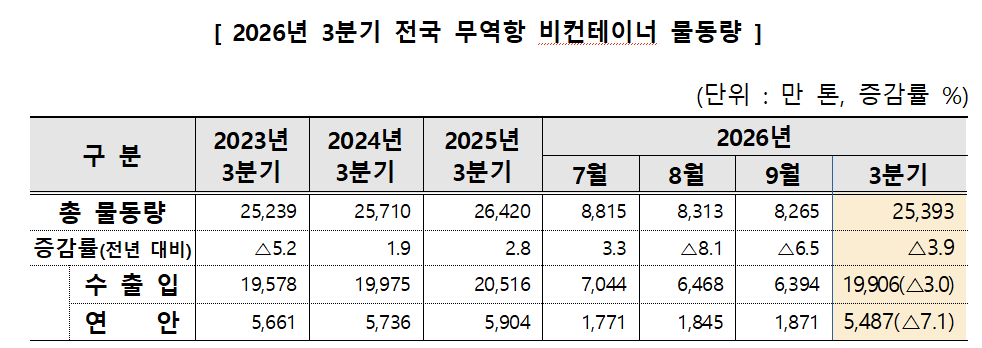
Transshipment volumes reached 4.19 million TEU, up 20.7 percent from 3.47 million TEU in the same period last year. Transshipment cargo from China and the United States rose 25.5 percent and 22.8 percent, respectively, while volumes from Japan climbed 11.2 percent and those from Europe jumped 108.8 percent.
The ministry attributed the gains primarily to a rise in alternative port calls at Busan and Gwangyang caused by typhoon-related congestion at Chinese ports, as well as the strengthening of Busan's role as a transshipment hub.
Import-export container volumes, by contrast, fell 1.1 percent to 4.34 million TEU from 4.39 million TEU a year earlier. Volumes from the United States and Japan rose 2.4 percent and 6.9 percent, respectively, but China was down 0.9 percent and Malaysia dropped 15.7 percent. Cargo volumes from the Middle East plunged 49.5 percent.
Among individual ports, Busan posted the strongest growth. The port handled 6.77 million TEU in the third quarter, up 11.2 percent from a year earlier. Transshipment volumes there rose 20.3 percent to 4.09 million TEU, while import-export volumes edged down 0.3 percent to 2.68 million TEU.
Gwangyang's total container throughput slipped 1.0 percent to 499,000 TEU, dragged down by a 6.7 percent decline in import-export volumes to 419,000 TEU. Transshipment volumes, however, surged 50.2 percent to 80,000 TEU as adverse weather at major Chinese ports drove more vessels to call at Gwangyang instead.
Incheon handled 860,000 TEU, down 2.1 percent from a year earlier. The ministry said the decline reflected a rise in vessels unable to enter Incheon due to schedule delays caused by typhoons in southeastern China.
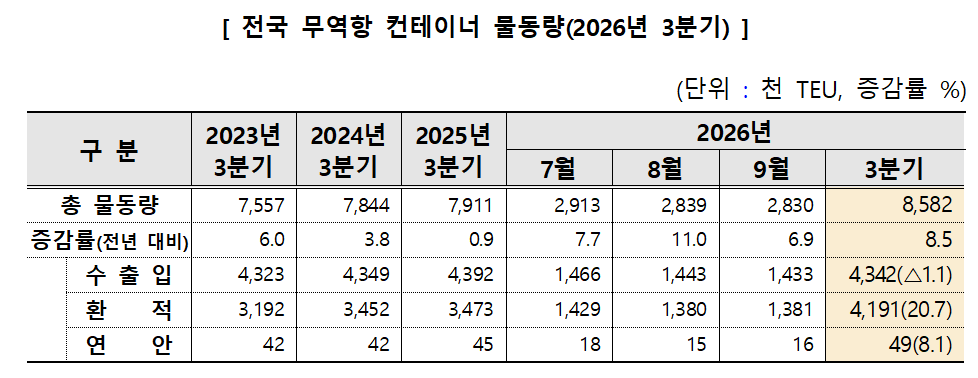
Total throughput at the country's trade ports — combining container and non-container cargo — reached 406.91 million tons in the third quarter, up 1.4 percent from 401.3 million tons a year earlier. Import-export cargo rose 2.9 percent to 351.53 million tons, while coastal cargo fell 7.0 percent to 55.38 million tons.
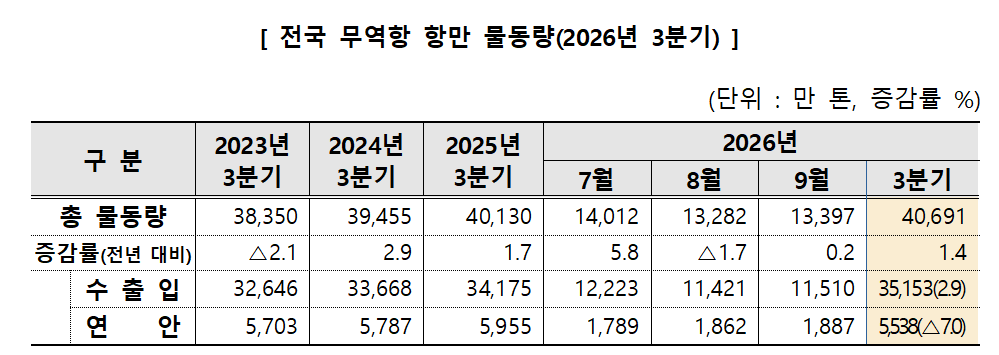
Non-container cargo totaled 253.93 million tons, down 3.9 percent from a year earlier. Crude oil imports increased, but the prolonged conflict in the Middle East weighed on oil and gas imports, while a downturn in the petrochemical sector reduced refined petroleum product volumes, the ministry said.
By commodity, petroleum product volumes fell 5.4 percent to 110.97 million tons. Refined petroleum products dropped 12.8 percent and petroleum gas and other gases declined 11.8 percent. Crude oil and petroleum volumes, however, rose 10.3 percent.
Ore volumes grew 6.3 percent to 31.97 million tons, and vehicles and auto parts rose 1.6 percent to 25.21 million tons. Thermal coal edged down 0.1 percent to 35.36 million tons, while chemical industry products fell 4.1 percent to 10.95 million tons.
Among major ports, Gwangyang's non-container throughput rose 2.0 percent to 59.15 million tons. Ulsan fell 2.9 percent to 47.19 million tons, and Pyeongtaek-Dangjin dropped 5.6 percent to 23.68 million tons. Incheon and Daesan also declined 4.1 percent and 4.9 percent, respectively.
Minister of Oceans and Fisheries Hwang Jong-woo said container volumes continued to grow on the back of rising transshipment cargo with major trading partners including the United States and China, even as non-container volumes fell due to the prolonged situation in the Middle East. "The Ministry of Oceans and Fisheries will continuously monitor and manage port operations through the end of the year to ensure there are no disruptions to import and export logistics," Hwang said.
adastra@heraldcorp.com