More than 200 representatives of Korean firms operating in the US gathered for the event
Trump trade policy seen continuing regardless of midterm outcome
Experts call for multilayered response strategy including state-level engagement
Practical guidance on visas, corporate setup and investment incentives also provided
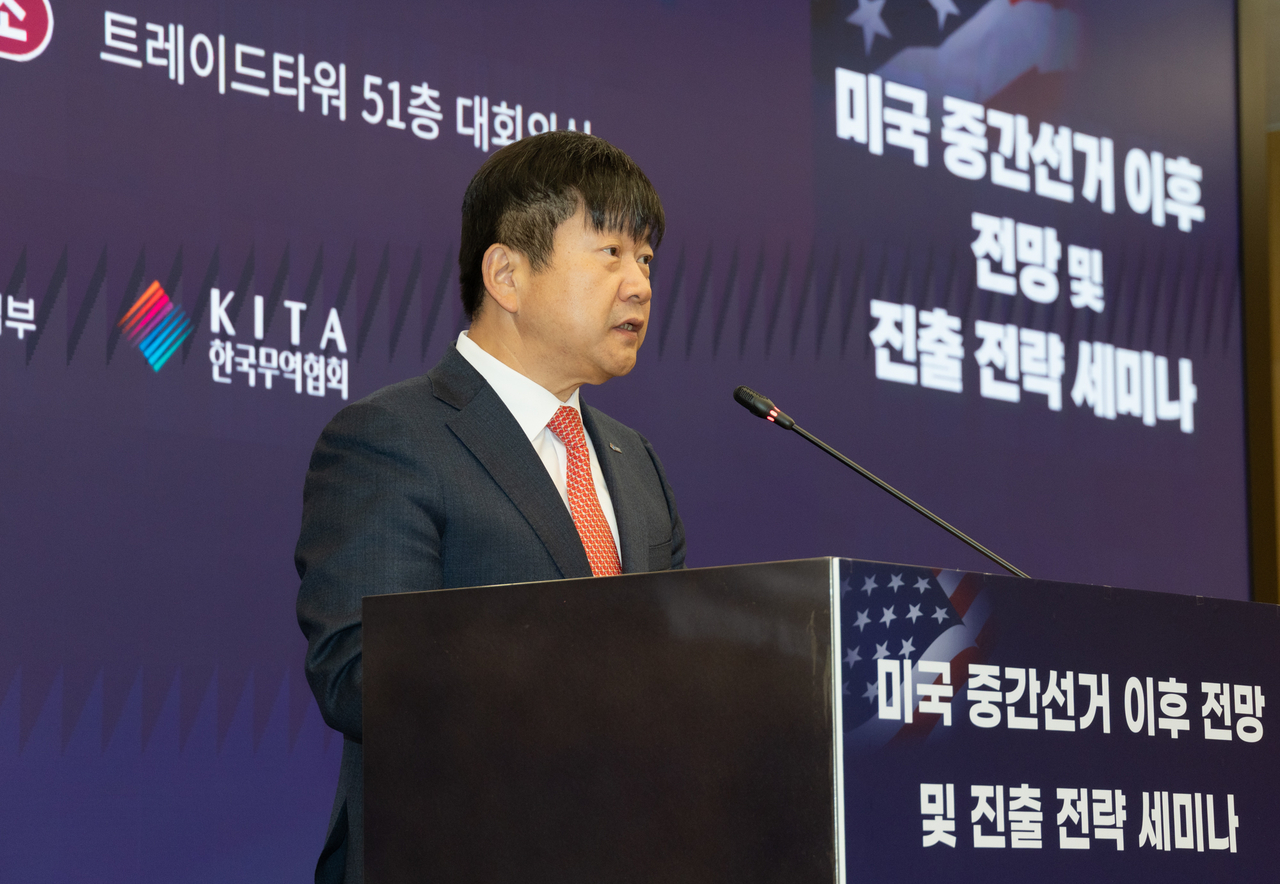
The Korea International Trade Association (KITA) held a "Seminar on the US Midterm Elections Outlook and Market Entry Strategies" at Trade Tower in Samseong-dong, Gangnam-gu, Seoul, on Wednesday, jointly organized with the Ministry of Trade, Industry and Energy, the Ministry of Foreign Affairs and the Ministry of SMEs and Startups.
The seminar was designed to examine key issues surrounding the US midterm elections, scheduled for Nov. 3 (local time), assess the outlook for economic and trade policy, and offer practical guidance for Korean companies operating in the United States. More than 200 people attended, including KITA Executive Vice President Jang Seok-min and Kim Seok-woo, director general of the Ministry of Foreign Affairs' bilateral economic diplomacy bureau.
Kim identified the smooth entry and stay of Korean corporate personnel in the United States as "one of the most fundamental yet important tasks" for strengthening Korea-US economic ties. "The Ministry of Foreign Affairs and relevant agencies have been working closely with the US side to find ways to improve visa-related issues," he said, urging companies to "not hesitate to reach out to Korean diplomatic missions abroad if you encounter difficulties in your local business activities."
In the first session, Seo Jeong-geon, a professor of political science and diplomacy at Kyung Hee University, analyzed the competitive landscape of key battleground races and the political environment expected to follow the midterms. He identified soaring oil prices and high inflation in the wake of the Iran war, along with voter sentiment on immigration and tariffs, as the central issues of the election. On Korea-US relations, Seo forecast potential improvement through follow-through on investment commitments to the United States and cooperation in shipbuilding and semiconductors after the midterms.
Jo Seong-dae, head of KITA's trade research division, then examined how US trade policy might shift depending on the midterm results. "Even if the Democratic Party recaptures both chambers in the midterms, the Trump administration's America-first trade policy stance through executive orders is likely to continue," Jo said, stressing the need for "a multilayered response strategy that strengthens cooperation not only with the federal government and Congress but also with state and local governments."
Practical presentations aimed at companies operating in the United States followed. Kim Yong-sang, an attorney at law firm Yulchon, explained the requirements for different US visa categories and key considerations during the screening process, and outlined common difficulties that can arise during business trips and entry procedures along with corporate response measures. Hong Uk-seon, another attorney at the firm, and Park Jong-seo, an accountant, covered legal and tax considerations including the choice of US corporate structure, incorporation procedures, local regulation and investment incentives.
"Strategic investment between Korea and the United States is entering a full-scale implementation phase, raising expectations among our companies, but uncertainty remains high due to changes in tariff policy and trade regulation," said Jang, KITA's executive vice president. "We hope this seminar helps Korean companies understand the economic and trade policy changes expected after the midterms and build their business strategies for the US market."
KITA plans to hold a follow-up seminar on Nov. 5, shortly after the midterm elections, on the theme of "The Global Trade Order After the US Midterm Elections and Korea-US Trade Issues." The event will discuss the Trump administration's foreign policy direction in the second half of its term based on the election results, the status of investment commitments to the United States, and emerging challenges in Korea-US trade cooperation such as non-tariff barriers and economic security.
Meanwhile, KITA recently co-hosted a "Smart City and Construction Open Innovation Day" at the COEX Startup Branch in Samseong-dong, Gangnam-gu, Seoul, together with the Seoul Business Agency and the Seoul, Gyeonggi Province and Incheon creative economy innovation centers.
The event was organized to connect the on-site needs of large corporations in the smart city and construction sectors with the innovative technologies of startups, identifying opportunities for proof-of-concept testing and commercialization partnerships. More than 100 people attended, including representatives from large companies, investors and startups in the relevant fields.
likehyo85@heraldcorp.com