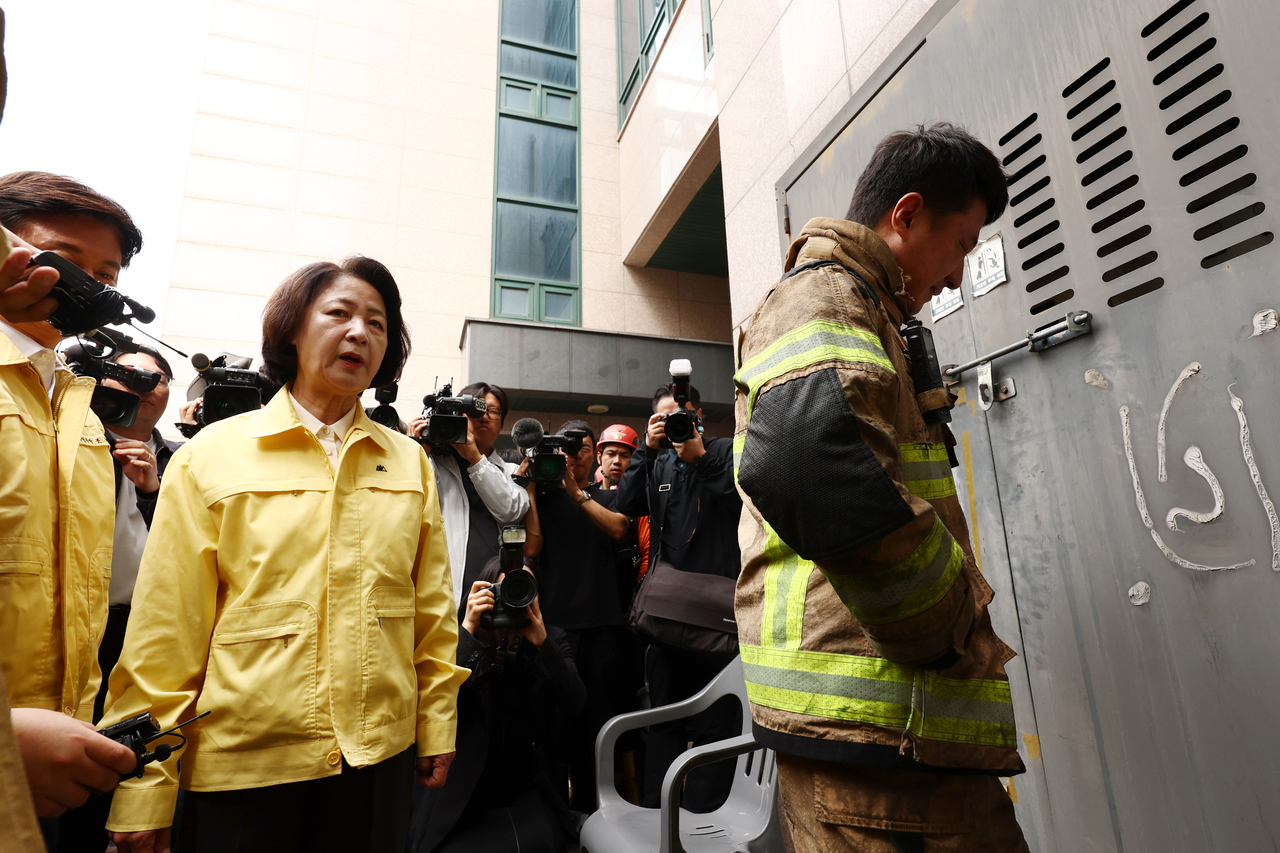
Amid the controversy surrounding Gyeonggi Province Governor Choo Mi-ae's remarks likening fire department spending to a "fiscal straw," a civil servant has stoked further debate by posting online that firefighters are overpaid relative to their actual workload — and that the "straw" label is justified.
The post, titled "Firefighters really are a straw," appeared recently on Blind, an anonymous online community for workers. The author, identified on the platform as a current civil servant, laid out a series of statistical and anecdotal claims against what they described as the outsized public reverence for firefighters.
The author opened by arguing that the on-duty death rate for firefighters — between 0.006 and 0.007 percent — is barely higher than the 0.005 percent rate for general administrative civil servants. "This controversy is just a convenient opportunity people are seizing," the author wrote.
They went on to claim that the industrial accident fatality rate for ordinary workers stands at 0.0098 percent, higher than that of firefighters, and that the on-duty death rate for police officers is 0.010 percent — also higher. "At best, the on-duty mortality rate for fire officials is about average compared to other occupations," the author wrote.
The author also argued that among correctional officers, patrol officers and firefighters, only firefighters prefer indoor assignments over field duty — a sign, they said, that those without call-outs are "coasting." "Every citizen and civil servant works hard, yet firefighters alone are constantly glorified — that is deeply wrong," the author wrote.
The author added a personal anecdote: "A friend of mine is a firefighter. He stays up all night at a PC bang playing games, then goes to work and sleeps." They said the situation made them feel that the public was being kept in the dark and treated as fools.
The post concluded: "Firefighters on night shifts basically sleep soundly and go home, yet they earn close to twice my salary and get treated like heroes. I'm writing this because I can't stand it. Fire officials are the ultimate masters of media manipulation."
The post drew sharply divided reactions online.
Some users sided with the author, writing that "more than 70 to 80 percent do nothing, yet the pay is too high," and that it was understandable to resent firefighters being treated as heroes while soldiers also endure hardship. Others pushed back: "Are you just jealous that they walk into black smoke while you can't stand seeing them get hero treatment?" and "Does risking your life look easy to you?"
The debate over firefighter pay is not new. A similar controversy erupted in July.
At that time, a post circulating on SNS claimed that a firefighter with 12 years of service earns 75 million won ($56,600) a year and argued the salary was excessive relative to the number of emergency call-outs, reigniting public debate.
In response, a netizen identifying herself as the wife of an active-duty firefighter pushed back, noting that firefighters carry out a wide range of duties beyond emergency responses — including removing beehives, rescuing animals and conducting safety checks for vulnerable residents.
The current wave of controversy traces back to Oct. 13, when Choo said at a National Assembly audit of Gyeonggi Province by the Public Administration and Security Committee that fire department spending felt like "the biggest headache — like a fiscal straw."
Her remarks were intended to criticize the fiscal structure under which local governments still bear a significant share of personnel and related costs for firefighters, even after they were reclassified as national civil servants. But as the backlash spread, Choo apologized, saying she had no intention of demeaning firefighters.
yeonjoo7@heraldcorp.com