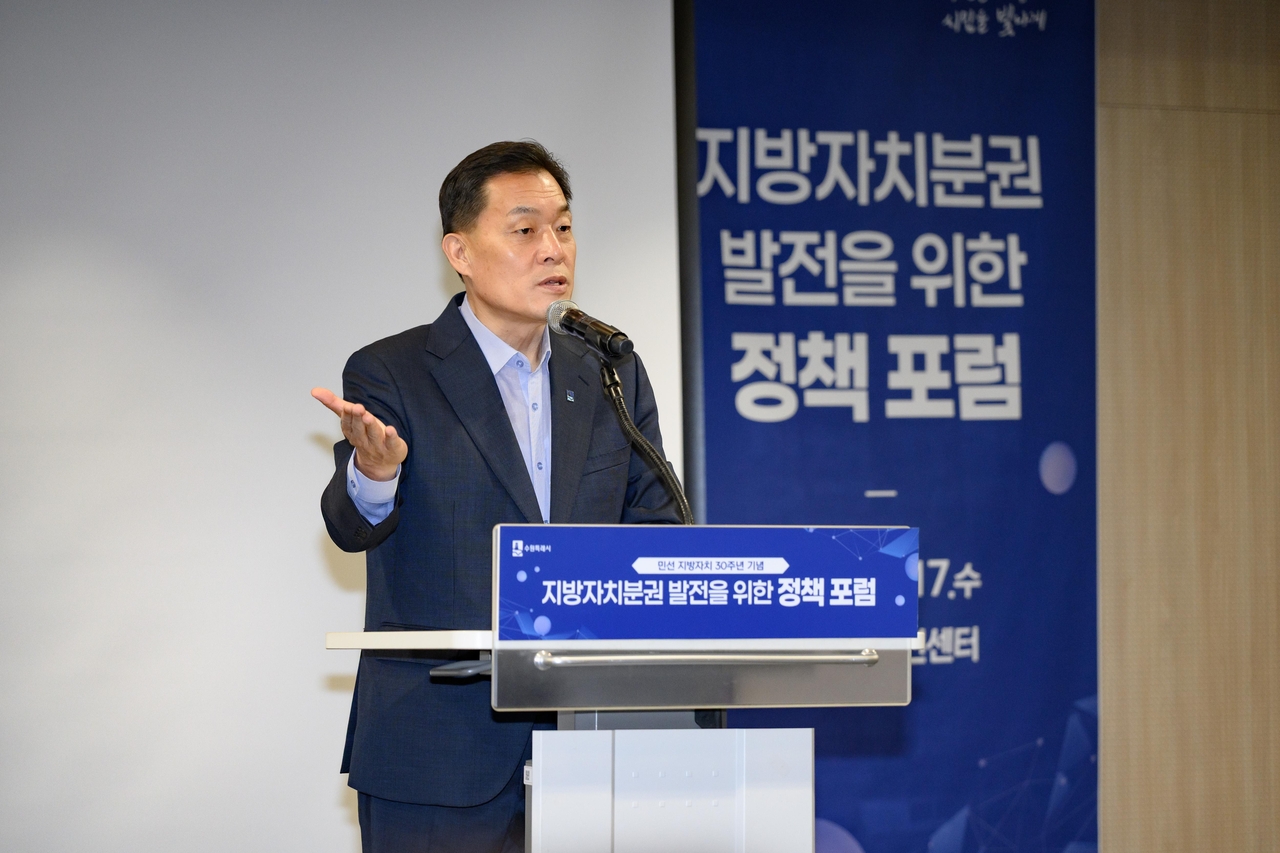
Suwon Special City Mayor Lee Jae-jun said the city will leave no gaps in preparing follow-up measures — including drafting a regional development plan and transferring new administrative powers — ahead of the Special Act on Support for Special Cities taking effect next May.
Yet even as the law's passage secured expanded administrative authority, the road to genuine local autonomy remains long. While administrative powers and responsibilities have been transferred, the city's legal status and fiscal standing have barely moved. For special cities — which have driven the first major reform of local governance in more than 30 years — securing legal recognition and fiscal authority is essential if they are to be more than a half-measure.
Suwon Special City's autonomy has climbed one step. The Special Act on Support for Special Cities was promulgated on June 2, and a consolidated bill merging nine government and lawmaker proposals passed the National Assembly on May 7, with full enforcement set for June 3 next year. It marks four years since special cities were launched in 2022, and the first time their administrative powers have been given a proper legal framework. With Thursday — the Day of Local Autonomy and Balanced Development — approaching, this article examines the practical benefits Suwon Special City can expect once the law takes effect, and the challenges that still lie ahead for local governance.
The special city law lists 27 designated administrative functions in an annex. Eight functions whose transfer had already been completed were retained, and 19 new ones were added — all approved for transfer from the provincial level to special cities through deliberations by the Local Era Committee and the Decentralization Committee. Six additional functions defined under separate laws bring the total to 33.
Suwon Special City is particularly looking forward to greater autonomy in urban development. With the transferred powers, the city expects to add flexibility to development decisions, manage projects in ways that reflect local characteristics, and pursue redevelopment tailored to the city's identity.
Most immediately, the permitting process for large-scale buildings in Suwon will be streamlined. Projects involving structures of 51 floors or more, or with a total floor area of at least 200,000 square meters, will no longer require prior approval from Gyeonggi Province before a building permit can be issued. Large-scale developments like Starfield Suwon will be easier to advance, and developers can expect project timelines to shorten by roughly one to two months.
Beyond that, Suwon Special City will be able to directly designate tourism sites and draw up development plans for them, and will be able to establish its own industrial complex development support center and a local industrial complex planning review committee — simplifying procedures for industrial development suited to the city's needs. The city will also be able to approve and register arboretum and garden development plans without going through the provincial government, allowing it to build on its expertise as a green city that already operates two arboretums and promotes everyday garden culture for residents.
The city's authority to manage its own urban environment will also expand. Outdoor advertising special zones — such as those in the Gwanggyo and Homaesil districts — were previously designated at the city's request to Gyeonggi Province. Going forward, Suwon Special City will designate them directly, tailoring them to local conditions and character.
The law also opens a formal channel for Suwon Special City to weigh in on provincial-level policy. The mayor will now have an explicit legal basis to convey the views of the city's 1.2 million residents on matters such as the establishment of metropolitan transportation master plans, the designation and lifting of special traffic management zones, and decisions on applying the price ceiling on new apartments and designating adjustment target areas.
"Now that an institutional framework has been established four years after the launch of special cities, I will do everything in my power to ensure that residents feel real, tangible change," Mayor Lee said.
The path to securing a clear legal status and meaningful fiscal autonomy remains uncertain. Expanding special city authority must start with a firm legal foundation — specifically, amending the Local Autonomy Act to explicitly recognize special cities as a distinct category of local government, rather than simply acknowledging them under a provision granting special treatment to cities with populations of one million or more. A bill to that end was introduced by lawmaker Kim Young-jin on June 13, 2024. Securing legal status would allow special cities to use the designation officially and is expected to strengthen the basis for their development.
Securing adequate fiscal autonomy is equally important. Special cities need financial self-governance commensurate with the powers and responsibilities they have taken on. The central government's fiscal decentralization efforts have produced little change over the past 30 years and, if anything, have worked against special cities.
As of 2026, Suwon's fiscal independence ratio — a measure of revenue autonomy — ranks 11th nationally, yet its fiscal self-reliance ratio, which reflects spending autonomy, sits at 130th. In other words, the city collects substantial tax revenue but has little discretion over how to spend it. The gap is stark when comparing per-capita local tax burdens with per-capita spending. Based on the 2026 budget, the national average per-capita local tax burden is 789,000 won ($597), while residents of the four special cities each pay 1.07 million won — 35 percent more than the national average. Yet per-capita spending in special cities is 3.02 million won, compared with the national average of 8.3 million won — 36 percent less. Special city residents pay more in local taxes but receive fewer services in return.
Special cities have put forward two proposals to address this. The first would amend the Local Finance Act to raise the share of adjustment grants from 47 percent to 67 percent. The second would revise the enforcement decree of the Local Tax Collection Act to increase the provincial tax collection grant rate from the current 3 percent to 10 percent. If either measure is adopted, Suwon Special City's revenues are estimated to grow by around 40 billion won.
The future of local autonomy in Suwon is being shaped in part by the Suwon Special City Youth Planning Group for Decentralization. First formed in 2023, the group brings together about 30 young residents and university students to deepen their understanding of local self-governance and build related skills. Through its fourth cohort this year, a total of 120 young people have explored local governance and taken part in activities aimed at making decentralization accessible to their generation — spreading the message through short-form video, social media and AI-powered promotional content.
A civic council is also active, working to raise awareness of local autonomy and the need for decentralization among all Suwon residents. The Suwon Citizens Forum for Special City Development, launched in 2024, counts 59 members — representatives of civic organizations and business leaders who volunteer their efforts to advance local self-governance through campaigns and other activities.
fob140@heraldcorp.com