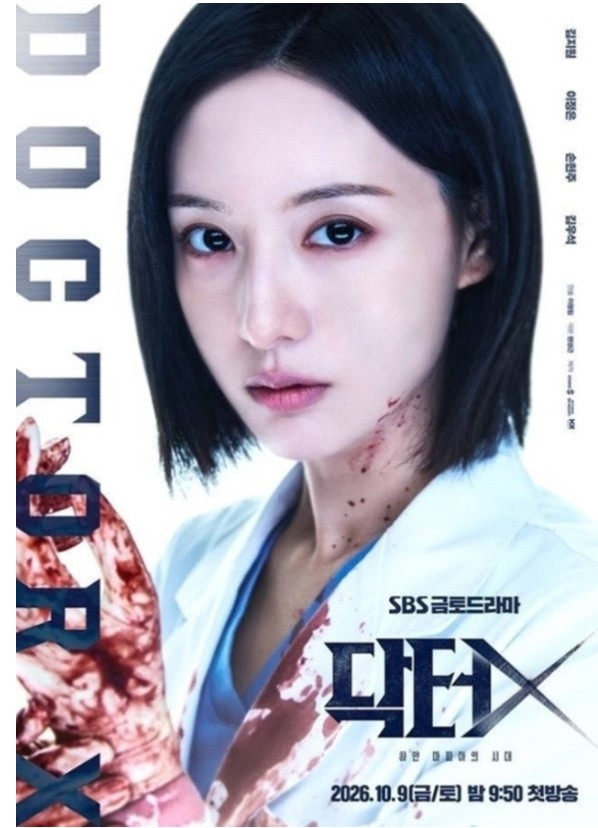
SBS drama series "Doctor X: Mafia in White" has drawn fresh controversy — this time over a bus stop sign installed for filming, with a complaint filed alleging a possible violation of the Road Act. The show had already faced a National Assembly petition demanding it be taken off the air after its depiction of the May 18 pro-democracy uprising.
A complainant said Tuesday they had filed a civil petition through the government's online grievance portal asking the relevant district office to determine whether a temporary bus stop sign erected during production of the SBS Friday-Saturday drama series violated the Road Act.
The safety and transportation division of Buk-gu District Office in Gwangju said it had received the complaint and would review its contents.
The scene in question appears in episode six, which aired Saturday. In it, bus No. 518 stops at a shelter in front of Minjuui Mun, the main gate of the National Cemetery for Democracy.
The actual bus stop is located about 350 meters from the gate. The stop sign shown in the drama is understood to be a portable filming prop mounted on a square-pipe stand. The complainant asked authorities to confirm whether the prop had been installed with proper permits.
Buk-gu District Office said the production team had filed no separate application for road occupancy permission and had held no consultations with the office. Under the Road Act, placing an object on a road without authorization — even temporarily — can result in a fine of up to 3 million won ($2,270).
Episode six followed the story of Oh Sang-beom (played by Ha Seong-gwang), who suffered a head wound from martial law troops' gunfire during the May 18 pro-democracy uprising in 1980. The character lost his brother at age 12 and has lived for 46 years with bullet fragments lodged in his skull. Genius surgeon Gye Su-jeong (Kim Ji-won) confronts his long-buried wounds and sets out to treat him.
Toward the end of the episode, a fictional former president named Ji Du-seok — widely seen as evoking former President Chun Doo-hwan — is shown being rushed to the hospital unconscious. The juxtaposition of a figure recalling a victim of state violence and one recalling its perpetrator in the same hospital left a strong impression on viewers.
Audience reaction after the broadcast was divided. Some viewers praised the episode as a meaningful portrayal of the pain carried by May 18 survivors, while others criticized the show for abruptly weaving politically charged subject matter into what is primarily a medical drama.
Some viewers, arguing that the adaptation had introduced a politically contentious episode absent from the original source material, filed a petition on the National Assembly's public consent petition platform calling for the show to be pulled. The petition gathered the 100 preliminary signatures needed to proceed. A statement posted on an online forum also demanded the production team explain its creative choices.
Others, however, praised the episode for shining a light on the wounds of victims of state violence. Actor Han Jeong-su posted a message Monday opposing the calls to cancel the show.
Studio S chief producer Lee Ok-gyu, who oversees the production, posted "no fear" on his account the day the episode aired, though he did not elaborate on what he meant.
Meanwhile, episode six drew a nationwide household viewership rating of 19.5 percent, according to Nielsen Korea — a new series high.
min3654@heraldcorp.com