Asset price correction possible amid AI profitability concerns
Vice minister stresses AI risk management, fiscal buffers
South Korea to lead G20 financial stability cooperation as 2028 chair
Heo Jang, second vice minister of the Ministry of Economy and Finance, said Tuesday that South Korea must closely monitor the risk that a slowdown in AI investment could trigger asset price corrections and broader financial market instability, and strengthen its preparedness for potential shocks.
Heo made the remarks in an opening address at the "2026 G20 Global Financial Stability Conference," co-hosted by the Ministry of Economy and Finance and the Korea Development Institute at the Four Seasons Hotel Seoul in Jongno-gu. He said the country must manage financial risks arising from AI adoption and proactively prepare for shifts in the AI investment cycle.
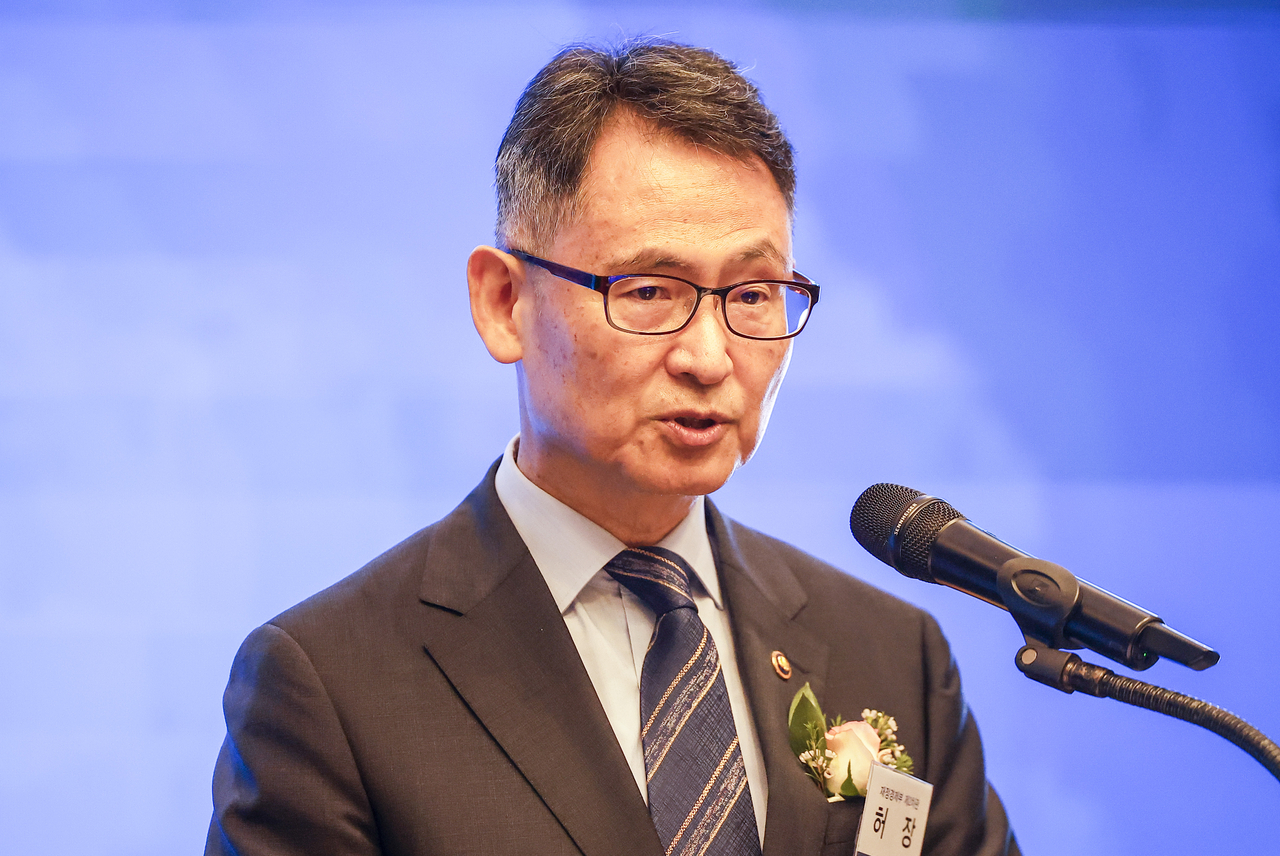
Heo said global financial markets have shown resilience, supported by solid economic growth and corporate earnings, but that risk factors threatening financial stability remain elevated. He said the spread of new technologies, including AI, combined with geopolitical shifts, is making uncertainty in financial markets increasingly complex.
"As financial institutions expand their use of AI, decision-making could become more synchronized and cyber risks could grow," he said. "If concerns about the profitability of AI companies materialize, asset price corrections in that sector could spill over into broader financial market instability."
He also identified inflationary pressures and rising fiscal burdens in major economies as factors that could heighten financial market volatility. "A rise in government bond yields in major economies could trigger sharp asset price corrections and increase financing costs for businesses," Heo said.
He added that rising energy and raw materials prices could weaken corporate profitability and debt-servicing capacity, warning that this too could feed into financial market instability.
Heo outlined three policy priorities for addressing these risks: managing AI-related financial risks and preparing for shifts in the AI investment cycle; maintaining financial system stability and securing fiscal buffers; and building a dual safety net that combines the global financial safety net with supply chain resilience.
"We need a regulatory and supervisory framework that is proportionate to the risks without unnecessarily constraining AI innovation," he said. "On that basis, individual financial institutions need to upgrade their AI governance and risk management frameworks."
In this regard, Heo cited the AI risk management best practices put forward by the Financial Stability Board on the sidelines of the G20 finance ministers and central bank governors meeting held in Bangkok this month. The 12 best practices cover areas including establishing AI governance and accountability frameworks, improving risk management systems, clarifying human oversight responsibilities, and managing third-party AI risks.
He also stressed the need to examine structural vulnerabilities in the financial system and maintain fiscal capacity to respond to shocks. "We must comprehensively assess not only the soundness of individual financial institutions but also systemic vulnerabilities, including interconnections among institutions," Heo said.
He said fiscal policy should focus on targeted support for vulnerable groups and investment to expand growth potential, so as to preserve the fiscal space needed to respond to future shocks.
Heo also called for using the global financial safety net to respond to external financial shocks and strengthening supply chain resilience to prevent disruptions in essential goods from spreading to the real economy and financial markets. "We must also work in parallel to fundamentally reduce the risk of supply chain disruptions by fostering an open and predictable trade and investment environment," he added.
Heo cited former International Monetary and Financial Committee Chair Agustín Carstens, who described financial stability as a public good and stressed the importance of effective international cooperation, to underscore the need for global coordination.
"The waves of uncertainty we face cannot be held back by any single country's seawall," he said. "The fragmentation of supply chains and the spread of new technologies, including AI, affect one another across borders."
He went on to say that as South Korea will become a member of the G20 Troika starting next year ahead of its 2028 G20 presidency, the government will actively contribute to international discussions on financial stability and work to translate cooperation among member states into concrete outcomes.
Kim Se-jik, president of the Korea Development Institute, also said in his opening remarks that "the key to financial stability in the AI era is building the capacity to absorb risks and shocks from structural change so that the financial system can continue to function."
Kim said individual countries face limits in responding to structural change based on their own experience alone, and called for international cooperation to share experiences and develop new policy ideas. He said it is particularly important, ahead of South Korea's assumption of the G20 presidency in 2028, to review major issues facing the international community and develop concrete cooperation agendas based on consensus among member states.
y2k@heraldcorp.com