Amended Occupational Safety and Health Act promulgated; key measures from labor safety package now law
Businesses hit with three suspension orders may face license revocation
Ministry to refine subordinate regulations to support smooth implementation
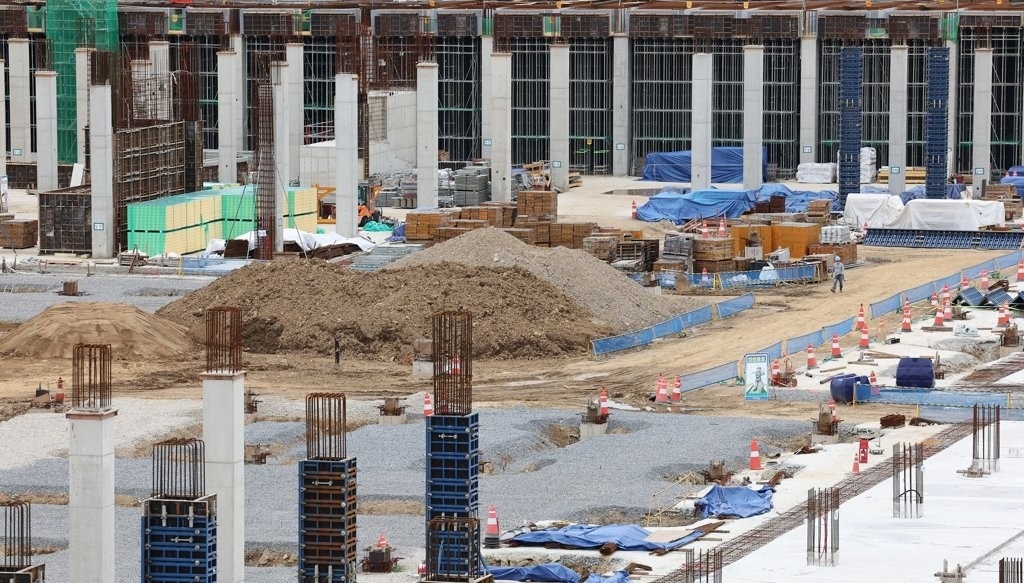
Workplaces where multiple or repeated fatal accidents occur will face fines of up to 5% of operating profit under a law set to take effect at the end of April next year.
The Ministry of Employment and Labor promulgated Tuesday an amendment to the Occupational Safety and Health Act that passed the National Assembly earlier this month, saying it will take effect six months from now.
Under the amended law, if an employer violates safety and health obligations under the Occupational Safety and Health Act and three or more workers die from industrial accidents within a single year, a fine of up to 5% of the company's average operating profit over the preceding three years may be imposed. If no three-year average operating profit exists, if it cannot be calculated, or if 5% of operating profit falls below 3 billion won ($2.27 million), the fine may be set at up to 3 billion won.
A dedicated review committee will calculate fines by weighing the frequency and severity of violations, company size, the number of fatalities, and efforts to prevent accidents and stop recurrences. Collected fines will be transferred to the Industrial Accident Compensation Insurance Fund for use in accident prevention. The ministry plans to spell out fine-imposition procedures, collection timelines, and committee setup and operations in subordinate regulations.
Workers' right to stop work will also be expanded. Workers, worker representatives and honorary industrial safety inspectors will be able to demand that an employer halt work when there is an imminent risk of an industrial accident or when such a risk is anticipated. Subcontracted workers will also be able to demand a work stoppage directly from the primary contractor. The conditions under which workers may stop work and evacuate on their own will be broadened from situations involving "imminent danger" to those where "imminent danger is anticipated."
The labor minister's authority to order work stoppages will be strengthened as well. Previously, such orders could be issued only after a serious accident had occurred — such as a collapse, fire, explosion or hazardous substance leak. Going forward, the minister will also be able to order a stoppage when there is an imminent risk of a serious accident. Work-stoppage orders will also be available when a worker has been injured in an accident and is unconscious or whose survival is uncertain.
Employers who receive corrective orders — such as a requirement to install safety railings — will face a new obligation to halt work. If there is an imminent risk of an industrial accident because a corrective order has not been carried out, work must stop until the correction is completed.
The law also establishes grounds for requesting the cancellation or revocation of a business registration when fatal accidents recur.
If an industrial accident — such as the simultaneous deaths of two or more workers — results from a violation of safety and health obligations under the Occupational Safety and Health Act, and the business has received two or more suspension orders within three years of the law's effective date and again becomes subject to a suspension request, the labor minister will be able to ask the relevant administrative authority to cancel or revoke the business's registration.
Additional measures include a new reward system for reporting violations of occupational safety and health laws. The obligation to budget for industrial safety and health management costs, previously limited to construction project clients, will be extended to contractors and other industries. Extreme heat and cold waves will be formally recognized as grounds for requesting an extension of construction project timelines. Safety-certified machinery and equipment — such as pressure vessels — will be eligible for certification exemptions not only when manufactured or imported for research and development purposes, or manufactured for export, but also when imported for re-export.
A new "Safe Workplace Committee" to oversee industrial safety policy will be established and begin operating in January next year. Chaired by the labor minister, the committee will have up to 20 members, including representatives of labor and management, vice-minister-level civil servants from related ministries, and industrial safety and health experts. It will deliberate on and coordinate major policies and master plans related to industrial safety and health, as well as review and improve existing systems.
"Preventing industrial accidents must start with labor and management joining forces to identify workplace hazards before accidents happen and fix them immediately," Labor Minister Kim Young-hoon said. "The government will thoroughly prepare — by refining subordinate regulations and enforcement systems — to ensure the new measures translate into real change on the ground toward building safer workplaces."
thlee@heraldcorp.com