Busan Metropolitan Council holds first policy forum of the 10th council term
Korea University campus town and Daegu urban campus cases presented
'University coexistence district' and 'university innovation district' models proposed
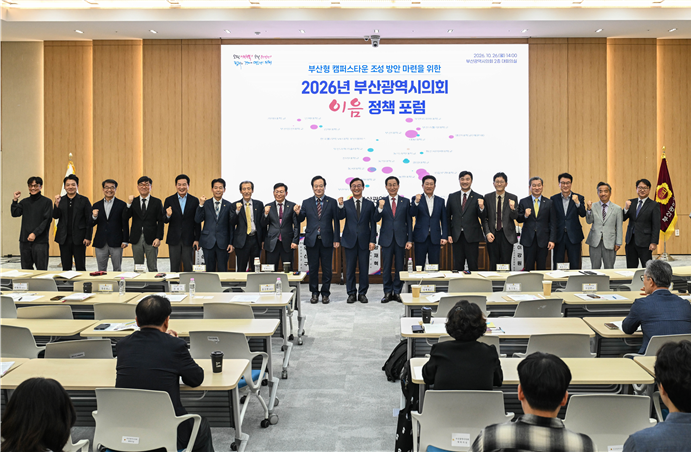
The Busan Metropolitan Council held a policy forum Monday afternoon at its main conference room, focused on developing a Busan-style campus town model to foster regional coexistence and growth.
The forum — the first of its kind under the 10th Busan Metropolitan Council — was organized to address urban decline driven by a shrinking school-age population, the crisis facing local universities and the deterioration of commercial districts near campuses. It also sought to explore ways to connect university resources — talent, technology and space — with the broader community.
In the opening presentation, Lee Myung-hoon, a professor at Korea University's College of Convergence Industry and Academia, introduced the university's campus town initiative as a model for linking startup support functions with local commercial districts, residential areas and public spaces. He cited the program's outcomes: 209 startup teams formed, 123 business registrations completed and 2,050 direct and indirect jobs created.
Urban designer Lee Sang-hyun then presented a case study from Daegu, where vacant buildings and underused spaces in the city center were connected to university education and cultural programs. The approach channels empty urban spaces into academic and cultural use and links university facilities with surrounding commercial districts to draw foot traffic and inject new vitality into the area. He suggested that applying a similar model in Busan could extend university functions into downtown and commercial zones, creating a framework for universities and local businesses to grow together by making use of existing spatial resources.
Woo Shin-gu, Busan's chief architect, outlined two directions for a Busan-style campus town. The first, a "university coexistence district," would integrate campuses with nearby commercial areas, residential neighborhoods and public spaces to create an environment where universities and communities grow together. The second, a "university innovation district," would extend university education, research and startup functions into downtown areas, aging industrial zones and key strategic sites to strengthen the city's capacity for innovation.
In the discussion that followed, Bae Gwan-gu, a city council member and representative of the council's research group "Busan and the Future," said a linkage framework must be established so that university talent and technology can translate into growth for local businesses and job creation for young people. Lee Gang-won, chairman of the Pusan National University Commercial District Association, called for transforming the area around Pusan National University in Jangjeon-dong into a space where youth culture and entrepreneurship converge, and for building a foundation for joint participation by universities and the local community.
Council Speaker Kang Mu-gil pledged to carefully review the policy proposals discussed at the forum. "We will work to establish the policy groundwork for building a Busan-style campus town and push forward with follow-up tasks so that the issues discussed today can translate into tangible results," he said.
kaf2002@heraldcorp.com