Minister vows audit probe over allegations Seoul routed funds through housing corporation; 'sunshine income village' program eyed for expansion to 3,000 sites by 2030
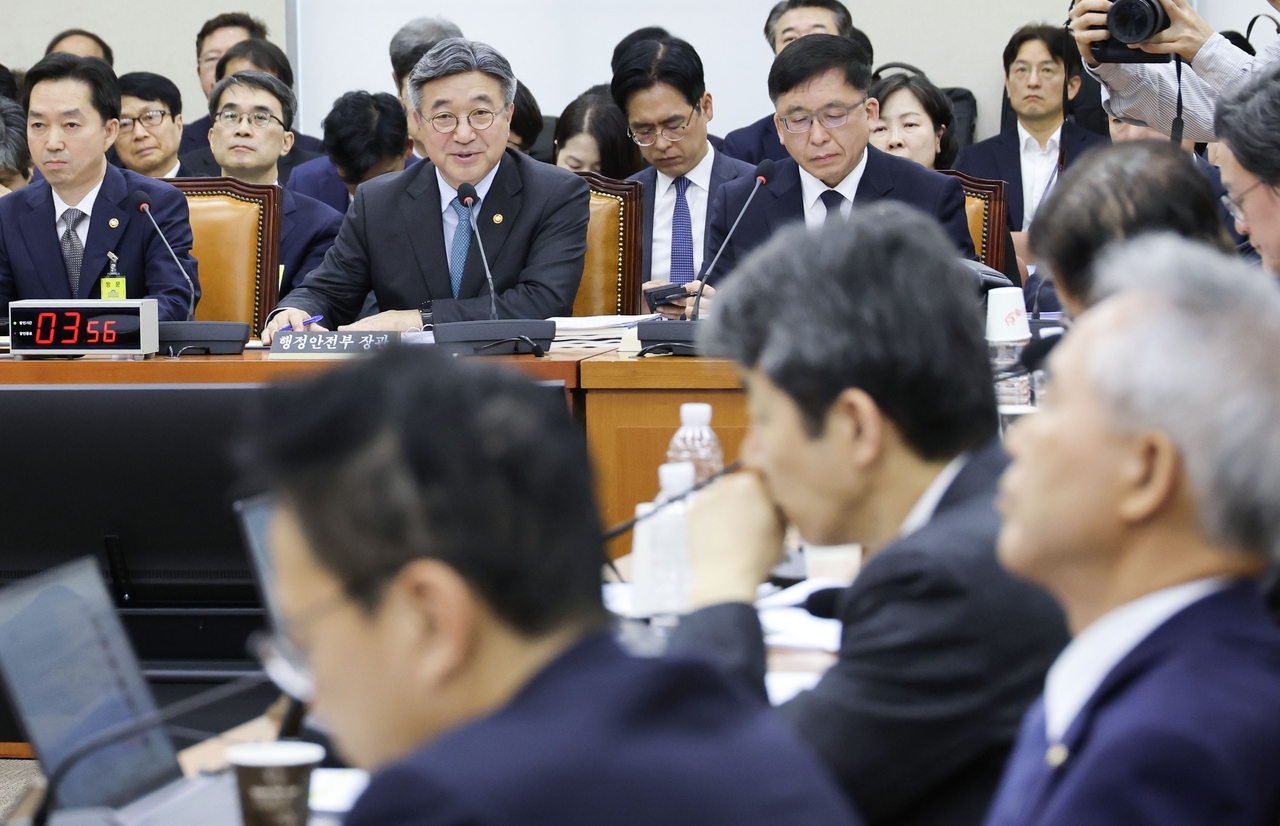
Minister of Interior and Safety Yun Ho-jung said Monday he would "explore every available measure, including an audit," in response to allegations that the Seoul Metropolitan Government had channeled investment into the Han River bus project through the Seoul Housing & Communities Corporation.
Yun made the remarks at the comprehensive national audit of the National Assembly's Interior and Safety Committee, responding to Democratic Party of Korea lawmaker Park Ju-min, who urged the minister to "please take care to prevent Seoul from engaging in unlawful conduct by routing funds through SH."
Park cited an investment review request that Seoul had reportedly submitted to the Ministry of Interior and Safety, noting that the city had listed expanding citizens' travel options and improving commute convenience as expected benefits of the Han River bus project — yet the service had "never operated a single vessel during peak commuting hours."
Park went on to say that advertising revenue was projected to double next year with no explanation in the submission for how that would be achieved, and that passenger figures cited on page 11 of the same document were entirely inconsistent with those on page 16.
"The ministry cannot simply proceed with this request as submitted. You did send an official notice asking for a review, correct?" Park asked.
Yun confirmed the assessment. "Yes, it is effectively a rejection," he said, explaining that Seoul had presented a plan to reduce deficits but that "the basis was far too thin and the content was not credible."
Yun also told Democratic Party lawmaker Kim Young-bae — who raised the ministry's audit authority over Seoul after alleging that Seoul Mayor Oh Se-hoon and city officials had given false testimony at a previous national audit of the city — that "an audit of Seoul is possible" and that he would "consider" pursuing one.
On the "sunshine income village" program, which is being rolled out nationwide, Yun said he aimed to expand it to "3,000 or more villages by 2030 if possible."
When Democratic Party lawmaker Park Jeong-hyeon noted that the program's open call was currently limited to towns and villages at the eup, myeon and ri administrative levels, leaving out areas that are rural in character but classified as dong, Yun said the ministry was "reviewing an expansion of eligible areas to include dong-level areas that retain rural characteristics."
The sunshine income village program is a renewable energy initiative in which residents participate in a village solar power project and share the resulting profits with the local community.
A total of 523 villages have been selected through the first and second rounds of applications, and a third round is open through Friday.
thlee@heraldcorp.com