Coast guard vessel transfers from Baengnyeongdo take up to 9 hours
Nighttime emergency response stretched thin
Doctor helicopter dispatches drop 70% in three years
Hospital ship with 12.6 billion won price tag falls short on care
Emergency patients on Incheon's islands take an average of 150 minutes to reach a mainland hospital — 2.4 times longer than the national average — according to data compiled by a lawmaker.
Transfers by Korea Coast Guard vessel from Baengnyeongdo, the westernmost island in the Yellow Sea, have taken more than nine hours, and restrictions on nighttime doctor helicopter operations mean critically ill patients must endure lengthy transfers with few alternatives.
The hospital ship meant to fill gaps in island medical care has repeatedly missed its service targets, prompting calls for urgent measures to address the healthcare void in Incheon's island communities.
Democratic Party of Korea lawmaker Heo Jong-sik released the findings Monday after analyzing data obtained from the Korea Coast Guard, the National Fire Agency and Incheon city. The data showed that 44 emergency patient transfers handled by the Incheon Coast Guard station from January through September this year averaged 150 minutes.
That was 2.4 times longer than the national average of 62 minutes across 808 island-area emergency transfers nationwide. Among coast guard stations handling 10 or more transfers, Incheon recorded the longest average time.
More than six in 10 emergency patients in Incheon — 28 of the 44 cases, or 63.6% — took more than two hours to reach a mainland hospital, compared with a national average of 14.9%, making Incheon's rate more than four times higher.
The time from receiving an emergency call to rescue teams arriving on scene also averaged 40.5 minutes in Incheon, more than double the national average of 20 minutes.
From the moment rescue teams reach the scene to the completion of a transfer, patients on Incheon's islands face significant delays at every stage.
The situation is particularly serious on Baengnyeongdo. This year, three patients transferred from Baengnyeongdo Hospital to mainland facilities by coast guard vessel took 9 hours and 9 minutes, 8 hours and 6 minutes, and 6 hours and 56 minutes, respectively.
Those were the longest transfer times recorded by any coast guard station for island-area emergency patients nationwide, excluding cases on Ulleungdo in the East Sea.
On Yeonpyeongdo, two coast guard vessel transfers took 5 hours and 40 minutes and 5 hours and 33 minutes. Of the 44 total transfers handled by the Incheon Coast Guard, only five — 11.4% — used a helicopter.
Even when a helicopter is available, getting an emergency patient to a hospital quickly is far from guaranteed.
National Fire Agency data show that the seven cases this year in which fire department helicopters airlifted patients from Baengnyeongdo took between 148 and 168 minutes from dispatch to hospital arrival.
In one case last month, a fire department helicopter was dispatched late at night to transfer an elderly patient showing signs of intestinal perforation. The helicopter reached the scene in 1 hour and 16 minutes, handed the patient over at a helipad in Jamsil, Seoul, and transported the patient to a university hospital in Guri, Gyeonggi Province. The total time from dispatch to hospital arrival was 2 hours and 33 minutes.
Other Baengnyeongdo cases this year saw an elderly woman suspected of acute cholecystitis arrive at a hospital in 2 hours and 48 minutes, a man with symptoms of cerebral hemorrhage and hemiplegia in 2 hours and 38 minutes, and an elderly woman with signs of aortic dissection in 2 hours and 42 minutes.
The high proportion of nighttime emergencies on Incheon's islands compounds the problem. Of the 44 transfers handled by the Incheon Coast Guard this year, 26 — or 59.1% — occurred at night, a rate 15.8 percentage points above the national average of 43.3%.
Fire department helicopters also handled a disproportionate share of island emergency calls: Incheon accounted for 31 of the 128 island-area emergency dispatches nationwide from January through September, or 24.2%.
Doctor helicopter dispatches fall 70% after sunset
Of Incheon's 31 fire helicopter dispatches, 18 — or 58.1% — were at night. Four of the 31 turned back before reaching the scene.
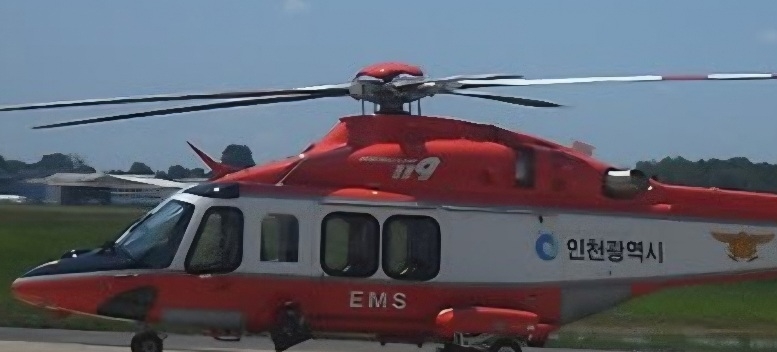
The concentration of nighttime emergency burden on the coast guard and fire department stems largely from operating restrictions on doctor helicopters, which under current guidelines may only fly between sunrise and sunset, leaving a critical gap in nighttime care for seriously ill patients.
Dispatches by the doctor helicopter based at Incheon Gil Hospital fell 70.4% over three years, from 115 in 2022 to 34 last year.
This year, 37 of 78 dispatch requests through late June were rejected or aborted, with adverse weather and approaching sunset cited as the main reasons.
The hospital ship responsible for primary care on the islands has also fallen short of its mandate.
Incheon's hospital ship, which targets 130 days of service per year, failed to meet that goal for four consecutive years from 2022 through last year.
A new 270-ton hospital ship built at a cost of about 12.6 billion won ($9.51 million) entered service this year, but as of late August had logged only 69 days of care — 53.1% of the annual target.
The northernmost Yellow Sea islands — Baengnyeongdo, Daecheongdo and Socheongdo — had received no hospital ship visits at all as of late August.
No backup care or supplementary sailings were arranged on days when the ship could not operate due to bad weather.
Staffing and fiscal challenges add to the difficulties. Of the ship's 16 crew positions, the posts of engineer and radiologist are both vacant.
National government funding for the ship ended after 2024, leaving Incheon city to cover the full 750 million won operating cost this year on its own.
Heo urged improvements to the nighttime emergency medical system and stronger coordination among relevant agencies, citing the harsh realities facing emergency patients on Incheon's islands.
"We need to introduce medium-sized or larger helicopters with verified safety records, expand nighttime flight capabilities, and integrate the currently fragmented transfer system — which is split among the coast guard, fire department, doctor helicopters and military helicopters — into a unified operation," he said.
He added that legal grounds for operating the hospital ship must be established, national funding restored, and the system reformed so that when bad weather halts service, supplementary sailings and transfers to higher-level hospitals are automatically arranged.
gilbert@heraldcorp.com