74 trees infected in Seoul this year; city mobilizes full-scale response at Namsan and beyond
Injection cycle shortened, staff training expanded, drone surveillance deployed
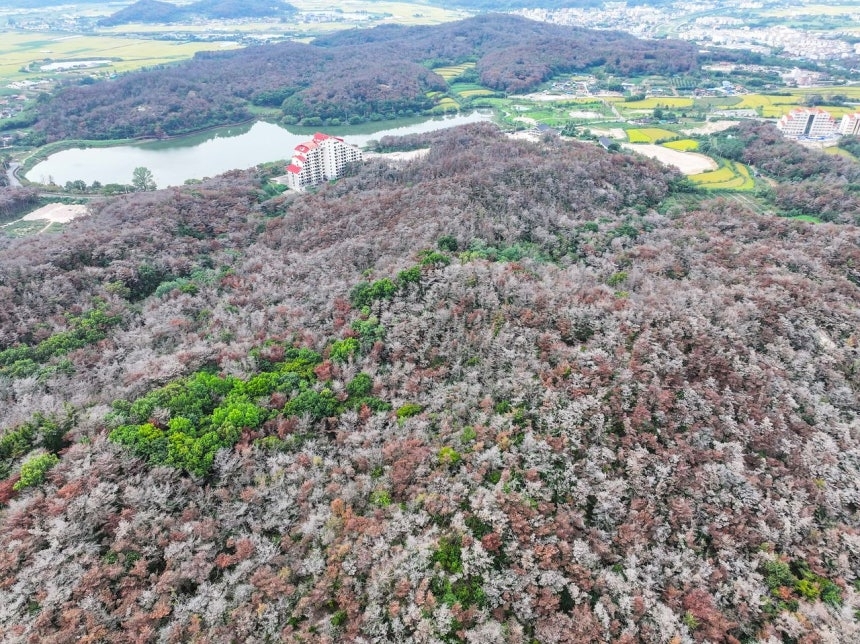
Pine wilt disease has been spreading across South Korea — and it has now reached Seoul. The Seoul Metropolitan Government announced Sunday that it is launching a full-scale response and strengthening its prevention systems.
Pine wilt disease is caused by pine wood nematodes that multiply rapidly inside pine and Korean white pine trees, killing them. Once a tree is infected, recovery is impossible and mortality is 100 percent.
One infected pine was confirmed Wednesday at Sagajeong Park in Jungnang-gu, according to the city and Yonhap.
The infected tree was located about 2.4 kilometers from the nearest known outbreak site, in Gyomun-dong, Guri.
As pine wilt disease continues to spread across Gyeonggi Province, concerns are growing that it will advance further into Seoul.
Seoul is a city ringed by mountains — four smaller peaks, including Namsan and Inwangsan, sit at its center, while larger ranges such as Bukhansan and Yongmasan surround its outskirts.
The city said those outer mountains border areas heavily affected by pine wilt disease, including Namyangju, Hanam and Seongnam, making vigilance essential.
The scale of damage in Seoul this year has grown sharply compared with previous years. Only five trees were affected in 2024 and about four in 2025, but 74 infected trees have been found so far this year.
Early detection and swift action are the cornerstones of controlling pine wilt disease. On Thursday and Friday, the city held surveillance training for officials from all autonomous districts, park and leisure centers, and botanical gardens.
The city plans to conduct drone surveillance within a 5-kilometer radius of any newly identified outbreak and to inspect major parks, forests, hiking trails and street trees at least once a month.
Namsan's pine forest, which the city considers a site of high public value for its ecological, cultural, scenic and emotional significance, will receive intensive preventive measures. The interval for preventive tree injections will be shortened from once every three years to once every two years.
Major parks with high public use — including Seoul Forest, Bukseoul Dream Forest, Citizens' Forest and World Cup Park — will also receive tree injections on a two-year cycle.
The city also plans to consider using pesticides with a four-year preventive effect to control the insect vectors that carry the nematode, taking into account the risk level of each area.
In addition, the city will activate a wide-area response framework to share information and coordinate joint action when needed with the Korea Forest Service, the National Institute of Forest Science and Gyeonggi Province.
"We will do our utmost to protect Seoul's precious forests through strengthened surveillance and preventive control, as well as tailored responses based on the risk level of each area," said Kim Young-hwan, director of the Seoul Metropolitan Government's Garden City Bureau. "We also ask citizens to actively report any suspicious trees, such as dead or dying pines."
sun@heraldcorp.com