The Kospi, which has struggled to rebound from last week's sharp selloff, may find a turning point next week as Samsung Electronics and SK hynix report their third-quarter earnings. While foreign selling pressure has begun to ease, analysts say the market lacks buyers to absorb it — and whether the two chipmakers announce additional share buybacks is emerging as the pivotal variable. Earnings from major US technology companies and the Federal Reserve's benchmark interest rate decision are also expected to shape the market's direction next week.
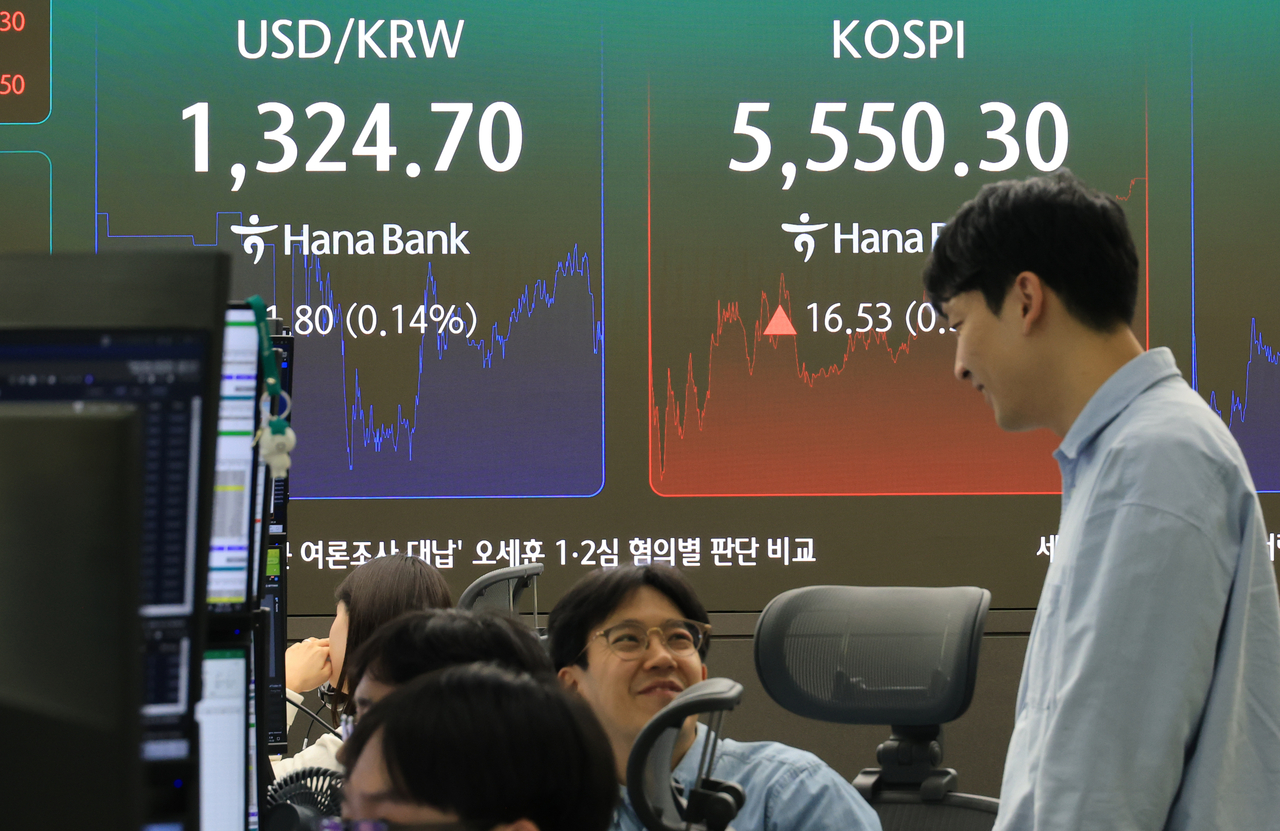
According to Korea Exchange, the Kospi closed up 16.53 points, or 0.30 percent, at 5,550.30 on Friday. The Kosdaq fell 12.41 points, or 1.62 percent, to finish at 751.69. For the week of Oct. 19 through Friday, the Kospi shed 2.08 percent and the Kosdaq dropped 5.42 percent.
Domestic stocks failed to stage a meaningful recovery this week as concerns over the profitability of AI investment and sustained foreign selling weighed on the market. Semiconductor shares led a brief rebound on strong results from SpaceX and Super Micro Computer, but the rally fizzled after Meta's free cash flow swung to a deficit, reviving worries about the burden of AI capital spending. Analysts also pointed to a supply-demand headwind after Samsung Electronics completed a 15 trillion won ($11.3 billion) buyback program on Oct. 6, followed by SK hynix wrapping up its own program — hitting its 40 trillion won target — on Wednesday.
"Large-scale foreign selling appears to be subsiding, but there is no buyer to absorb it," said Lee Jae-won, a researcher at Yuanta Securities Korea. "The end of the buyback programs, combined with a decline in trading volume and customer deposits, has weakened the market's ability to absorb price shocks." He added that easing foreign selling alone is not enough to expect a sustained rebound.
Next week is packed with major corporate earnings releases at home and abroad, as well as key central bank policy meetings. SK hynix reports its third-quarter results on Wednesday, followed by Samsung Electronics on Thursday. Market watchers are focused not only on the earnings figures but also on whether either company will announce a new buyback program. NH Investment & Securities estimated that SK hynix has more than 30 trillion won available for additional shareholder returns.
A string of US technology earnings is also due. Microsoft and Alphabet report on Thursday (Korean Standard Time), with Amazon, Intel and SanDisk following on Friday. The key questions are how much AI-related sales and profit have grown, and whether the companies have the financial capacity to sustain heavy capital expenditure. "If solid AI growth is confirmed alongside evidence of investment returns and sustainability, it should ease concerns about AI credibility and profitability and strengthen the momentum for a market rebound," said Lee Kyung-min, a researcher at Daishin Securities.
The Fed's rate decision is another major variable. The Federal Open Market Committee holds its meeting Tuesday through Wednesday (local time). According to CME FedWatch, the probability of a rate hold stands at 87.27 percent, up 14.95 percentage points from 72.32 percent a week earlier. A hold is widely expected, but attention is turning to the timing of any future rate increases as rising global oil prices keep inflation pressure alive.
The US personal consumption expenditures price index for September is due on Thursday. It is closely watched as a gauge of whether inflation pressures are persisting, after both the September consumer price index and producer price index came in above market expectations. The European Central Bank, which also holds its policy meeting Thursday, raised its benchmark interest rate by 25 basis points last month, but is widely expected to hold this time as it assesses the inflationary impact of rising energy prices. The Bank of Japan, which decides on rates on Friday, faces scrutiny over whether and when it will raise rates further amid continued yen weakness and inflation concerns.
NH Investment & Securities set its Kospi forecast range for next week at 5,100 to 6,400, citing third-quarter corporate earnings and shareholder return programs as upside drivers, and geopolitical risks as the main downside factor.
"The recent Kospi decline stems less from fundamental deterioration than from the absence of buyers to absorb foreign selling," said Na Jeong-hwan, a researcher at NH Investment & Securities. "If a large-scale buyback is confirmed, corporate buying could absorb some of the foreign selling and help ease the supply-demand imbalance in the Kospi."
hajun825@heraldcorp.com