The global AI market is facing a harsh test of profitability. From South Korea's Elice Group, which cratered more than 30 percent on its Kosdaq debut, to US neocloud firm CoreWeave drowning in debt, to Anthropic posting a net loss of more than $80 billion in just the first half of this year, major AI companies are stumbling in unison — and fears of a broader AI reckoning are spreading fast.
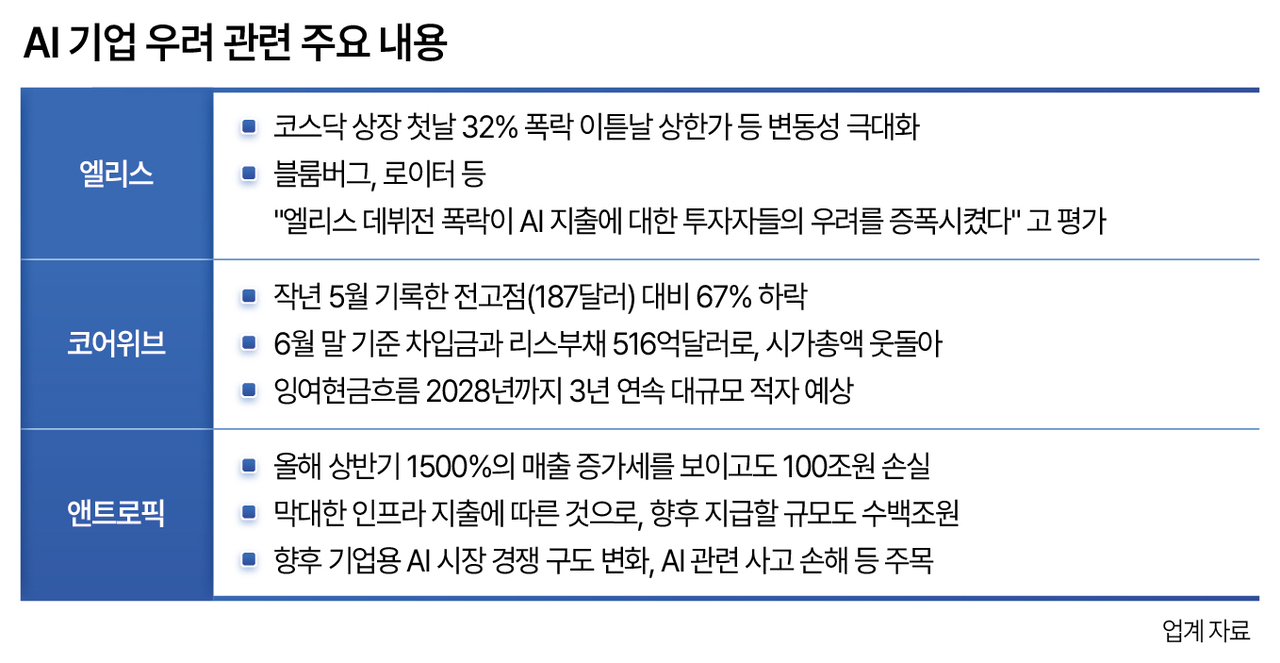
Elice Group, an AI infrastructure company, made a dismal debut on the Kosdaq on Tuesday, plunging more than 32 percent from its offering price of 90,500 won ($68) per share, according to Korea Exchange. Although early bargain-hunting on Wednesday pushed the stock to its daily upper limit, the fallout from Tuesday's collapse remained significant.
Bloomberg and other major US outlets gave notable coverage to the share price collapse of Elice, a relatively small Kosdaq-listed company.
Hebe Chen, a senior market analyst at Vantage Global, said the "disastrous debut" of Elice "reconfirms that the era of buying anything AI has shifted to an era of questioning anything AI."
Reuters said Elice's debut-day plunge "amplified investor concerns about AI spending."
The unusual level of international media attention on Elice speaks to how deeply anxious global markets have become about AI profitability.
Founded in 2015 as a coding and software education platform, Elice Group has been reinventing itself as an AI infrastructure company by expanding into GPU and data center leasing through its AI cloud business.
Cloud services already account for roughly 76 percent of its sales in the first half of this year, reflecting a significant business transformation. Yet some in the market have questioned whether the offering price was far too high relative to the company's current earnings power.
Beyond Elice, the global AI infrastructure sector has seen a string of signals pointing to cooling investor sentiment, including IPO setbacks and surging funding costs.
CoreWeave is the most prominent example. The US company has been battered by a sharp share price decline and a crushing debt load. Its stock had fallen 66.8 percent as of Tuesday from its intraday all-time high of $187, reached on June 20 last year. The company borrowed aggressively to expand capacity, leaving it exposed when high interest rates persisted and fears of further rate hikes mounted.
According to KB Securities, CoreWeave's total borrowings and lease liabilities stood at $51.6 billion as of the end of June this year, exceeding its market capitalization. More recently, yields on its unsecured corporate bonds briefly spiked to 15 percent, sending its share price down more than 15 percent.
The cash flow pressure is even more acute. CoreWeave spent roughly $6.2 billion servicing debt in the first half of this year, outpacing its operating cash flow of $3.7 billion over the same period. With capital expenditure projected at $36.4 billion this year and $47.9 billion next year, its free cash flow is expected to run at -$27 billion this year, -$31.7 billion next year and -$21.7 billion in 2028 — three consecutive years of massive deficits.
CoreWeave itself has acknowledged that it will need "significant additional debt or equity financing for future investment."
The financial scorecard of Anthropic, the AI model developer pursuing what could be a record-breaking IPO, has added further fuel to the profitability debate. According to an S-1 registration statement obtained by the Wall Street Journal on Tuesday (local time), Anthropic's sales in the first half of this year reached $16.3 billion — a 15-fold jump from $1.1 billion in the same period last year. Yet despite that revenue surge, the company posted a net loss of $80.7 billion in just the first six months of this year, nearly double its full-year loss of $42 billion last year.
The losses stem from massive infrastructure spending. Anthropic poured $9 billion into computing capacity and infrastructure in the first half of this year alone, surpassing its full-year spending of $7.3 billion last year in just six months.
The deeper concern is that the spending shows no sign of letting up. Anthropic's outstanding commitments for computing resources alone total $450 billion. Third-quarter sales growth also appears to be slowing on a quarter-on-quarter basis, and additional risks to future profitability include potential liability from AI-related incidents and community opposition to data center construction.
Ken Griffin, the billionaire hedge fund titan and Citadel CEO, said at a recent conference in New York that investors are "almost certainly" in the middle of an AI bubble. "Many companies are still grappling with how much they need to spend on AI technology and how that technology will transform the economy," he said.

jiyun@heraldcorp.com