Samsung Electronics' in-house loans arm homeseekers with low-rate 'ammunition' outside bank regulations
Corporate support funds in Dongtan reached 8.12 billion won in September
Share of total home-purchase funds jumps from 0.7% to over 4% in two months

Corporate support funds used to buy homes in Hwaseong's Dongtan-gu surged to six times the level recorded in July — the first month the area fell under the land transaction permit system — during September, when Samsung Electronics launched its employee housing loan program.
An analysis of home-purchase funding disclosure forms obtained through People Power Party lawmaker Kim Mi-ae's office, extracted Oct. 6, showed that 851 home sales worth a combined 558.3 billion won ($419 million) were reported in Dongtan-gu between July and September. Of that total, 8.12 billion won was sourced from corporate support funds — including in-house loans — in September alone, up more than 6.7 billion won from 1.38 billion won in July.
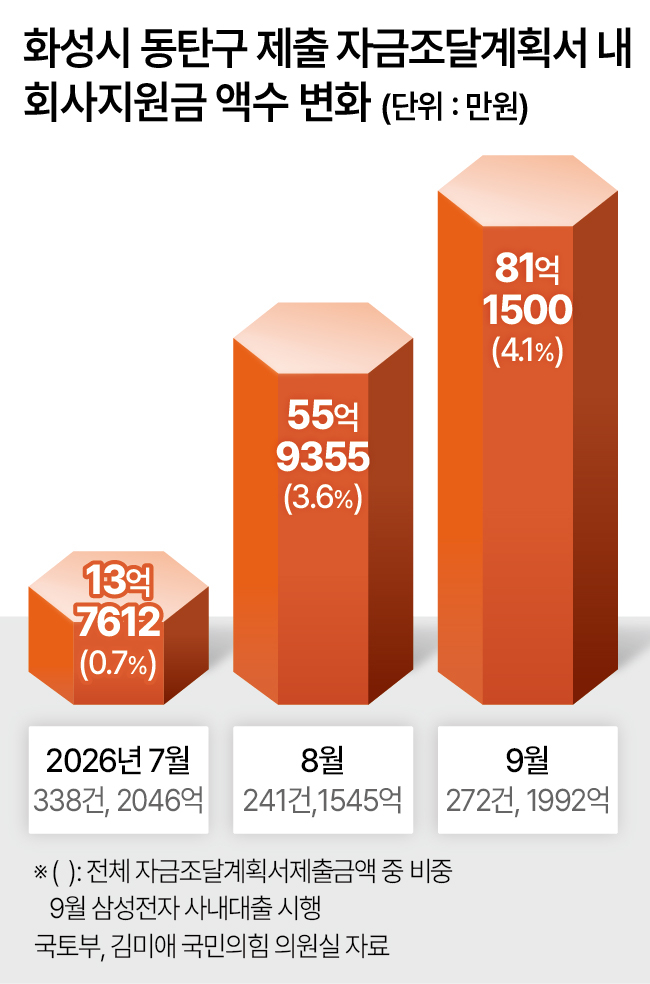
The surge in in-house loan use is particularly striking because it occurred as overall transaction volumes were falling. More than 5,000 home sales were recorded in Dongtan-gu in the first half of the year, with funding disclosure forms for over 1,400 transactions submitted in June alone. After tighter regulations — including the land transaction permit requirement — took effect in July, filings plunged to 338 (204.6 billion won) that month, then fell further to 241 (154.5 billion won) in August before partially recovering to 272 (199.2 billion won) in September.
Even as transaction volumes shrank, corporate support funds' share of total home-purchase financing climbed consistently — from 0.7 percent in July to 3.6 percent in August (5.59 billion won) and 4.1 percent in September (8.12 billion won). That compares with a corporate support fund and private loan share of less than 1 percent (12.8 billion won) among Dongtan-gu home purchases in the first half of the year covering transactions of 600 million won or more, as reported in a July 27 article.
The trend stands in contrast to proceeds from stock and bond sales, another major source of home-purchase funding, which fell from 12.7 billion won in July to 6.2 billion won in August and 8.8 billion won in September. With stock market volatility eroding buyers' ability to raise funds through equities, the share of stock and bond proceeds in total home-purchase financing dropped from 6.2 percent in July to 4.2 percent in September. In-house loans, meanwhile, grew in prominence and by September matched stock and bond proceeds as a share of total funding.
The same pattern is visible in Suwon's Yeongtong-gu, another district in the nearby semiconductor belt. Funding disclosure forms were filed for 667 transactions (533.5 billion won) in July, 405 (309.2 billion won) in August and 419 (300.7 billion won) in September in that district. Corporate support funds used for home purchases in Yeongtong-gu reached 6.83 billion won in September, up from 4.33 billion won in July and 2.69 billion won in August. As a result, corporate support funds' share of total home-purchase financing in Yeongtong-gu rose from below 1 percent in July and August to about 2.3 percent in September.
Industry observers say in-house loans targeting employees without homes — launched last month by Samsung Electronics and others — have been actively deployed for home purchases. Samsung Electronics began offering loans of up to 500 million won last month exclusively to employees who do not own a home. The loans carry an annual interest rate of 1.5 percent and apply to homes of up to 85 square meters in the greater Seoul area and major metropolitan cities priced at 2.5 billion won or below. Because the loans are exempt from the debt service ratio regulation, they allow homeseekers to sidestep bank lending restrictions, effectively serving as financial ammunition outside the regulatory perimeter.
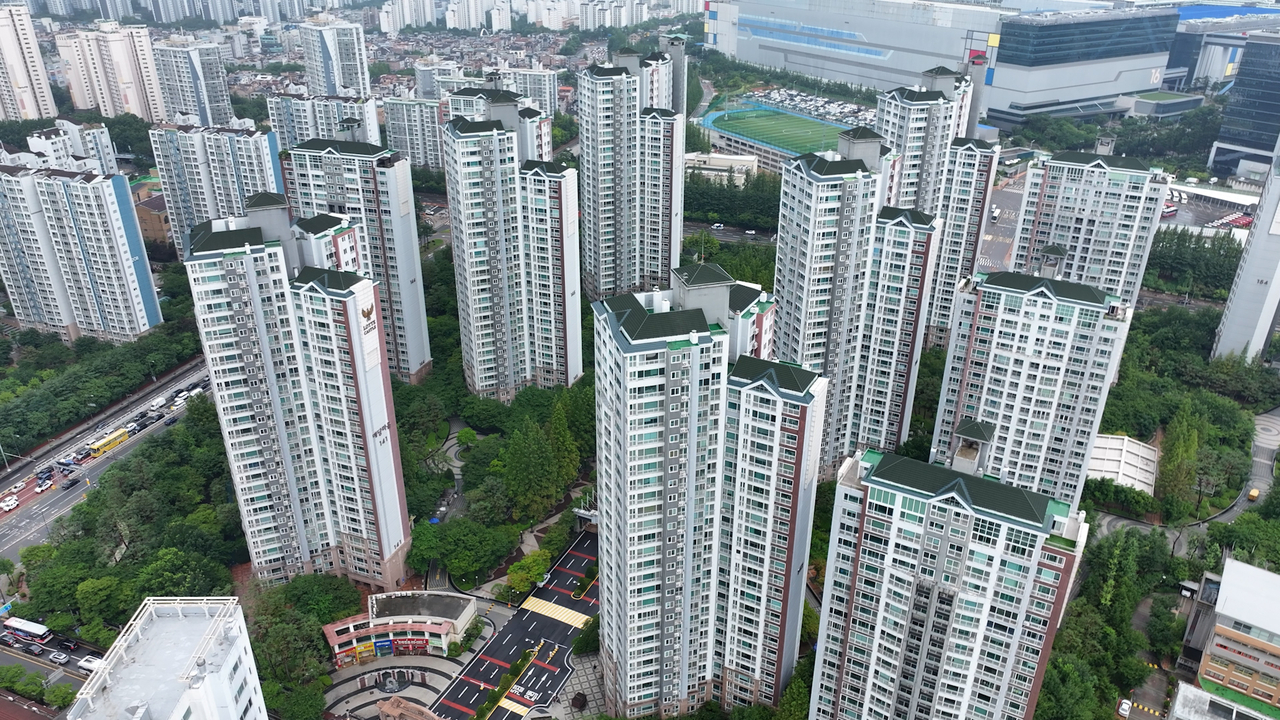
Home prices in Dongtan-gu have continued to rise on expectations tied to the semiconductor boom, pushing average transaction values higher even as overall deal volumes have contracted. According to the Korea Real Estate Board, Dongtan-gu posted a sale price index change rate of 20.14 percent as of the second week of October, the highest in the country. The average amount per funding disclosure form filed in Dongtan-gu rose from 605.32 million won in July to 640.99 million won in August and 732.47 million won in September, surpassing the 700 million won mark.
Experts forecast that corporate support funds will account for a growing share of home purchases, noting that the in-house loan program is set to run through 2035 and that additional liquidity could continue to flow into the market.
"Because in-house support funds and performance bonuses are generated every year, the southeastern Gyeonggi Province area — with its strong employment base — will drive demand even under tighter regulations," said Kim Hyo-seon, a senior real estate specialist at KB Kookmin Bank. "The existence of third-party funding sources like corporate support funds, outside of bank loans, can weaken the effectiveness of the government's lending restrictions."
hope@heraldcorp.com