Economic, Social and Labor Council to hold citizen forum Saturday–Sunday; six key tasks on agenda, including job duties, compensation and parental leave
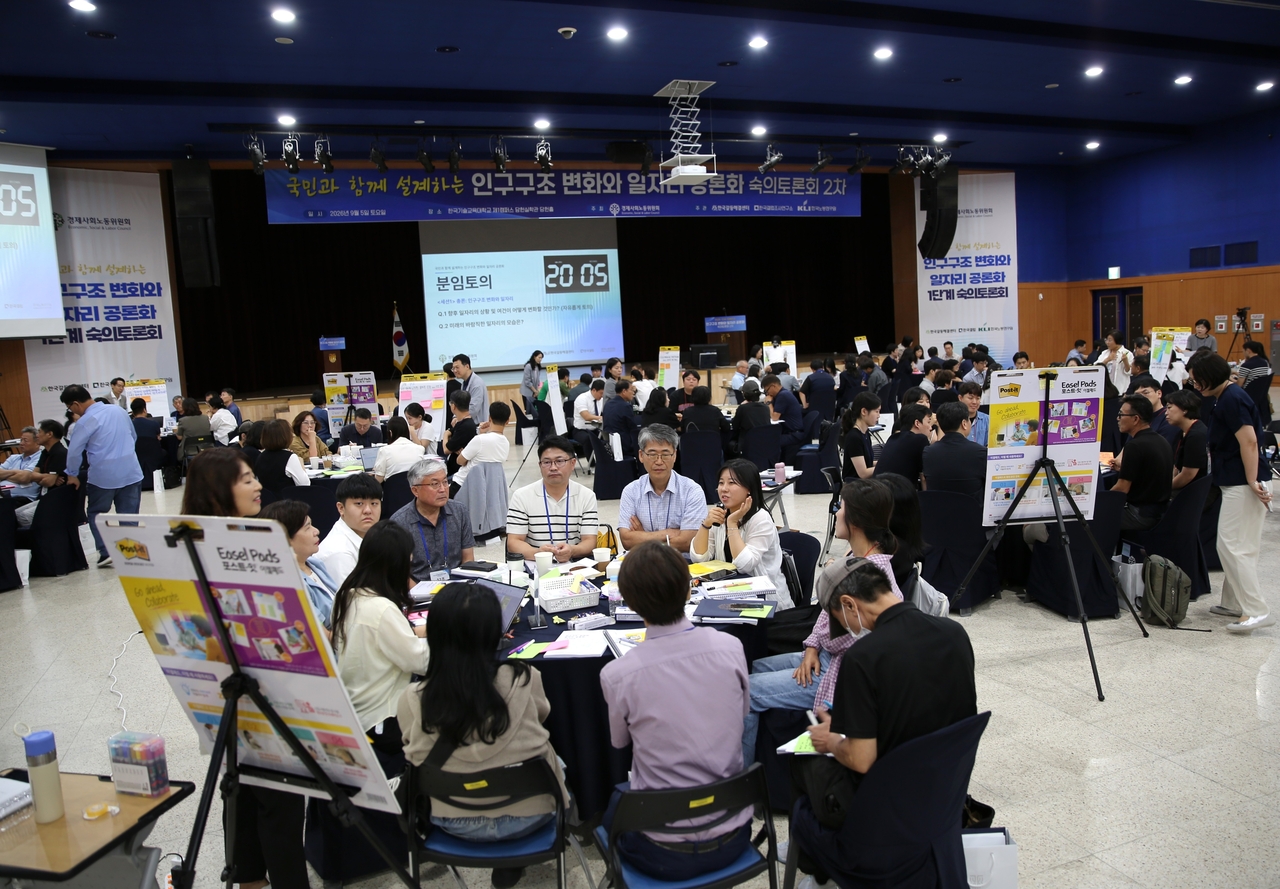
One hundred citizens will directly design implementation measures for employment policy in response to demographic change, working through six key tasks identified in earlier public deliberations — from intergenerational skills and technology transfer to redesigning job duties, working hours and compensation systems, and expanding parental leave and flexible work arrangements.
The Economic, Social and Labor Council announced Friday that its Special Committee on Demographic Change and Employment Public Deliberation will hold a "100-Person Citizen Forum: Finding the Path to Implementation" at the Dadam Future Learning Center of Korea University of Technology and Education on Saturday and Sunday.
The forum is the second-stage deliberation program of the "Public Deliberation on Demographic Change and Employment Designed Together with the People" initiative. It will focus on what systems need to change and what support is required to turn employment challenges identified by citizens into actual policy.
The council earlier held deliberative forums on Aug. 30 and Sept. 5, drawing a total of 277 citizen participants from the Greater Seoul area and other regions. Through those sessions, three core tasks each were selected in two categories: "mutually beneficial employment," covering work shared across generations, and "lifelong employment," covering uninterrupted work throughout a person's career.
The three tasks under mutually beneficial employment are intergenerational communication, organizational culture, and social consensus and conflict mediation; mutual transfer of skills and technology across generations through mentoring and the expansion of collaborative jobs; and redesigning job duties, working hours and compensation systems.
The three tasks under lifelong employment are creating quality jobs by region and fostering employment industries; expanding parental leave and flexible work arrangements and building a life-cycle-appropriate work environment; and strengthening lifelong and vocational education across life stages.
Citizen participants will be divided into three subcommittees to hear expert presentations, hold group discussions and conduct question-and-answer sessions.
The first day will focus on mutually beneficial employment tasks and the second on lifelong employment tasks. Participants will examine anticipated obstacles in the policy process, the institutional conditions required, and the respective roles of labor, management and government, before consolidating and refining proposals through a plenary session of all subcommittees.
Implementation proposals from the forum will be reported to the fourth plenary session of the special committee on Nov. 5, then used to draft a citizen proposal document at the third-stage public deliberation on Nov. 14.
"This second-stage 100-person citizen forum goes beyond identifying problems to designing solutions," committee chair Kim Ji-hyung said. "The implementation proposals put forward by citizens will serve as an important foundation for designing employment policy in response to demographic change and for sustaining social dialogue among labor, management and government."
fact0514@heraldcorp.com