
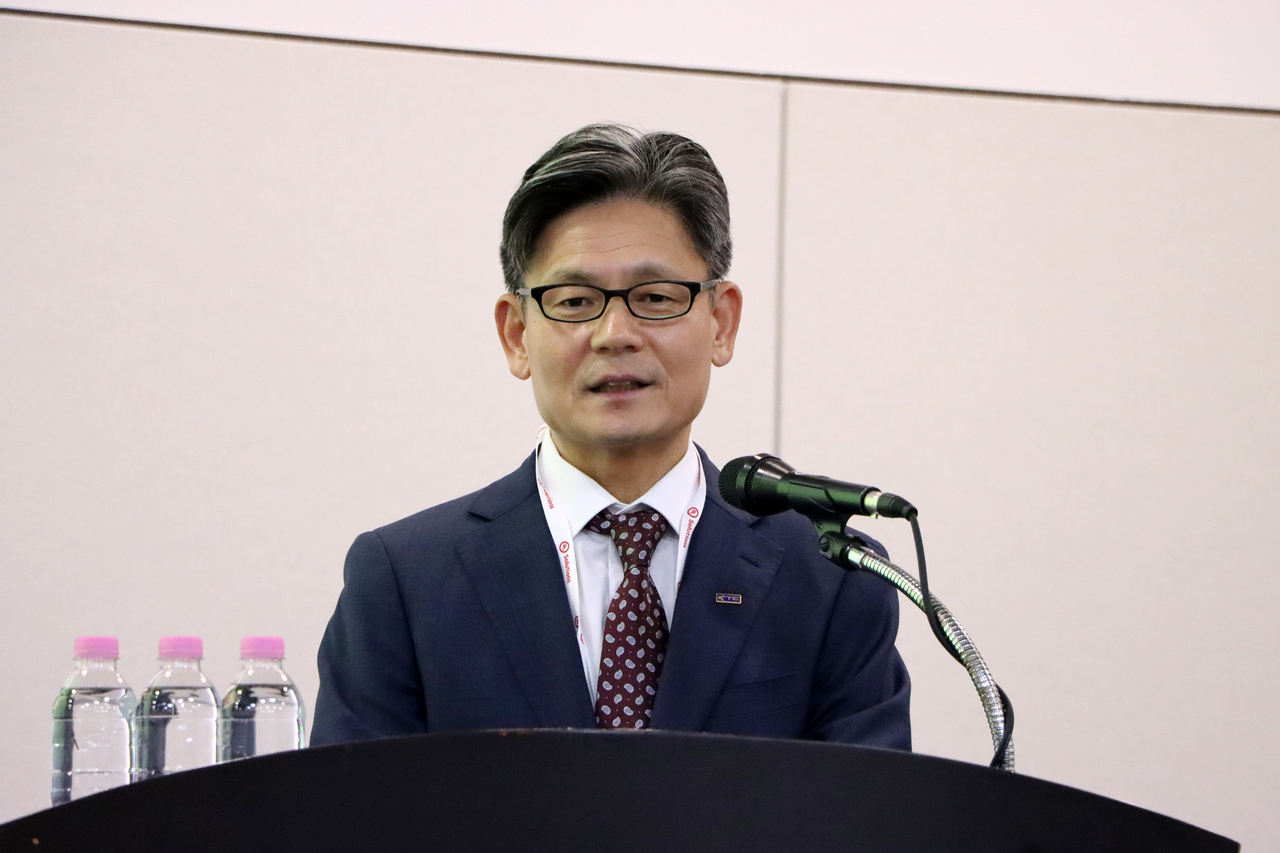
International symposium brings together experts from the US, Australia and beyond
Korea Testing Certification held the "2026 International Symposium on Next-Generation Refrigerants in the Era of Carbon Neutrality" on Thursday at KINTEX in Goyang, Gyeonggi Province. The symposium was organized as part of the 2026 Korea International HVAC&R Expo, which runs from Wednesday through Friday, and brought together participants to discuss policy and technical cooperation strategies for reducing hydrofluorocarbons and transitioning to low-global-warming-potential refrigerants.
The event drew about 120 attendees, including KTC President Yang Byeong-nae and Jeon Yong-ok, standing vice president of the Korea Air-Conditioning and Refrigeration Industry Association, along with refrigeration and air-conditioning industry experts from the United States, Australia, China, India and Africa, as well as domestic industry representatives.
HFCs are refrigerants used in refrigeration and air-conditioning equipment that do not deplete the ozone layer but are greenhouse gases that contribute to global warming. Under the Kigali Amendment to the Montreal Protocol, South Korea froze its HFC production and consumption at baseline levels in 2024 and plans to raise its reduction rate relative to that baseline to 10 percent by 2029 and 80 percent by 2045.
KTC conducts technical support for transitioning away from fluorinated greenhouse gases and carries out research to improve national greenhouse gas statistics. The agency has recently been developing a national HFC reduction model, high-efficiency refrigerant recovery and recycling equipment, and a pilot project for full life-cycle refrigerant management. Through these efforts, KTC aims to support the government's greenhouse gas reduction policy and establish a practical technology and demonstration base for refrigerant recovery and management in industrial settings.
To ensure the quality and reliability of virgin and reclaimed refrigerants, KTC has built a precision refrigerant analysis system based on the AHRI 700 standard and provides testing services covering key quality parameters such as purity, mixture composition, moisture and acidity. The agency is also pursuing designation as an AHRI 700 Refrigerant Testing Laboratory to strengthen its internationally recognized refrigerant quality testing capabilities. AHRI 700 is a refrigerant quality evaluation standard established by the Air-Conditioning, Heating, and Refrigeration Institute that sets quality criteria and testing methods for the purity, composition and impurities of virgin and reclaimed refrigerants.
At the symposium, Jang Jae-hoon, a KTC division head, presented a technology development roadmap for real-time measurement and recording of pressure, temperature and weight data during refrigerant recovery, linked to the national Refrigerant Information Management System. He outlined a plan to improve the reliability of refrigerant recovery data and establish a full life-cycle management framework connecting recovery, reclamation, recycling and reuse.
"It is important not only to transition to low-global-warming-potential refrigerants but also to ensure the safety and energy efficiency of equipment and to systematically manage refrigerant recovery and reclamation after use," Yang said. "KTC will support companies in transitioning their refrigerants by linking policy research, technology development, field demonstration, and testing and evaluation, and will contribute to national greenhouse gas reduction and the competitiveness of the refrigeration and air-conditioning industry."
oskymoon@heraldcorp.com




