A joint civil-government-police-fire response will cover the Konkuk "Food Street" and Konkuk University Station area from Oct. 29 to Nov. 4, deploying 25 AI-enabled crowd-detection CCTV cameras and a four-tier density response system.
Gwangjin-gu will implement a special crowd safety management plan for the 2026 Halloween season to prevent accidents caused by large gatherings, the district office announced. The Seoul Metropolitan Government has designated Oct. 23 to Nov. 1 as a special safety period.
The plan was drawn up to reflect the characteristics of the Konkuk University area and to get ahead of an expected surge in foot traffic, including from a trial run of the "Dalbit Yajang" outdoor night market scheduled during the same period.
Preparations began Oct. 6, well before the peak Halloween dates. On Oct. 12, the district convened a safety policy coordination committee to review measures with partner agencies including the Gwangjin Police Station, Gwangjin Fire Station and Seoul Metro. Road and lighting infrastructure has since been repaired, and crackdowns on illegally stored goods, street vendors and unauthorized parking on side streets have been completed.
Particular attention was paid to fire and evacuation risks from indoor crowding: fire-safety and evacuation facilities at seven venues licensed to allow dancing were inspected in detail. During the Halloween period, patrols around those venues will be stepped up to monitor safety both inside and in the surrounding pedestrian areas.
Working with the district's smart-information division, officials also conducted a full inspection of 25 AI-powered crowd-detection CCTV cameras and nine emergency bells and speakers. Field personnel received training on the public-safety LTE network (PS-LTE) and a mobile operations center application to enable real-time coordination among partner agencies.
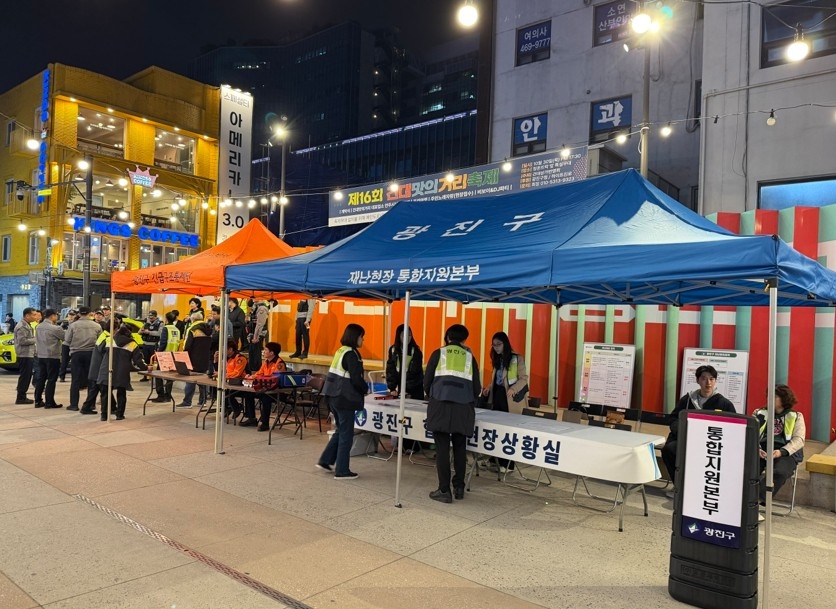
From Oct. 29 through Nov. 1 — when crowds are expected to peak — a disaster-safety operations center on the first floor of the district office and a field command post at the Cheongchun Tteurak outdoor performance venue near Konkuk University Station will run simultaneously each night. The two centers will share real-time crowd density and hazard data to support rapid on-site response.
District staff, police, firefighters, volunteer fire brigade members and neighborhood watch volunteers will be deployed on the ground, supplemented by professional safety personnel funded through the Seoul Metropolitan Government's disaster management reserve. They will focus patrols on subway exits, narrow alleyways, the areas around dancing-permitted venues and the trial Dalbit Yajang stretch, ready to disperse crowds or call in emergency reinforcements as needed.
The CCTV control center will monitor crowd density around the clock using the AI crowd-detection system and apply a four-tier response protocol — escalating to police deployment and one-way pedestrian routing as density rises. Should density reach the "serious" threshold of five or more people per square meter, the district will request that trains bypass Konkuk University Station without stopping and will coordinate exit controls with relevant agencies. Public announcements and emergency text alerts will be used to disperse crowds quickly.
Gwangjin-gu District Mayor Kim Kyung-ho said the district would scrutinize everything "from the fire and evacuation facilities of dancing-permitted venues to narrow alleyways and subway exits," adding that it would "work closely with partner agencies and make full use of AI systems and on-the-ground personnel to do our utmost to keep residents and visitors safe."
seouldream01@heraldcorp.com