The Kospi is facing a supply-demand crunch as large-scale share buybacks by Samsung Electronics and SK hynix — two pillars of the domestic stock market — wind down in quick succession. Samsung Electronics completed a 15 trillion won ($11.3 billion) buyback program, and SK hynix is now expected to finish its own as early as this week. With foreign investors continuing to sell and a major source of buying demand about to disappear, analysts warn that downward pressure on the Kospi could intensify.
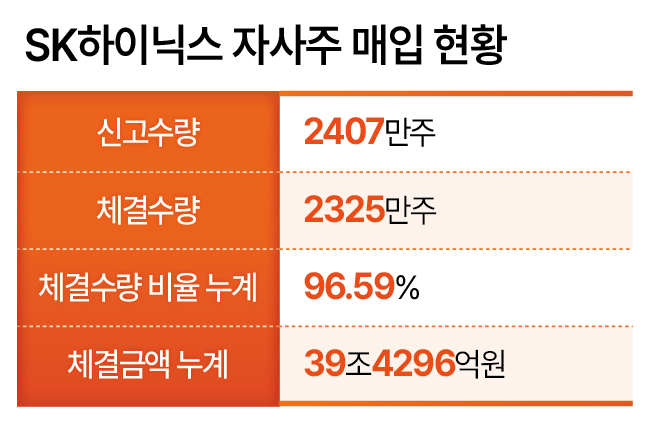
According to Korea Exchange's corporate disclosure channel KIND, SK hynix's buyback completion rate stood at 96.59 percent as of Tuesday. The company had acquired a cumulative 23.25 million shares at a total cost of 39.43 trillion won.
SK hynix announced in August that it would acquire 24.07 million of its own shares for 40 trillion won and cancel all of them. The buyback window was set to run from Aug. 20 through Nov. 19.
About 820,000 shares remain to be purchased. Given that SK hynix has recently been buying 400,000 to 500,000 shares per day, the program is expected to conclude within two trading days — roughly a month ahead of the original Nov. 19 deadline.
Samsung Electronics acquired 56.85 million of its own shares for approximately 15 trillion won between Aug. 24 and Oct. 6. Once SK hynix completes its program, both of South Korea's top two chipmakers will have wrapped up their buybacks within this month.
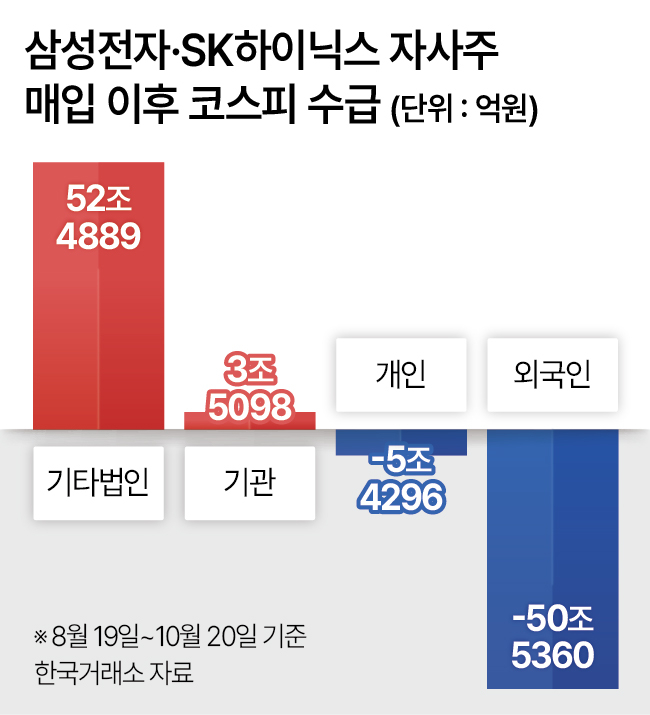
The buybacks by the two semiconductor giants had served as a key source of buying demand in the domestic market, effectively absorbing a wave of foreign selling. According to Korea Exchange, other corporations — a category that includes listed companies buying back their own shares — made net purchases of 52.49 trillion won on the Kospi from Aug. 20 through Tuesday. Over the same period, foreign investors recorded net selling of 50.54 trillion won. In effect, corporate buybacks offset the bulk of that foreign outflow.
The concern now centers on what happens after the buybacks end. With foreign selling showing no signs of abating, the removal of buying support from both companies could leave the Kospi more vulnerable to further declines.
A shrinking pool of market liquidity adds to the pressure. Investor deposits held at brokerages totaled 92.1 trillion won as of Monday, according to the Korea Financial Investment Association — the lowest level in about nine months since Jan. 16, when they stood at 91.22 trillion won.
Kospi trading volume has also been declining. "Daily average Kospi trading value fell from around 23 trillion won last week to around 17 trillion won this week," said Han Ji-young, an analyst at Kiwoom Securities. "With the order book thinning out, even a relatively modest volume of foreign net selling — 530 billion won the previous day — is causing greater intraday share price volatility than before."
Analysts at home and abroad agree that the recent slide in the domestic market reflects supply-demand imbalances rather than any fundamental deterioration in corporate health. The Kospi and Kosdaq fell 3.7 percent and 3.3 percent, respectively, on Tuesday — steeper drops than Japan's Nikkei 225 (-1.3 percent) and Taiwan's Taiex (-1.1 percent) on the same day, a divergence that analysts say points to domestic liquidity stress as the primary driver.
"A rebound in US semiconductor stocks alone is not enough to improve domestic supply-demand conditions," said Lee Jae-won, an analyst at Yuanta Securities Korea. "Foreign selling since the start of the year has been concentrated in Samsung Electronics and SK hynix, and the buyback vacuum — combined with limited buying capacity from retail investors and pension funds — is amplifying the decline."
Analysts also note there is little evidence that the fundamental value of major chipmakers has been structurally impaired. According to SK Securities, the 12-month forward price-to-earnings ratios for Samsung Electronics and SK hynix stood at approximately 3.5 times and 2.8 times, respectively, as of Tuesday. The 24-month forward price-to-book ratios for both companies have also fallen below 1 — levels last seen at the trough of previous semiconductor downturns.
In a report released Tuesday, JPMorgan said concerns about a memory chip cycle slowdown appear to be excessively priced into the shares of Samsung Electronics and SK hynix. "Current share prices reflect the possibility that earnings will peak as early as the first half of 2027 and then turn lower, but there is insufficient evidence to support that view," the report said.
The next near-term inflection point for the Kospi is likely to come from additional shareholder return announcements. "Even if the current buyback ends, the third-quarter earnings season getting under way in October could serve as a catalyst for new shareholder return programs," said Heo Jae-hwan, an analyst at Eugene Investment & Securities.
SK hynix is expected to announce additional shareholder return measures alongside its third-quarter earnings release. "We expect at least 30 trillion won in additional shareholder return capacity based on free cash flow," said Kim Rok-ho, an analyst at Hana Securities. "Buybacks and cancellations are likely to be favored over dividends."
Kim Sun-woo, an analyst at Meritz Securities, also said he expects "an immediate new return policy to be announced once the ongoing 40 trillion won buyback program concludes."
Samsung Electronics said in August that its remaining shareholder return capacity for this year stood in the 90 trillion to 110 trillion won range. Of that, the company plans to pay out 30 trillion won — including regular quarterly dividends — as a third-quarter dividend. The specific dividend details are to be decided at a board meeting later this month, with the overall scale and method of the remaining shareholder returns to be finalized at the end of January next year.
"The nearest inflection point is the concretization of shareholder returns at the end of October," said Noh Dong-gil, an analyst at Shinhan Securities. "However, for the share price to sustain a recovery, doubts about AI investment funding and excess profits from memory chips will also need to ease." The medium- to long-term direction of the Kospi, he added, ultimately hinges on the AI demand and investment cycle.
moon@heraldcorp.com