Busan manufacturer cuts production time from 50 to 46 hours with one paid day off a month
IT firm shifts to 35-hour week, slashes report-writing time by 75%
Korea Labor Foundation shares best practices as 347 firms join work-hour reduction project this year

Companies have shown it is possible to cut working hours without reducing pay while also raising productivity.
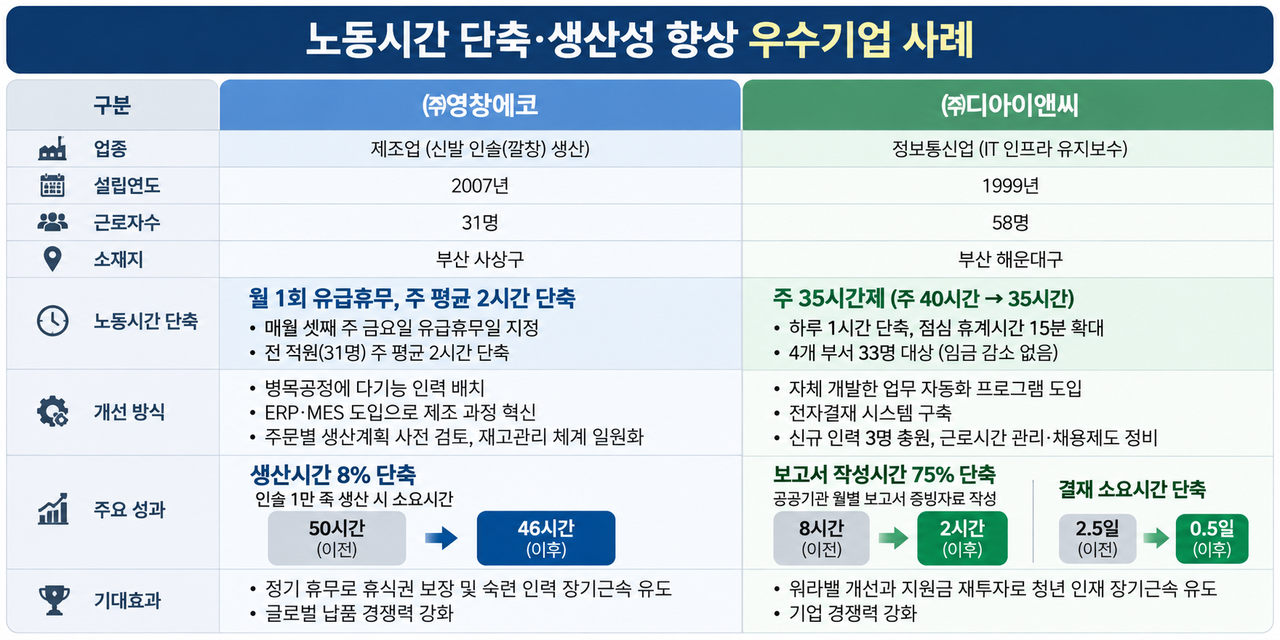
A manufacturer that introduced a 4.5-day workweek with paid time off reduced the time needed for production by 8 percent, while an information technology firm that shifted to a 35-hour week cut report-writing time by 75 percent through workplace automation.
The cases challenge the common concern that shorter working hours lead to lower productivity, demonstrating that improvements in work processes and technology can raise both efficiency and output at the same time.
The Korea Labor Foundation held the third steering committee meeting of its Work-Life Balance Plus 4.5 Project on Wednesday at Youngchang Eco in Sasang-gu, Busan, sharing the experiences of two Busan-based companies that achieved both shorter working hours and higher productivity.
The Work-Life Balance Plus 4.5 Project supports companies that reduce actual working hours — including through a 4.5-day week — without cutting wages, based on labor-management agreement. This year, 347 companies nationwide are taking part.
The steering committee meeting was organized as part of a productivity-improvement campaign by a public-private joint support team launched in May. Participants discussed ways to spread successful cases of productivity gains — with minimal disruption from reduced working hours — to other regions and industries.
Youngchang Eco, located in Sasang-gu, Busan, is a manufacturer that supplies shoe insoles to global sports brands including Nike. The 31-employee company joined the project to address long working hours concentrated during peak seasons and to retain skilled workers.
Youngchang Eco designated the third Friday of every month as a paid day off, reducing average weekly working hours by two hours per employee. Given the nature of manufacturing — where equipment must be preheated before each shift — the company opted for one paid day off per month rather than trimming minutes from each workday.
To prevent production disruptions from the shorter hours, the company assigned multi-skilled workers to bottleneck processes and introduced enterprise resource planning and manufacturing execution systems. It also began reviewing production plans by order in advance to reduce mold changeovers and unified its inventory management system.
As a result, the time needed to produce 10,000 insoles fell from 50 hours to 46 hours — a reduction of four hours, or 8 percent. The company improved production efficiency through manufacturing process changes even while cutting working hours.
I&C Technology, an IT firm in Haeundae-gu, Busan, pursued shorter working hours and greater efficiency at the same time.
The IT infrastructure maintenance company had long struggled with frequent overtime and holiday work due to nighttime operations and emergency outage responses, making it difficult to retain key staff and attract young talent.
In response, the company reduced weekly working hours from 40 to 35 for 33 employees across four departments out of a total workforce of 58. Wages remained unchanged, daily working hours were cut by one hour, and the lunch break was extended by 15 minutes.
To minimize gaps in coverage, the company introduced an in-house workflow automation program and an electronic approval system. It also hired three additional staff members to prevent work from becoming concentrated on specific employees.
As a result, the time needed to prepare monthly report documentation submitted to public institutions fell 75 percent — from eight hours to two hours per report. Average approval time also dropped from 2.5 days to half a day. The company maintained its existing maintenance service standards even after cutting working hours.
The Korea Labor Foundation said the two cases show that sustaining shorter working hours requires productivity gains to back them up. Simply reducing hours is not enough, it said — improvements to work processes, automation and workforce management must accompany the change.
The steering committee meeting was attended by representatives from the Federation of Korean Trade Unions, the Korea Enterprises Federation, the Korea Labor Institute, the Korea Institute for Small and Medium Enterprises and Startups, and the Ministry of Employment and Labor, who shared the challenges and lessons learned by individual companies and discussed ways to spread best practices more widely.
"The cases of the two Busan companies show that changes in how we work, combined with technology, can raise both corporate productivity and workers' quality of life," said Park Jong-pil, secretary general of the Korea Labor Foundation. "We will create an environment where more companies can join the push to reduce working hours and sustain that through productivity gains."
fact0514@heraldcorp.com