Busan Economic Forum on Korean Peninsula geological risk
Expert urges firms to review safety, supply chains, production and logistics with major earthquakes in mind
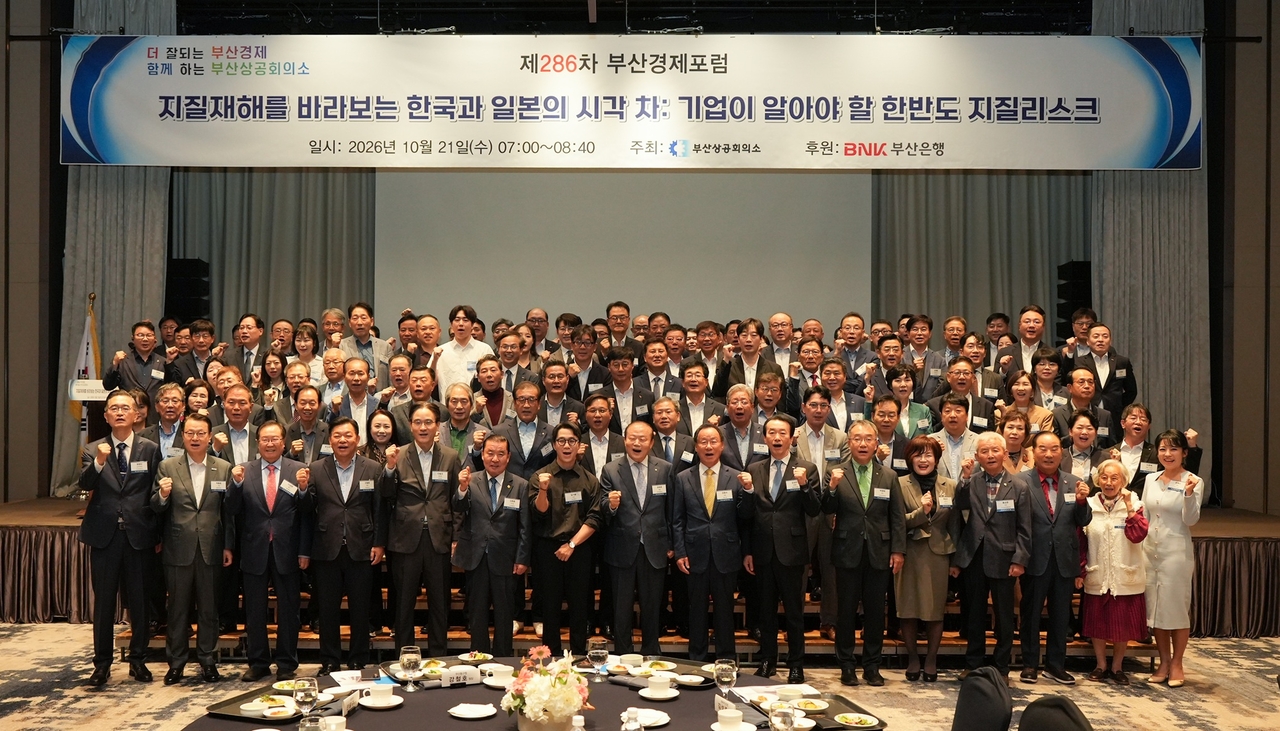
The Busan Chamber of Commerce and Industry held the 286th Busan Economic Forum at Lotte Hotel Busan on Wednesday morning, under the theme "Differing Korean and Japanese perspectives on geological disasters: geological risks on the Korean Peninsula that businesses need to know."
The forum drew about 150 regional business leaders and executives, including Busan Chamber of Commerce and Industry Chairman Yang Jae-saeng, Vice Chairmen Kang Dong-seok and Shin Han-chun, auditors Kim Yeong-deuk and Kwon Gi-jae, Busan Dong-gu District Mayor Kang Cheol-ho, Small and Medium Venture Business Regional Office Busan Director Lee Cheong-il, Bank of Korea Busan Branch Director Lee Jeong-heon, KBS Busan Station Director Min Pil-gyu, Dongmyeong University President Lee Sang-cheon and BNK Busan Bank CEO Kim Seong-ju.
Kim Ki-beom, a professor in the Department of Geological and Environmental Sciences at Pusan National University, delivered the keynote address, outlining differences between South Korea and Japan in how they perceive and prepare for geological disasters. "Geological disasters must be recognized as a business management risk," he said. He noted that while Japan prepares at both the national and corporate level for worst-case scenarios, South Korea still operates under the assumption that it is a "seismically safe zone."
Kim urged companies to examine risk factors across all aspects of their operations — from workplace safety to raw materials and parts procurement, production and logistics — given historical records of major earthquakes on the Korean Peninsula and the potential for supply chain disruptions caused by a major earthquake in Japan.
"Disasters strike without warning, but the scale of the damage depends on how well prepared you are," he said. "For businesses, assessing the geological risks at their facilities, putting in place an effective business continuity plan and ensuring operations do not grind to a halt in a crisis — that is competitiveness."
Chamber Chairman Yang said even a company's hard-won competitive edge could be shaken in an instant if production and deliveries stop due to an unexpected disaster. "I hope this serves as a valuable opportunity to examine geological disasters from a business management perspective and to review workplace safety and supply chains," he said.
kaf2002@heraldcorp.com