Korea Federation of SMEs holds AI policy forum in Jeju
'Manufacturing data must be connected to build AI factories'
SME manufacturing know-how should be converted into data assets
Kim Ki-moon calls for AI adoption centered on cooperatives
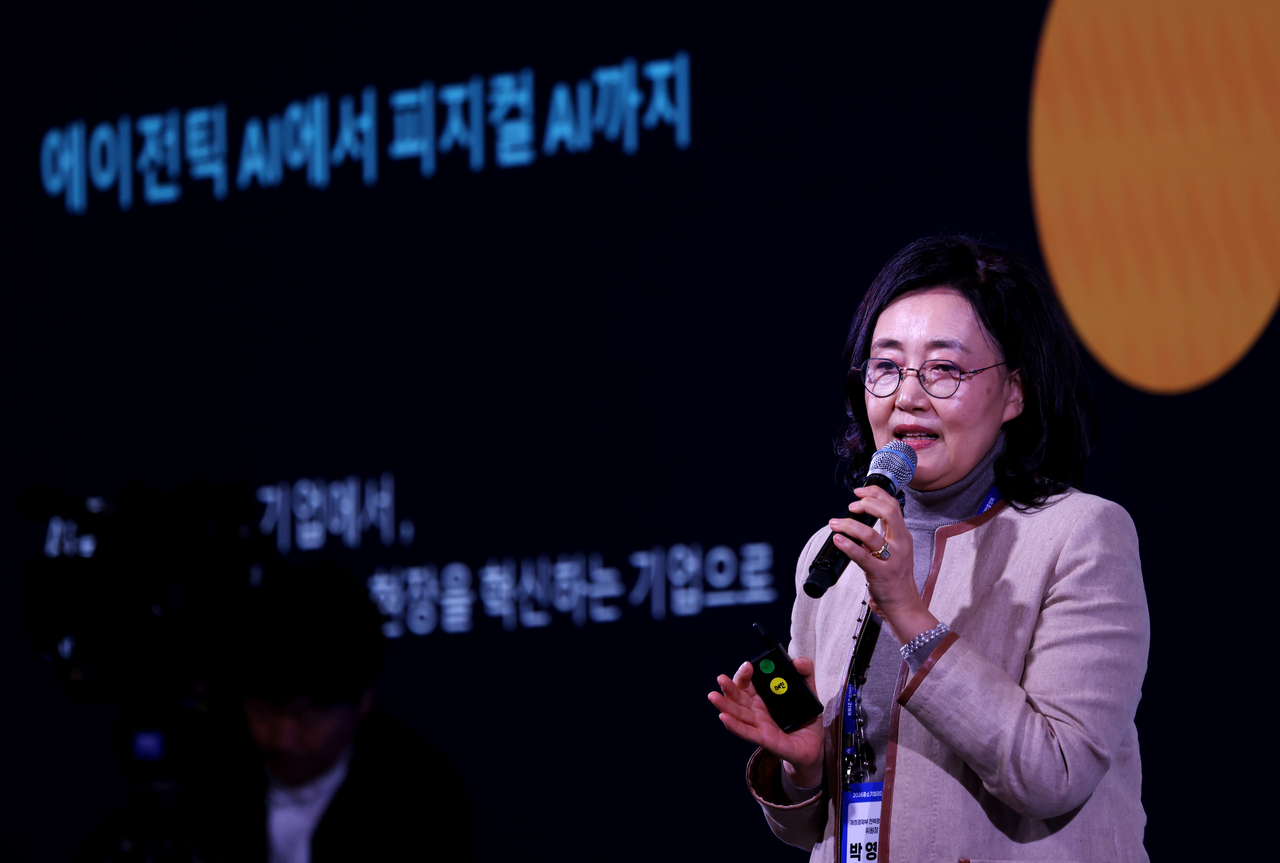
Park Young-sun, chairwoman of the Ministry of Economy and Finance's Strategic Economic Advisory Council, has proposed building a Korean data standard called "K-ontology" to secure industrial competitiveness in the AI era. The idea is to convert the decades of manufacturing experience and know-how that small and medium-sized enterprises have accumulated into data, then connect it with physical AI to create new growth engines.
Park made the proposal Wednesday in a keynote address at the 2026 SME Leaders Forum policy discussion held at Lotte Hotel Jeju, speaking under the theme "Act 2 of AI: Transforming the Future of SMEs."
Park calls for innovation beyond AI adoption in workplaces and factories
Park said AI technology is evolving from generative AI through agentic AI and on to physical AI. She described generative AI as the stage of answering questions and producing content, agentic AI as understanding goals and carrying out tasks, and physical AI as perceiving the real world and controlling the actions of robots and machines.
She said small and medium-sized enterprises must go beyond simply adopting AI and restructure the way they work so that AI becomes a genuine collaborator. The approach involves applying AI first to repetitive tasks such as drafting estimates and handling customer inquiries, then linking the entire workflow — from order intake and inventory checks to production scheduling and delivery commitments.
Park identified data standardization and connectivity as the central challenge for AI adoption. "We need to build a K-ontology standard and platform that connects national and industrial data," she said. "Physical AI must then be rolled out in stages on the basis of that connected manufacturing data."
Ontology is a technology that systematically links the meaning and relationships of scattered data so that AI can understand them. In simple terms, it functions as a kind of "data connection map" that allows AI not merely to read data but to grasp how each piece of information relates to the others.
In a manufacturing factory, for example, connecting data on equipment temperature, operating hours and product defect rates allows AI to analyze which machines produce the most defects and under what conditions. This forms the foundation for converting the manufacturing experience and know-how that SMEs have built up over many years into assets that AI can use.
The "K-ontology" Park proposed would standardize such a data-connectivity framework to suit Korea's industrial environment. The aim is to link data that individual companies currently manage in their own ways under a common standard, raising the level of AI utilization across the entire industry.
To that end, Park said pilot projects should be launched in the defense, manufacturing and healthcare sectors to secure early success cases, followed by efforts to train specialists, form consortiums and develop a K-ontology platform.
She also said manufacturing companies need to establish an "AI factory" — one that uses data to generate intelligence — as a new production base alongside their existing product factories.
Park laid out a vision in which every company operates two factories: one that makes products and one, the AI factory, that adds intelligence to those products and their production processes. She said the ability to use AI effectively will become a decisive competitive advantage as rivalry between companies intensifies.
Cooperative-led shared innovation proposed for SMEs' AI transition
The forum also heard calls for SMEs to convert their manufacturing data into assets and build a shared foundation for using them collectively as the era of physical AI approaches.
Kim Jun-ha, dean of the GIST Graduate School of AI Policy and Strategy, said in a presentation titled "The Vision of Physical AI and Strategies for SME Data Asset Conversion" that "the core competitive advantage in the physical AI era lies in the process data and skilled know-how accumulated on the factory floor."
He said SMEs must go beyond simply accumulating data and convert it into assets that AI can use. He called for a division of roles in which individual companies build up data, cooperatives establish common standards and shared demonstration infrastructure, and the government provides the supporting framework.
Cho Ju-hyun, president of the Small and Medium Business Research Institute, identified cost burdens and the risk of failure as the main reasons SMEs have been slow to adopt AI.
"The reason SME AI adoption has been sluggish is that it is hard for a single company to bear the costs and the risk of failure alone," Cho said. "We need a shared-innovation model that lets companies use common infrastructure — data, demonstration facilities and the like — together while each firm protects its own competitive edge."
The panel discussion that followed also raised the need to build shared infrastructure for SMEs' AI transition and to expand government support.
Han Byung-jun, vice chairman of the Korea Federation of SMEs, said it is important for managers to first identify the problems they need to solve on the ground, and that infrastructure too costly for individual companies to build on their own should be developed jointly through cooperatives.
Jang Yong-hwan, chairman of the Gyeongin Foundry Industrial Cooperative, said "foundry SMEs hold manufacturing data and real-world problems but lack AI specialists and the capacity to invest." He called on the government to expand SME participation in research and development and demonstration projects, and to support long-term technology verification in actual factories.
Oh Min-seok, vice president of Megazone, said "simply subsidizing the purchase of robots or solutions will not be enough for physical AI to take root on the factory floor," and proposed building regional and sector-specific shared infrastructure covering everything from data preparation and on-site deployment to maintenance.
Jang Young-jae, director of the KAIST Manufacturing Physical AI Research Institute, stressed the importance of manufacturing intelligence capable of making integrated judgments and managing an entire factory. He proposed an "AI Factory Manager for All" model in which AI models validated through small-scale demonstrations are rolled out across different industries.
From the government side, Kwon Soon-jae, director general for regional enterprise policy at the Ministry of SMEs and Startups, and Song Chang-jong, head of the Device AX Innovation Team at the Ministry of Science and ICT, attended and outlined policy directions for spreading physical AI among SMEs.
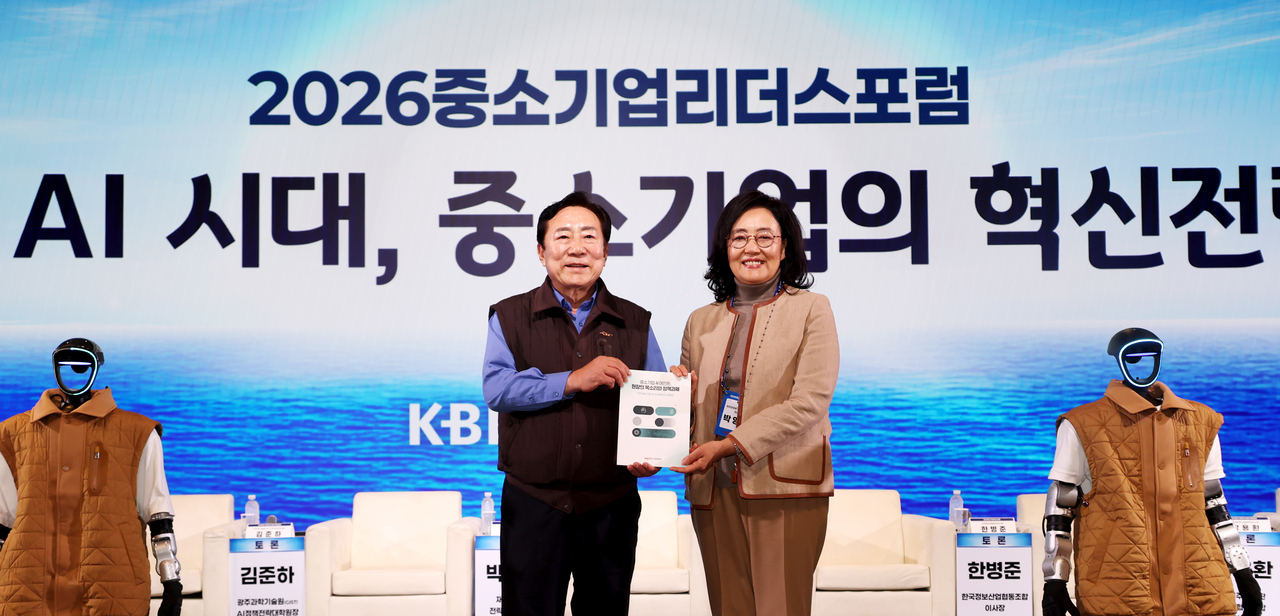
Before the forum began, Korea Federation of SMEs Chairman Kim Ki-moon presented Park with a report titled "The Great AI Transformation of SMEs: Voices from the Field and Policy Challenges," which compiled the difficulties SMEs are encountering in their AI transition and the policy support they are seeking.
boo@heraldcorp.com