- Temperature stimulus applied to the middle knuckle lets fingertips sense heat and cold
- Nine virtual surfaces — including ice, iron and sand — recreated to boost VR immersion
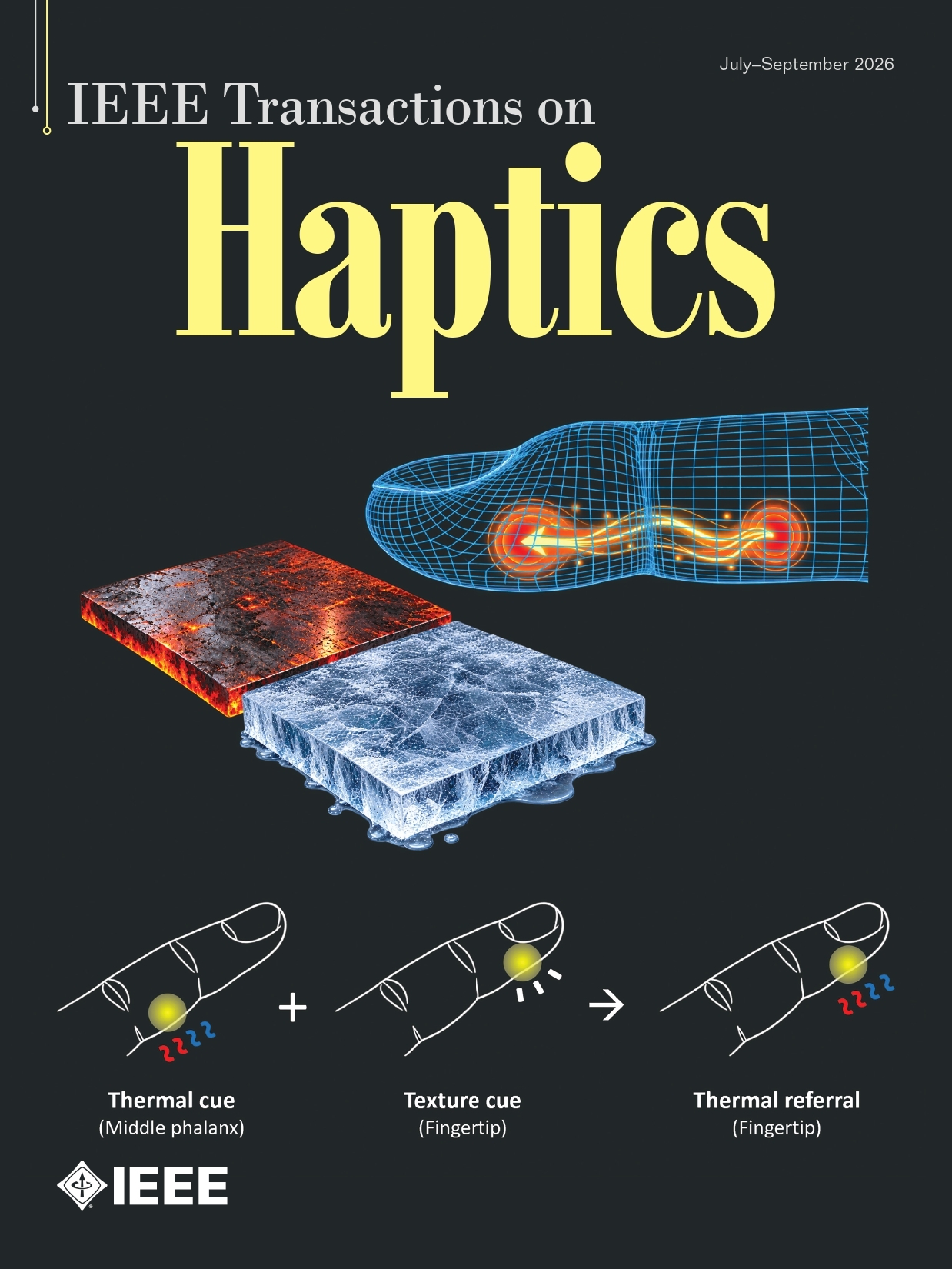
Researchers have developed a technology that lets users feel as though they are touching a scorching iron plate — without applying heat directly to their fingertips.
The Gwangju Institute of Science and Technology (GIST) announced Wednesday that a research team led by Professor Park Geon-hyeok of the AI department had developed a haptic technology capable of conveying both the temperature and surface texture of virtual objects without directly stimulating the fingertip with heat or cold.
Conventional VR haptic devices have relied mainly on vibration or friction to simulate surface roughness. Adding thermal sensations — hot or cold — required heating or cooling the device element in direct contact with the skin, making the hardware structure and control systems considerably more complex.
The research team focused on a phenomenon known as "thermal referral," in which a temperature stimulus applied to one part of the skin is perceived at a different part of the same hand.
The team built a device that applies a temperature stimulus to the middle knuckle of the index finger while spinning textured discs against the fingertip to simulate the feel of different surface materials. The design allows users to sense both temperature and texture at the same time without the fingertip itself being heated or cooled.
In experiments with 12 participants, applying a 40-degree stimulus to the middle knuckle produced a perceived sensation of heat at the fingertip in an estimated 86 percent of cases.
Temperature also influenced how rough a surface felt. Participants touching the same fabric material rated it as rougher when a 36-degree or 40-degree stimulus was applied than when the temperature was 24 degrees.
When participants actively moved their fingers to explore a virtual surface, the transfer of cold sensations became even more pronounced.
In a separate experiment with another 12 participants, a 24-degree stimulus produced a cold sensation at the fingertip 51 percent of the time when the hand was stationary, but that figure rose to 86 percent when participants moved their fingers across the surface. By contrast, the probability of perceiving heat from a 40-degree stimulus was 86 percent when stationary and 79 percent when moving, showing no significant boost from motion.
The research team also assessed the technology's potential for VR applications by recreating nine virtual surfaces with varying temperatures and textures, including ice, a heated iron plate and sand.
Participants rated the nine surfaces an average of about 72 to 78 out of 100 for realism, 68 to 73 for interest and 69 to 76 for immersion.

The technology is expected to find applications in VR gaming, immersive content and remote haptic interfaces, among other fields. However, the team said further work is needed to reduce the time required for temperature changes, shrink the device's physical footprint and improve the rendering of smooth surface textures.
"This research is significant in that it moves beyond existing work focused on conveying surface texture at room temperature and demonstrates that texture and temperature can be delivered together," Park said. "We will develop this into a VR and haptic interface technology that allows users to feel and interact with virtual objects of various temperatures and textures as if they were real."
The findings were published in volume 19, issue 3 of the international journal IEEE Transactions on Haptics.
nbgkoo@heraldcorp.com