About 300 students attend lecture at Donggang Hall on Korean society's inequality and possible remedies
Former minister highlights asset inequality as more severe than income gap, saying it divides young people before they even start
Jeon stresses that democracy's strength comes from dialogue and compromise, and calls youth political participation the beginning of change
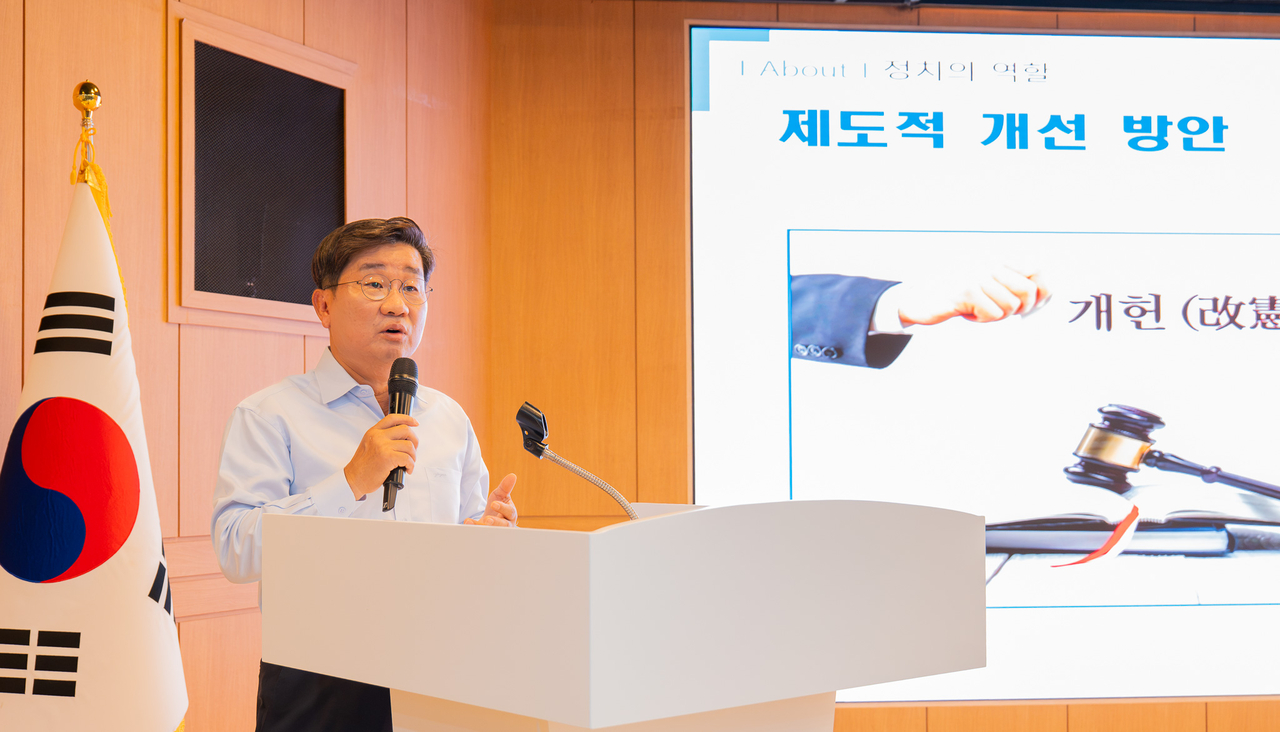
"Inequality is a structural problem that cannot be solved by individual effort alone. Ultimately, the power to change that structure lies in politics."
That was the message Jeon Hae-chul, former minister of interior and safety and a special professor at Hanyang University, delivered to students at Dongshin University. He argued that overcoming deepening wealth polarization and unequal opportunity requires political action to reshape social structures — and that young people's active engagement must be the starting point.
Dongshin University hosted Jeon for a special lecture Monday afternoon at Donggang Hall in its Daejeong Library, with the topic "The State of Inequality in Korean Society and Ways to Address It." About 300 students attended to reflect on the realities of inequality facing South Korea and the future of its democracy.
Jeon opened by walking through key indicators — the Gini coefficient, the income quintile ratio and the relative poverty rate — to illustrate how severe inequality in South Korean society has become.
He drew particular attention to asset inequality, which he said far outstrips the income gap. Citing the World Inequality Lab's 2026 World Inequality Report, he noted that as of 2024, the top 10 percent in South Korea held 37.4 percent of total income and 65.9 percent of net wealth, while the bottom 50 percent held just 1.8 percent of net wealth.
"The concentration of assets is far more severe than the concentration of income," Jeon said. "The asset gap between one generation becomes a gap in starting conditions for the next, and we must break the vicious cycle in which that inequality is passed down."
He went on to say that inequality has spread beyond a simple economic divide, becoming a structural threat to the sustainability of Korean society — fueling political conflict, a crisis of democracy, elderly poverty, high suicide rates and a low birth rate.
As remedies, he proposed strengthening social safety nets such as child allowances, basic pensions and unemployment benefits, expanding public transfer income, redistributing income through a progressive tax system, and narrowing the wage gap between regular and non-regular workers as well as between large corporations and small and medium-sized enterprises.
The lecture's central argument converged on the role of politics in driving these structural changes.
"It is ultimately politics that creates the institutions to reduce inequality and turns them into policy," Jeon said. "Politics that moves beyond conflict and confrontation — that builds social consensus through dialogue and compromise — must be restored."
He also introduced what he described as the "four warning signs of authoritarian behavior" put forward by Harvard University professor Steven Levitsky, co-author of "How Democracies Die": rejection of democratic norms, denial of the legitimacy of political rivals, encouragement or tolerance of violence, and suppression of the basic rights of the press and dissenters.
Jeon relayed Levitsky's assessment that South Korean democracy had shown resilience after the emergency martial law crisis, through legal processes and collective civic resistance, and said the ultimate power to protect democracy lies in institutions and civic consciousness.
On political reform, he proposed a decentralized constitutional amendment to distribute power, improvements to the single-member district system, and a shift to a regional proportional representation system to promote cooperative governance.
He cautioned, however, that "no matter how good the institutions are, democracy cannot function properly without a political culture of mutual tolerance — recognizing one's political opponents — and restraint in the exercise of power."
Closing the lecture, Jeon emphasized the role of young people.
"The difficulties young people face in finding jobs, securing housing and building assets are not personal problems — they are challenges our society must solve together," he said. "Our society can change when young people turn the issues directly affecting their lives into items on the political agenda and actively participate in the push for a better society."
A question-and-answer session followed, during which students exchanged views with Jeon on inequality in South Korean society and the role of politics.
The lecture gave students an opportunity to deepen their understanding of the structural problems facing South Korean society and to reflect on the meaning of democracy and civic participation.
Jeon graduated from Korea University's law school and passed the 29th bar examination. He has served as senior secretary for civil affairs in the Presidential Secretariat under the Roh Moo-hyun administration, as a National Assembly member for the 19th, 20th and 21st terms, as chair of the Assembly's intelligence committee and environment and labor committee, and as minister of interior and safety under President Moon Jae-in. He currently serves as senior counsel at law firm Haemaru and as a special professor at Hanyang University.
kkm9971@heraldcorp.com