RDA launches web-based quality database for apples, oriental melons and onions, visualizing changes under different storage conditions
Optimal storage temperature for oriental melons set at 10 C; pre-drying cuts onion decay rate by up to 66.3%
Farmers and distributors will soon be able to use data — rather than experience and intuition — to decide when to ship apples and at what temperature to store oriental melons to avoid cold damage. Research has also shown that simply pre-drying onions before storage can cut their decay rate by up to 66.3 percent, offering a straightforward way to reduce post-harvest losses.
The Rural Development Administration said Wednesday it has launched a pilot operation of a web-based quality database covering three horticultural crops — apples, oriental melons and onions — that integrates pre- and post-harvest quality data and visualizes how quality changes under different storage conditions.
Until now, post-harvest quality data for agricultural produce had been collected under inconsistent measurement standards across different research reports, and cultivation records were not linked to storage quality data. That made it difficult for APCs and farmers to draw on comprehensive information when deciding how to store crops or when to bring them to market.
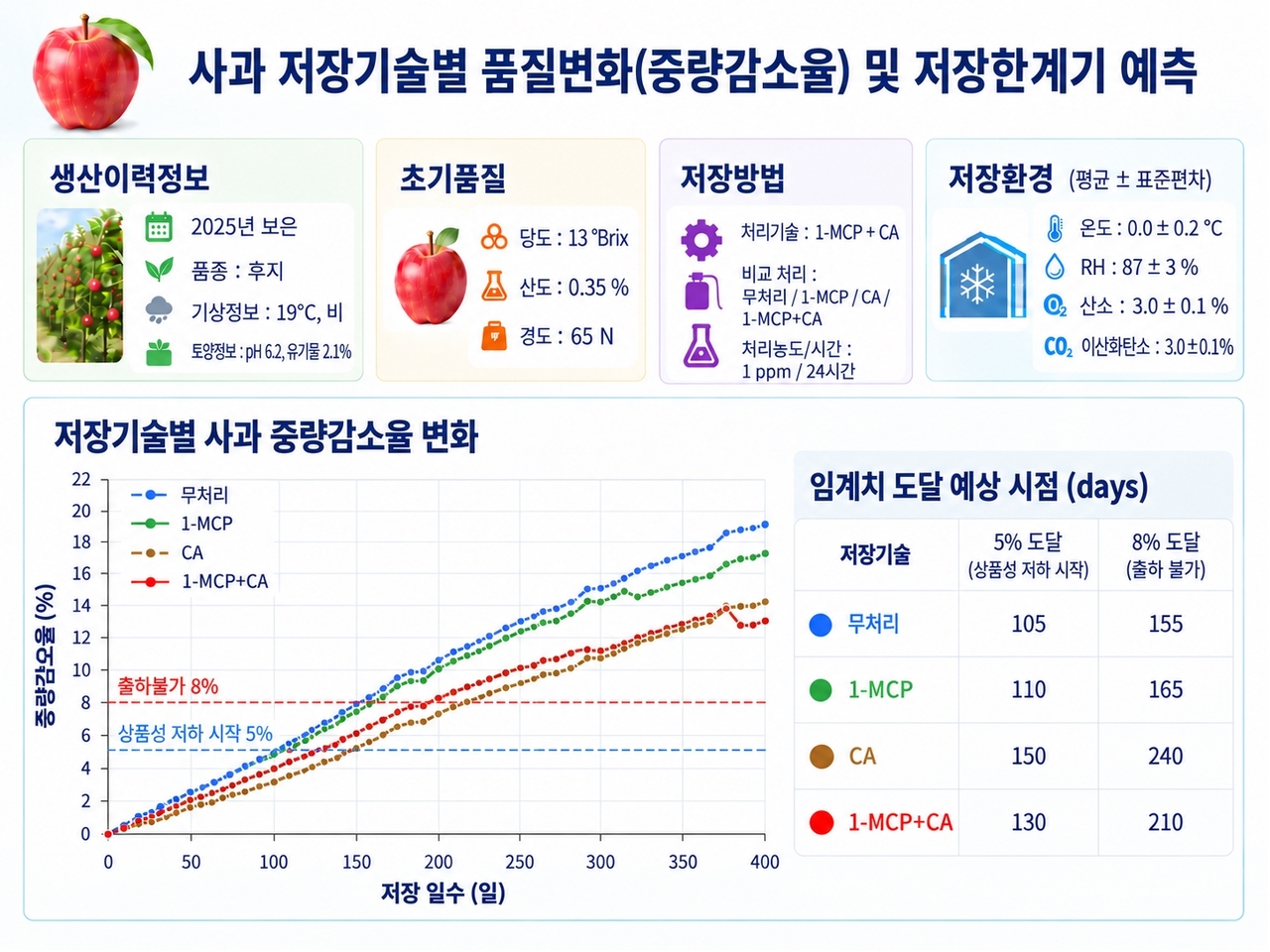
The new database presents, in a single view, everything from the growing environment by region, crop and variety to post-harvest quality, pre-treatment methods, and quality changes under varying storage temperatures and humidity levels. It is accessible through the website of the National Institute of Horticultural and Herbal Science, where users can view graphs showing quality changes and storage limits under different conditions.
The database allows users to compare quality outcomes across a range of storage technologies, including low-temperature storage, modified atmosphere storage — which controls the gas composition inside packaging — treatment with 1-MCP to suppress ethylene activity, and controlled atmosphere storage, which regulates oxygen and carbon dioxide concentrations.
For apples, the system uses weight loss during storage as the key indicator of declining marketability. It flags the points at which weight drops by 5 percent and 8 percent under each storage method, giving distributors a data-based reference for deciding when to ship.
An APC, for example, can enter the storage date, method, temperature and post-harvest quality of a batch of apples and then track the weight-loss trend and when it is expected to cross the marketability threshold. The RDA said this would allow distributors to move the most at-risk stock first, rather than defaulting to a first-in, first-out approach.
For oriental melons, researchers analyzed quality differences across storage temperatures and identified 10 degrees Celsius as the optimal storage temperature. They compared browning rates and loss rates for melons stored at 4 C, 7 C, 10 C and room temperature to determine the conditions that minimize cold damage.
The database also accounts for the fact that the skin color of oriental melons varies depending on which fruiting node — the first through fourth — produced them, and establishes brightness and color measurement standards accordingly. This allows quality comparisons to be made on a consistent basis regardless of where the produce was grown.
For onions, the database quantifies the effect of curing, a pre-storage drying process. Onions can lose up to 30 percent of their weight during storage, making post-harvest management critical.
According to field data from the RDA, onions that were cured before being stored at 0 C for seven months showed reductions of up to 54.3 percent in weight loss, 55.1 percent in sprouting and 66.3 percent in decay. The findings suggest that pre-storage treatment alone can significantly reduce losses during long-term storage.
The RDA also standardized quality measurement criteria, unifying the measurement points and units for key indicators such as sugar content, acidity, firmness, skin color and respiration rate. This allows data collected from different equipment and sensors to be compared and analyzed consistently.
The RDA expects the database to serve as a data foundation for smart APCs — facilities that use robots, the Internet of Things and AI to manage produce from intake through sorting and dispatch.
After stabilizing the system during the pilot phase, the RDA plans to open the database to the public next year and expand the number of crops covered from three to 11 in stages.
"The quality database is an important first step in shifting post-harvest management from subjective experience to objective data," said Kim Dae-hyun, director of the National Institute of Horticultural and Herbal Science. "We will help producers and distributors determine the optimal shipping time based on data rather than instinct, and continue building field-centered data that earns the trust of both producers and consumers."
adastra@heraldcorp.com