Over 3,500 signatures delivered to Seoul city hall, Cultural Heritage Administration, UNESCO and ICOMOS urging careful review
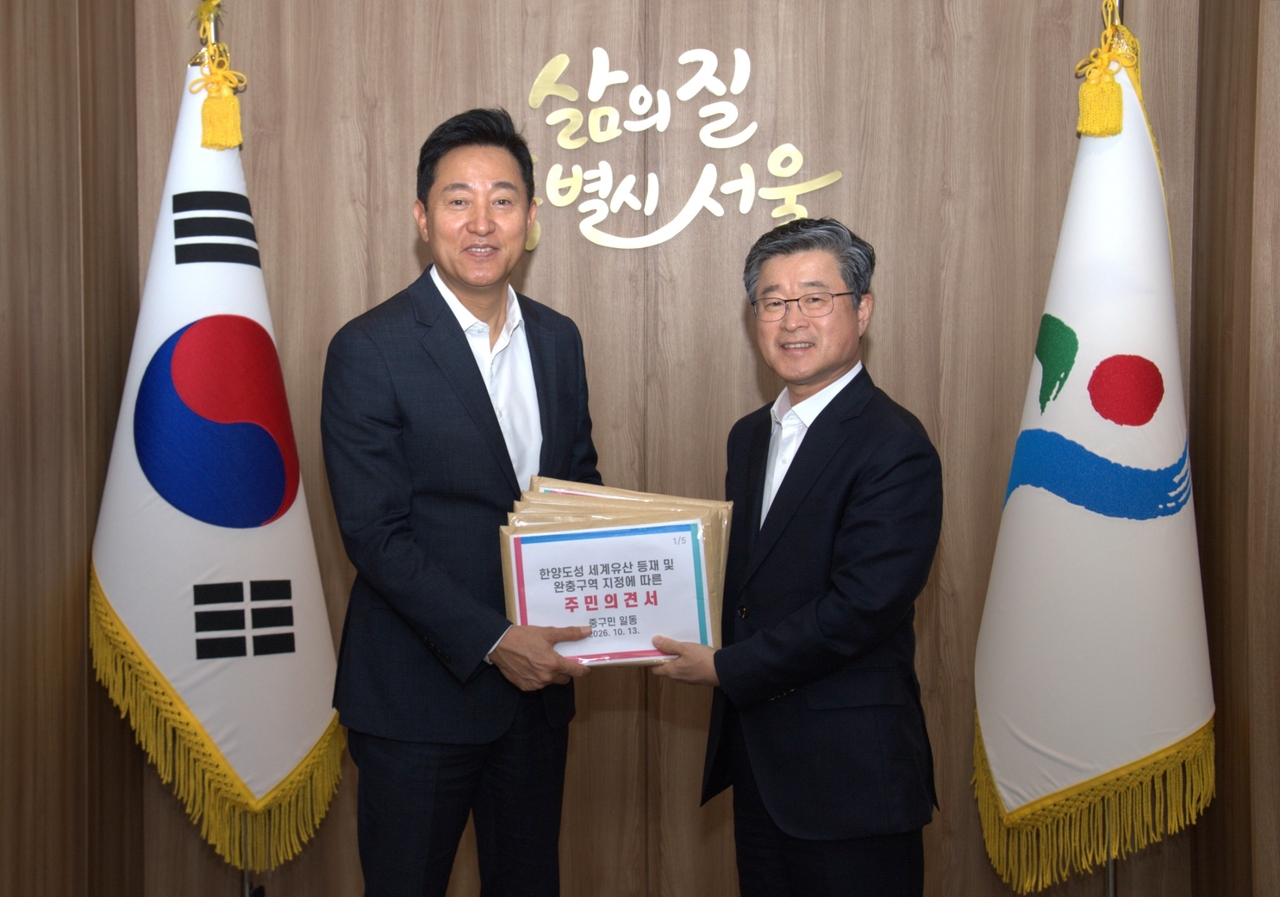
Jung-gu in Seoul has delivered a residents' petition opposing the push to inscribe "Hanyang's Capital Fortress Walls" on the UNESCO World Heritage List, submitting the document to the Seoul Metropolitan Government on Oct. 13 and then to the Cultural Heritage Administration, UNESCO and ICOMOS on Tuesday.
The petition, bearing more than 3,500 signatures, expresses residents' concerns that a World Heritage designation would delay urban renewal projects and restrict property rights in the district.
Earlier in January, the Seoul Metropolitan Government, the Cultural Heritage Administration and other agencies submitted a nomination dossier to the UNESCO World Heritage Centre for "Hanyang's Capital Fortress Walls," a serial property encompassing Hanyangdoseong, Bukhansanseong and Tangchundaeseong.
The Hanyangdoseong section of the fortress runs through Jung-gu, stretching from Gwanghuimun through Dasandong and Namsan to Sungnyemun. Because aging residential neighborhoods and urban redevelopment zones line the walls, Jung-gu residents have been watching the inscription process closely. Their chief concern is the Heritage Impact Assessment, or HIA, that would become mandatory once the site is listed.
Under World Heritage rules, a 100-meter buffer zone would be established around the walls, requiring an HIA before any construction or urban renewal work could proceed. The assessment process alone typically adds one to three years to a project timeline, making delays all but certain. The precedent from Gongju's Gongsanseong fortress — already a World Heritage site — is instructive: a nearby renewal project was asked to substantially revise its plans and was set back roughly three years as a result.
Residents are also worried that even projects outside the buffer zone could be drawn in, since the Cultural Heritage Administration has the authority to request an HIA for developments beyond the designated boundary, potentially widening the affected area considerably.
That uncertainty has raised alarms about a range of projects in the district — housing renewal schemes in Sindang zones 9, 10 and 13, a remodeling plan for Namsan Town, and urban redevelopment work around Gwanghuimun, Dongdaemun Design Plaza and the Seosomun area.
Jung-gu is a district where housing renewal projects long stalled by height restrictions around Namsan have only recently begun to gain momentum. Residents fear that a World Heritage designation could impose yet another layer of regulation, delaying hard-won opportunities to improve their living conditions.
Ordinary buildings adjoining the fortress walls in Dasandong, Jangchungdong and Sindangdong would also face new restrictions on new construction, extensions and renovations.
Adding to residents' anxiety, even sections where the walls no longer stand could fall within the scope of review — whether for the preservation of underground remains or the delineation of the serial heritage boundary — meaning areas with no direct contact with the walls could still be affected.
As concerns and inquiries mounted, Jung-gu held a community information session at the main hall of Sindang Nuri Center on Sept. 3 at residents' request. About 200 people attended, and district officials explained the current state of the inscription process and its potential impact on renewal projects while gathering residents' views.
At that meeting, residents formally submitted to the district a petition opposing the World Heritage inscription bid, along with a signature list of more than 3,500 names, citing fears over project delays and property rights restrictions.
Jung-gu then forwarded the petition and signature list to the Seoul Metropolitan Government, the Cultural Heritage Administration and other relevant agencies so that residents' views could be reflected in the inscription process. The district also asked the agencies to weigh not only the importance of preserving the heritage site but also the protection of residents' property rights and the impact on ongoing renewal projects, and to proceed with careful deliberation.
A second community session is scheduled for Nov. 5 at the Sindang Nuri Center main hall, where the district will update residents on developments since the petition was submitted and collect further input. Jung-gu said it plans to maintain consistent communication with residents, monitor the impact on renewal projects, and work with relevant agencies to address any excessive regulations or unreasonable procedures.
"Preserving the value of cultural heritage is important, but improving the residential environment for residents who have long been preparing for renewal projects is equally a duty that the administration must attend to with care," Jung-gu District Mayor Kim Gil-sung said. "We will do everything we can to ensure that residents' concerns and opinions are fully conveyed to the relevant agencies, and we will provide tailored support for each project site to ensure that urban development proceeds on a stable footing."
seouldream01@heraldcorp.com