Two previous attempts failed; nets to be deployed Wednesday
Authorities rush rescue effort ahead of expected temperature drop starting Thursday
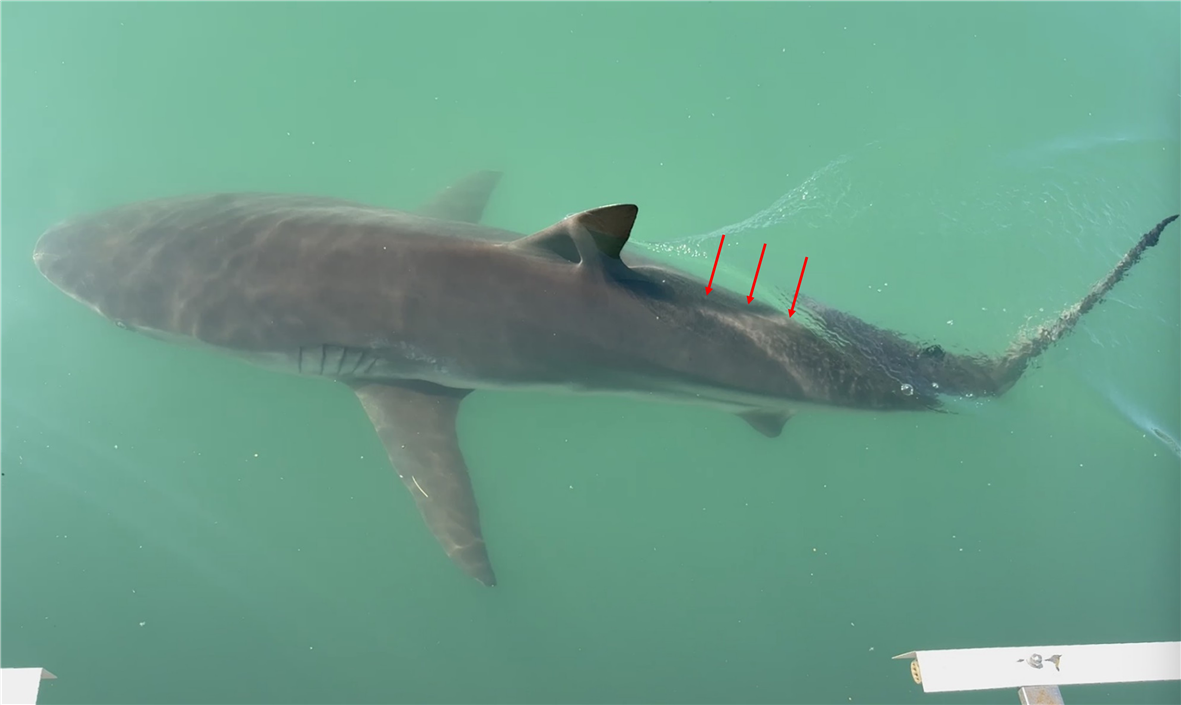
Authorities are preparing a third attempt to guide a 3-meter blacktip shark, nicknamed "Bucang-i," out of a waterway at Busan Port's North Port waterfront park, where it has been stranded for more than a month. Concerns over the shark's health are mounting after two previous efforts to steer it toward open water failed, with no confirmed feeding activity and falling water temperatures expected.
The Ministry of Oceans and Fisheries announced Tuesday that it will carry out the third open-sea guidance operation Wednesday in a joint effort with the Busan city government, the National Marine Biodiversity Institute of Korea and other relevant agencies.
Bucang-i, a blacktip shark measuring about 3 meters in length, was first spotted Sept. 18 in the scenic waterway of the North Port waterfront park in Busan. Authorities have made two attempts to move it to open water, but the shark has remained in the waterway. Officials have continued to monitor its health and behavior in the interim.
The urgency behind the third attempt stems from a judgment that the shark's living conditions are deteriorating. The artificial waterway offers limited depth and space, no feeding activity has been confirmed, and experts warn that a further drop in water temperature could harm the animal's health.
The Ministry of Oceans and Fisheries convened an advisory meeting Monday involving the National Institute of Fisheries Science, the National Marine Biodiversity Institute of Korea, and specialists in sharks and veterinary medicine. The experts agreed that the shark should be guided to open water as quickly as possible, given the restricted water depth and the anticipated temperature decline.
Wednesday was chosen for the operation because no cruise ships are scheduled to be in port that day. The expected sharp drop in air temperature starting Thursday was also a factor.
This attempt will use a method of incrementally repositioning nets to address the waterway's depth and topographical constraints that hampered the two earlier operations.
Workers will first secure nets to pontoons — floating platforms used for waterborne operations — and then gradually shift the nets as Bucang-i moves toward the open sea. Once the shark passes through, the nets will block its path back into the waterway, steering it toward the ocean.
On Tuesday afternoon, the ministry will conduct a preliminary survey of the seafloor topography and obstacles at the waterway entrance using underwater drones. Equipment will be installed Wednesday morning, with the full guidance operation set to begin in the afternoon.
Earlier Tuesday, the ministry held a response meeting near Busan Station at 10 a.m., bringing together 10 agencies — including the Busan city government, the National Marine Biodiversity Institute of Korea, the National Institute of Fisheries Science, the Busan Port Authority and the Busan Facilities Corporation — to coordinate a detailed action plan and define each agency's role.
During the operation, authorities will continuously monitor Bucang-i's health and movement while minimizing stress to the animal. Access to the site will be restricted to ensure the safety of workers and park visitors.
"Based on expert advice, the relevant agencies will work in close cooperation to do everything possible to safely guide Bucang-i to open water," said Hwang Jun-seong, director general for marine environment policy at the Ministry of Oceans and Fisheries. He also urged the public to refrain from any actions that could interfere with the operation and to follow access restrictions and the instructions of safety personnel on site.
adastra@heraldcorp.com