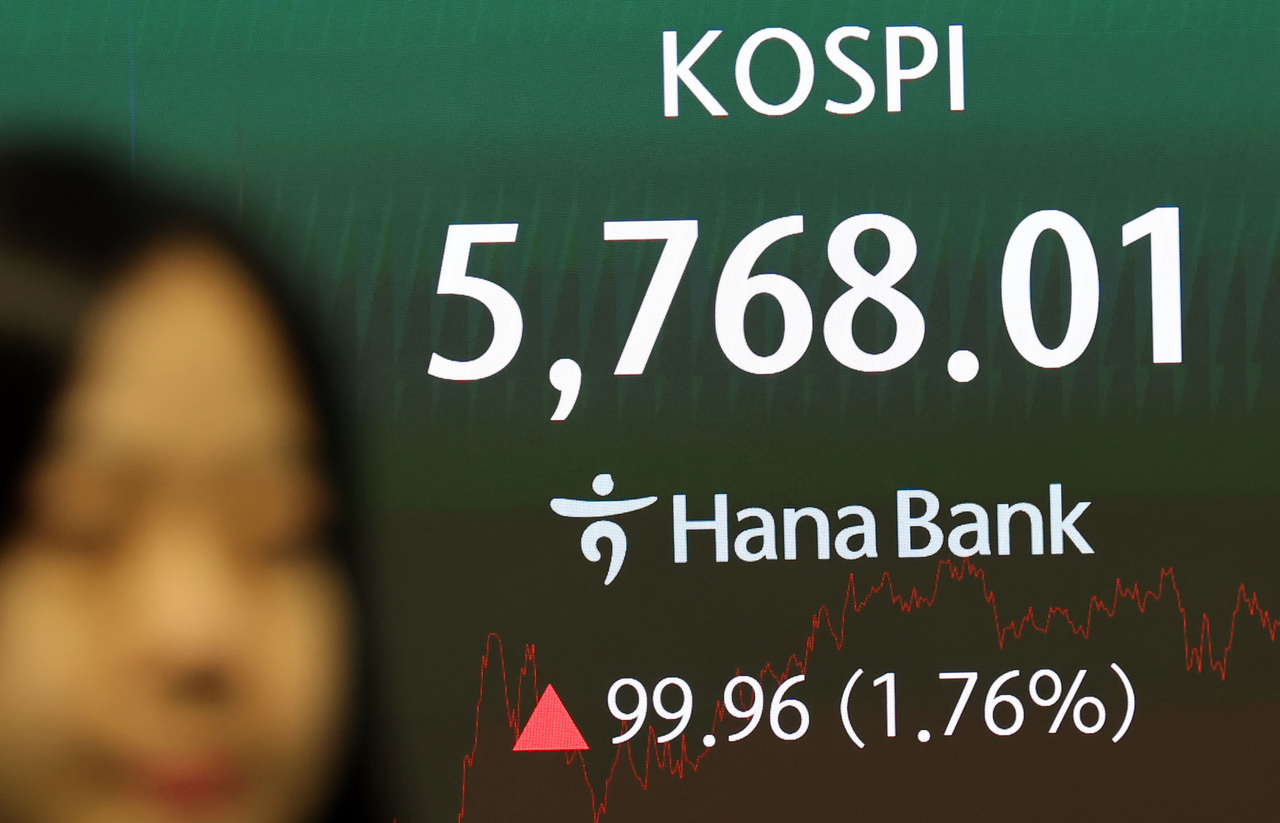
Foreign investors continue to exit South Korea's stock market, with the decline in foreign ownership of Samsung Electronics and SK hynix running at 1.6 to 1.8 times the rate seen across the broader Kospi. Foreign investors, who have been net sellers of more than 208 trillion won ($156 billion) since the start of the year, have maintained a selling bias even as the Kospi slid from around 7,000 points to roughly 5,500 earlier this month.
Amid growing concerns over debt levels at major AI companies, foreign capital has been flowing out of semiconductor-heavy emerging markets — a trend playing out in both South Korea and Taiwan. Investor sentiment toward emerging markets centered on semiconductors shows no sign of improvement.
According to Korea Exchange data as of Monday, the Kospi's overall foreign ownership ratio has fallen 3.54 percentage points from its year-to-date high, while Samsung Electronics dropped 6.41 percentage points and SK hynix fell 5.82 percentage points over the same period. Foreign investors have been reducing their stakes in the large-cap semiconductor stocks that led this year's market rally at a pace well above the market average.
Samsung Electronics' foreign ownership ratio hit a year-to-date low of 45.98 percent on Friday before edging up to 45.99 percent on Monday, still hovering near its lowest level of the year. That figure is comparable to levels last seen in December 1998, shortly after the Asian financial crisis. It is also the lowest reading in roughly 18 years, dating back to the period following the 2008 global financial crisis.
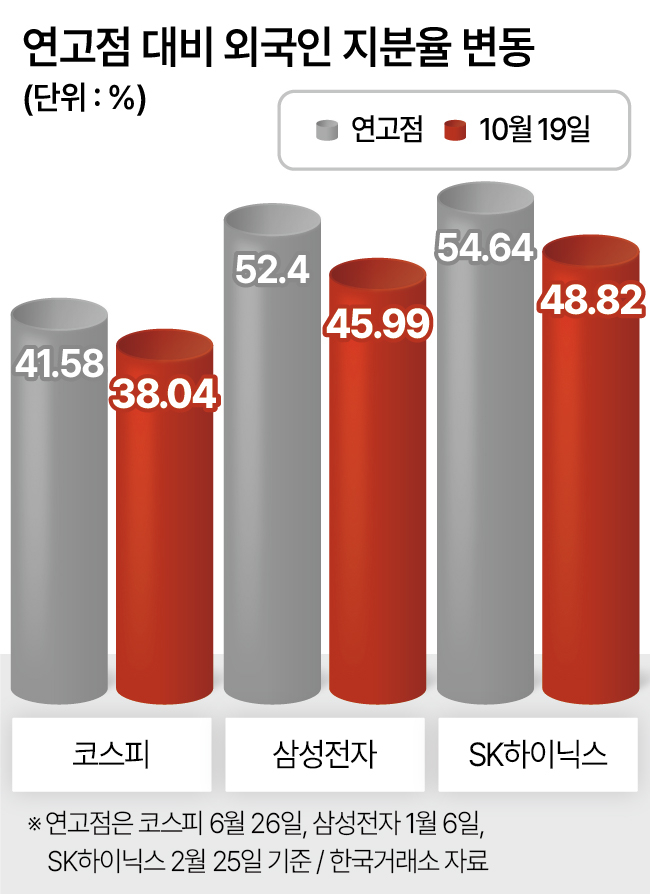
Samsung Electronics' foreign ownership ratio had risen consistently from late last year, reaching 52.4 percent on Jan. 6, but has since fallen more than 6 percentage points from that peak. SK hynix, which recorded a foreign ownership ratio of 54.64 percent on Feb. 25, also hit a new year-to-date low of 48.82 percent on Monday.
The pattern of foreign buying accompanying share price gains — once a reliable feature of the market — has largely disappeared this year. Even as share prices have risen, foreign holdings have moved in the opposite direction. "Last year, Samsung Electronics' share price and the number of shares held by foreign investors moved in the same direction, with a correlation coefficient of around plus 90 percent," said Jeon Gyun, a researcher at Samsung Securities. "This year, the two indicators have been moving in opposite directions — and the same is true for SK hynix."
Nor have foreign investors turned into clear net buyers when the index has fallen. After the Kospi reclaimed the 7,000-point level on Oct. 2, foreign investors continued net selling of around 1.7 trillion won even as the index retreated to around 5,500 points. Of the 11 trading sessions from Oct. 2 through Monday, only two saw modest net buying — in the range of 90 billion to 300 billion won. On a year-to-date basis, net selling on the Kospi has exceeded 208 trillion won.
The inability of record earnings or index gains to stem foreign selling is a pattern shared by Taiwan's stock market, which is similarly dominated by global IT and semiconductor stocks. Taiwan's Taiex index has surged more than 60 percent this year, yet foreign net selling has already exceeded three times last year's full-year total. Thursday's single-session net selling hit a record high of around 302.6 billion Taiwan dollars. The parallels with Samsung Electronics and SK hynix are clear: TSMC alone accounts for 40 percent of the Taiex, and earnings growth alone has proven insufficient to attract foreign capital inflows.
"Looking at Taiwan, foreign net purchases and market performance used to move in tandem, and since 2018, quarterly foreign net buying had tended to lead TSMC's sales growth rate by about three quarters," said Jeong Jeong-yeong, a researcher at Korea Investment Securities. "Even though TSMC posted record quarterly sales in the third quarter of this year, foreign net selling has expanded — suggesting investors are reassessing both the Taiwan market and TSMC itself."
As foreign selling persists in semiconductor-heavy South Korea and Taiwan, global institutional investors are growing increasingly cautious about the AI industry's further upside potential. Mark Habib, global head of digital infrastructure at S&P Global, said Monday (local time) that "it is reasonable to assume there is more debt out there that we are not aware of" at major AI companies, warning that financial risks could mount if expected returns on investment fail to materialize or competition among AI firms intensifies. His comments came as he projected that capital expenditure on AI by six major AI companies would exceed $7 trillion between 2025 and 2030.
As foreign investors continue to pull back from large-cap domestic stocks, attention is turning to the possibility that investment demand — previously concentrated in large semiconductor names — could rotate into small- and mid-cap Kosdaq stocks as well as value and dividend plays.
"In the first half of 2027, a stock-rotation rally could emerge within the Kosdaq, with gains cycling through multiple names, and in the second half, the healthcare sector — long overlooked since the yield curve inversion — could draw renewed attention," said Kang Hyeon-gi, a researcher at DB Securities. He added that in sectors such as transportation, insurance, food and beverage, and media, a strategy of increasing exposure to stocks that combine relative value and dividend appeal — and that are less sensitive to swings in interest rates — could prove advantageous.
kacew@heraldcorp.com