Demo held off Long Beach, California
3.5-hour event showcases autonomous maritime technology
Vessel equipped with HD Hyundai's in-house solution
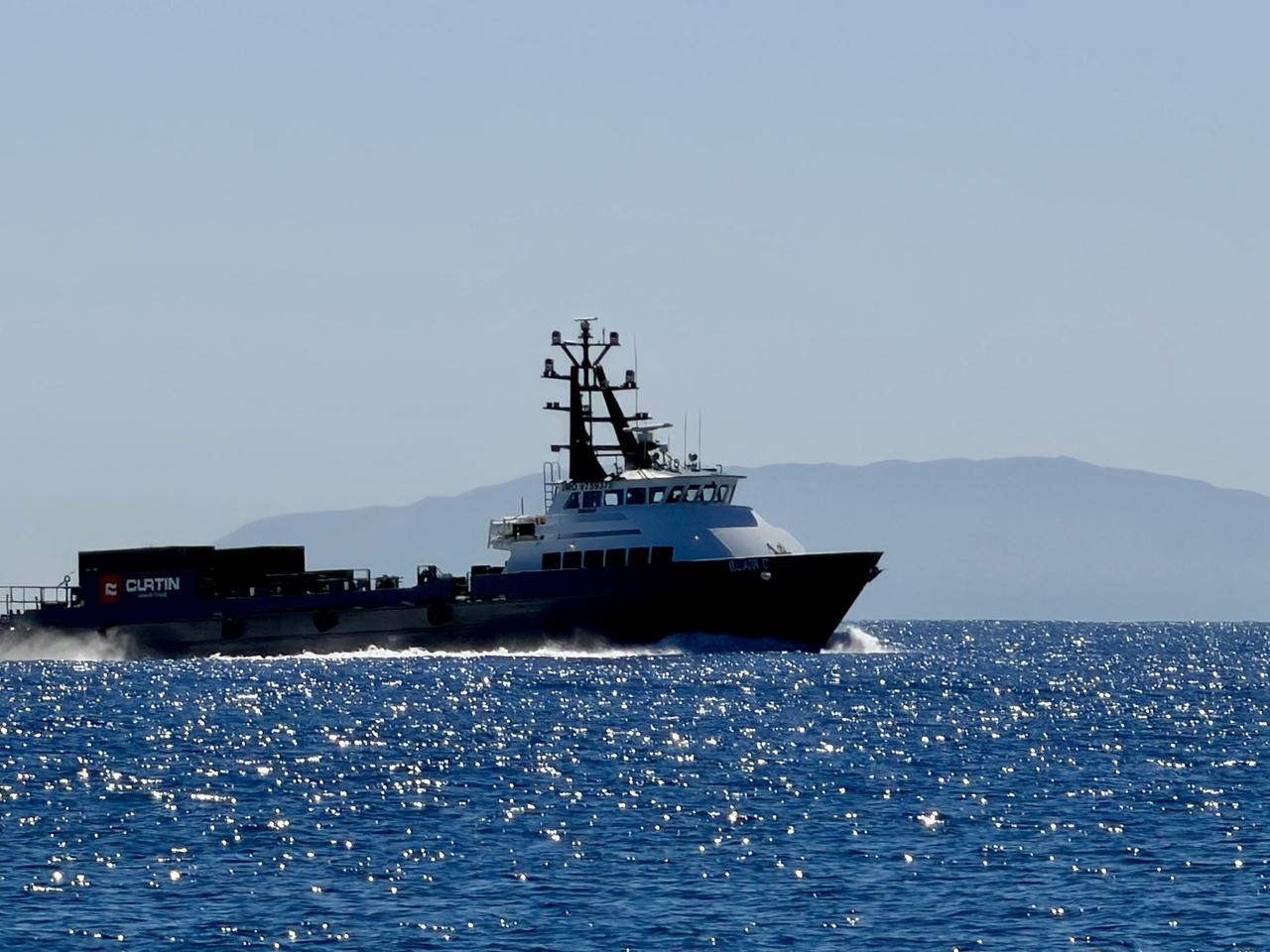
HD Hyundai announced Monday that it had successfully held a joint demonstration of an autonomous unmanned surface vessel with US AI defense company Anduril off Long Beach, California.
About 40 officials from both countries attended the event, including HD Korea Shipbuilding & Offshore Engineering Future Technology Research Institute President Jang Gwang-pil, along with representatives from Anduril, the US Navy and Coast Guard, the American Bureau of Shipping, and South Korea's Navy and Defense Acquisition Program Administration (DAPA).
Over roughly three and a half hours, the two companies demonstrated a range of maritime scenarios — including autonomous navigation, mid-mission changes, formation sailing and emergency responses to engine failures — showcasing the vessel's advanced technological capabilities. Of particular note was the vessel's ability to make continuous independent decisions and respond across multiple real-world combat situations, completing a complex autonomous mission without interruption.
The vessel used in the demonstration was a converted 368-ton unmanned surface test ship previously operated by the US Navy. It was equipped with VAone, HD Korea Shipbuilding & Offshore Engineering's proprietary total vessel autonomy solution, and Lattice, Anduril's mission autonomy solution.
VAone stands for Vessel Autonomy — No. 1 & Only One. Built on HiNAS Prime, an autonomous navigation solution developed by Avikus, HD Hyundai's autonomous navigation subsidiary, it monitors a vessel's engine status in real time and detects anomalies. It also incorporates an autonomous engine system capable of automatic responses, as well as a damage autonomy solution that detects and addresses hull damage on its own.
The two companies plan to use the capabilities validated through the demonstration as a springboard for entering the global unmanned surface vessel market in earnest.
"This demonstration was significant in that it confirmed the vessel's ability to carry out complex missions across a wide range of real-world situations that could arise after departure," Jang said. "We will continue to push forward with technology development and advancement to secure an early lead in the unmanned surface vessel market."
Meanwhile, HD Hyundai Heavy Industries plans to hold a launching ceremony in Ulsan as early as next month for an unmanned surface vessel jointly developed with Anduril.
yeongdai@heraldcorp.com