Semiconductor packaging, back-end processing; 1,500 jobs expected
Amkor Technology Korea will break ground on a roughly 3 trillion won expansion of its Gwangju factory. The company ranks second globally among specialized semiconductor back-end processing firms and is considered the world's largest in automotive semiconductor back-end processing.
Amkor will hold a ground-breaking ceremony Monday morning at its existing Gwangju factory site, known as K4, to launch construction of an advanced semiconductor back-end processing production line. The total expansion investment of about 3 trillion won ($2.22 billion) is roughly three times the originally planned 1.01 trillion won, and the project is expected to create 1,500 new jobs. New production lines will be added sequentially within the existing factory site through 2031, following phased capacity expansion stages.
The expansion is also expected to generate synergies with the construction of Samsung Electronics and SK hynix fabrication plants under the Honam semiconductor cluster initiative, which targets first mass production in 2030.
If four or more fabrication plants are built in the Gwangju area by the early 2030s as envisioned under the Honam semiconductor cluster plan, the region could establish a foundation for completing the entire semiconductor production process — from front-end to back-end — in one location.
Amkor had originally pursued an expansion of around 1 trillion won, but the limited capacity of existing wastewater treatment facilities emerged as an obstacle to a larger investment.
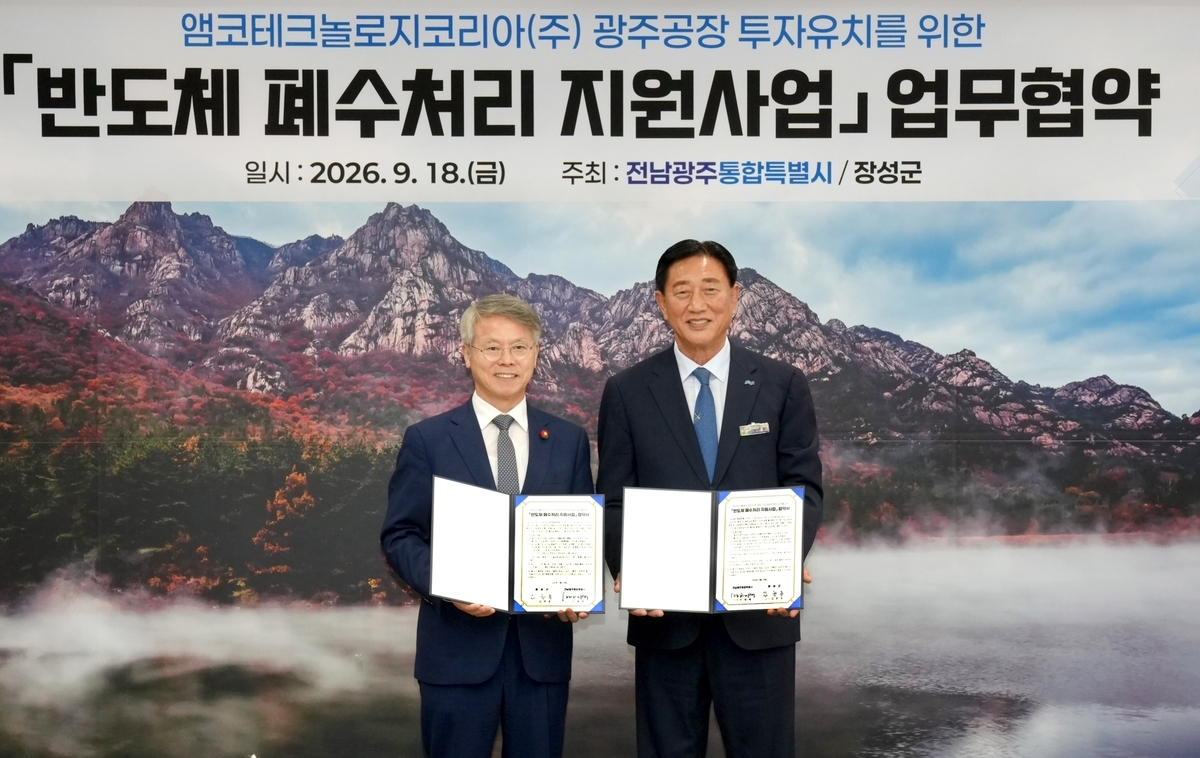
Amkor asked the city for support on Sept. 16, and the city, after reviewing options including freeing up spare capacity at existing facilities and redistributing treatment volumes, devised a plan to use a public wastewater treatment facility in neighboring Jangseong-gun.
The city held emergency talks with Jangseong-gun the following day and signed an MOU the day after that to jointly use the Jangseong public wastewater treatment facility. Confirming that the Jangseong facility had ample available capacity, Amkor then raised its expansion investment to 3 trillion won.
The city plans to provide administrative support throughout the roughly four-year construction process. It will establish a regular consultative body with Amkor, led by the city's semiconductor industry division, to monitor project progress and address any difficulties the company encounters.
"We will prepare all at once — power, water, roads and transportation, as well as residential, education and medical services," Mayor Min Hyeong-bae said. "We will build an industrial city where companies invest, talented people come to live and families can settle together."
sij@heraldcorp.com