
Transactions above 2.5 billion won fall 10.7%
Upgrade demand and 'survival buying' drive mid-tier surge
'Rush to climb the housing ladder before it's too late'
![Demand to upgrade to higher-tier neighborhoods and so-called "survival buying" are being reflected in market prices as strict lending regulations introduced by the Oct. 15 real estate measures last year remain in force. [Image generated with ChatGPT]](https://wimg.heraldcorp.com/news/cms/2026/10/15/news-p.v1.20261015.14d9b90e1f524448acd3ca2a5dbcca6b_P1.png)
One year has passed since the government rolled out its "Oct. 15 measures" last year, designating all of Seoul and key areas of Gyeonggi Province as land transaction permit zones and tightening mortgage loan limits by price tier in an effort to stabilize the housing market. As a result, demand for ultra-premium apartments priced above 2.5 billion won — where the loan ceiling was cut to 200 million won ($149,000) — has cooled, while transactions in the 1.5 billion to 2.5 billion won range have surged. Analysts say both genuine end-user demand and upgrade-seeking buyers have gravitated toward the price band where borrowing remains relatively accessible. Rising home prices pushing formerly sub-1.5-billion-won units into the higher tier have also contributed.
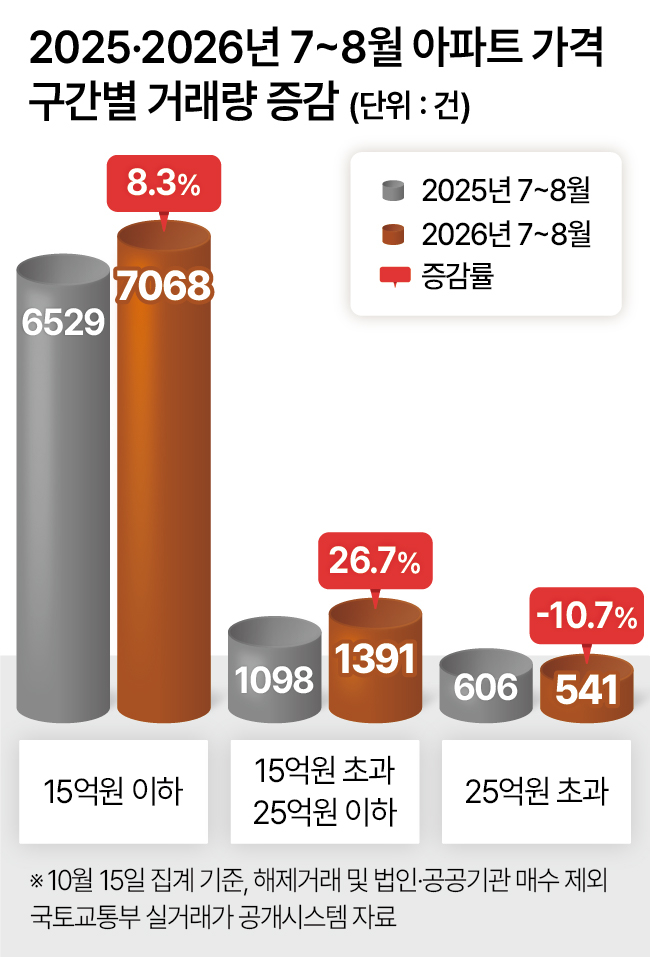
According to the Ministry of Land, Infrastructure and Transport's actual transaction price disclosure system, Seoul apartments in the 1.5 billion to 2.5 billion won range — excluding canceled deals and purchases by corporations or public institutions — recorded 1,391 transactions in July and August this year, up 26.7 percent from 1,098 in the same period last year. The July–August window was chosen as the comparison benchmark because it provides a stable transaction count that accounts for the reporting lag inherent in the land transaction permit system.
Breaking down transaction volume by price tier over the same period, apartments priced at 1.5 billion won or below rose 8.3 percent, from 6,529 to 7,068 units, while those above 2.5 billion won fell 10.7 percent, from 606 to 541 units. The steepest increase was concentrated in the 1.5 billion to 2.5 billion won band.
That price band also expanded its share of overall transactions. It accounted for 15.5 percent of all deals in July and August this year, up 2.1 percentage points from 13.3 percent in the same period last year. By contrast, the share of transactions above 2.5 billion won shrank from 7.4 percent to 6.0 percent.
By district, transactions in the 1.5 billion to 2.5 billion won range rose noticeably in Han River belt districts such as Dongjak-gu and Yeongdeungpo-gu. In Dongjak-gu, deals for apartments at or below 1.5 billion won fell from 255 to 149 over the July–August period, while transactions in the 1.5 billion to 2.5 billion won range climbed from 83 to 144 — a gain of 61 deals. In Yeongdeungpo-gu, sub-1.5-billion-won transactions dropped about 31.1 percent, from 386 to 266, while deals in the 1.5 billion to 2.5 billion won range — where buyers can still borrow up to 400 million won — more than doubled, rising from 46 to 97.
Part of the shift reflects complexes that previously traded below 1.5 billion won crossing into the higher price tier. The 84-square-meter unit at Sindonga Riverpark in Noryangjin-dong, Dongjak-gu, Seoul, first broke the 1.5 billion won threshold in December last year and has risen steadily since, setting a record high of 1.7 billion won on Sept. 4. The 79-square-meter unit at Yeongdeungpo Prugio in Yeongdeungpo-gu, Seoul, had no transactions above 1.5 billion won through last year, but set a new high of 1.68 billion won on March 19 this year. That unit type is currently trading in the 1.5 billion to 1.6 billion won range.
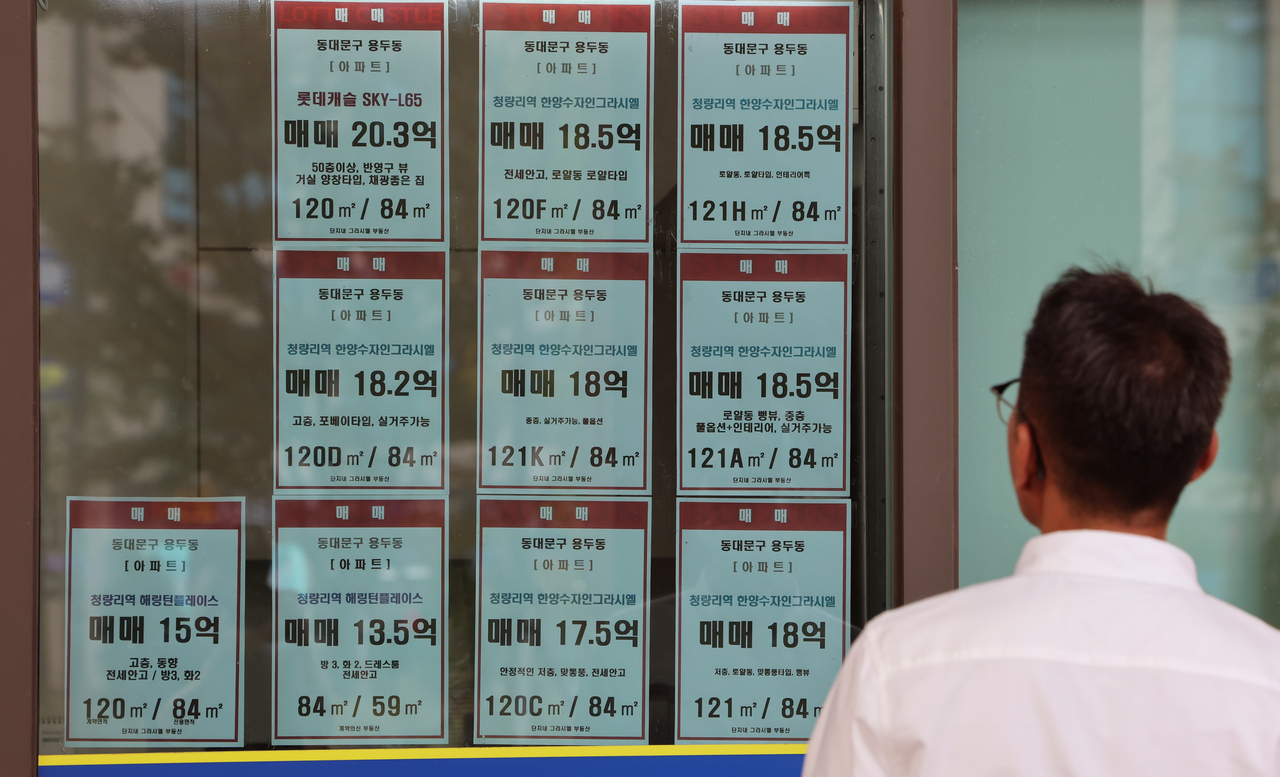
Experts attribute the pattern to the tightened lending regulations introduced by last year's Oct. 15 measures. The government at the time designated all of Seoul as an adjustment target area, speculative overheating district and land transaction permit zone, and applied differentiated mortgage loan ceilings based on home price. In the Greater Seoul metropolitan area and other regulated zones, the maximum loan is 600 million won for homes priced at or below 1.5 billion won, 400 million won for those between 1.5 billion and 2.5 billion won, and 200 million won for those above 2.5 billion won.
Analysts say the surge in the mid-tier band reflects a convergence of two forces under the strict lending environment: buyers seeking to upgrade to higher-tier neighborhoods, and so-called "survival buying" — the impulse to secure a home before prices climb further out of reach.
"Once a home price exceeds 2.5 billion won, the available loan amount drops sharply," said Seo Jeong-yeol, a real estate professor at Youngsan University. "What we're seeing is upgrade demand rushing to get a foothold on the housing ladder while borrowing is still feasible." He added that the terminology for heavily leveraged buying has grown more urgent. "The word 'all-in borrowing' has been replaced by the stronger term 'survival buying,' and the fierce atmosphere looks set to continue for now," he said.
Seo Jin-hyeong, a real estate professor at Kwangwoon University, said the trend reflects cash-capable middle-tier buyers moving into the semi-premium segment on expectations of further price appreciation. He described the dynamic as buyers rushing to acquire homes with remaining upside before prices cross the 2.5 billion won threshold and loan limits tighten further.
Meanwhile, younger buyers also accelerated their purchases over the same period. Court registry data on ownership transfer filings for collective buildings — including apartments and officetels — show that buyers in their 20s and 30s in Seoul totaled 15,112 in July and August this year, up about 23 percent from 12,282 in the same period last year. Their share of all buyers also rose, from about 36 percent to 41 percent.
On the rise in buying among those in their 20s and 30s, Professor Seo Jin-hyeong said the trend reflects not only heavily leveraged purchases by young buyers but also demand driven by parental financial support to help the younger generation get onto the property ladder.
shy@heraldcorp.com
hwshin@heraldcorp.com




