
475.8 billion won sold through Wednesday — 79.3% of target
Six brokerages exhaust initial allotments; banks lag far behind
High-risk profile, 5-year lock-up deter deposit-oriented customers
![Financial Services Commission Chairman Lee Eok-won signs up for the National Participation Growth Fund in May. [Herald DB]](https://wimg.heraldcorp.com/news/cms/2026/10/15/news-p.v1.20260919.51c8aee95f9948d59cf19ff0fc87b084_P1.jpg)
Sales of the second National Participation Growth Fund closed Thursday with a stark divide between banks and securities firms: major brokerages sold through their entire allotments while a large number of banks failed to move even half of theirs. The gap reflects a fundamental difference in customer profiles — bank clients who favor deposits and savings products proved far less willing than brokerage investors to lock up their money for five years in a high-risk fund.
According to the Financial Services Commission, cumulative sales over nine business days through Wednesday afternoon reached about 475.8 billion won ($355 million), or 79.3 percent of the 600 billion won target. On Wednesday alone, sales totaled 23.35 billion won — 17.97 billion won through securities firms and 5.38 billion won through banks, meaning brokerages outsold banks by more than three to one.
The gap held across the entire sales period. Mirae Asset Securities, Samsung Securities, Korea Investment & Securities, Kiwoom Securities, NH Investment & Securities and KB Securities all sold through their initial allotments. By contrast, Hana, IBK, Busan, KB and Woori banks each sold between 30 and 50 percent of their initial allotments, while banks in South Gyeongsang Province, iM and Gwangju Bank each sold less than 30 percent. Shinhan Bank reached 50 to 60 percent, and NongHyup Bank filled 91 percent of its target. As the sales gap widened, fund managers redistributed allotments among distributors twice during the period.
Financial regulators attributed the disparity in part to the nature of fund products, which tend to attract investors who already use brokerage channels.
"The second tranche was an additional offering made on the strength of the first sellout, and first-round subscribers are not re-entering, so the pace was always likely to be somewhat slower," an FSC official said. "Fund products by their nature tend to draw more subscriptions through securities firms."
Banks also pointed to their customers' investment preferences as the primary factor. The National Participation Growth Fund is a high-risk product with no principal guarantee. A buffer mechanism exists under which public funds and seed capital from asset managers absorb a portion of any losses first, but the fund is a closed-end vehicle with a five-year maturity that ties up capital for an extended period. Even after a stock exchange listing, low liquidity could make it difficult to sell units or force investors to accept prices below net asset value.
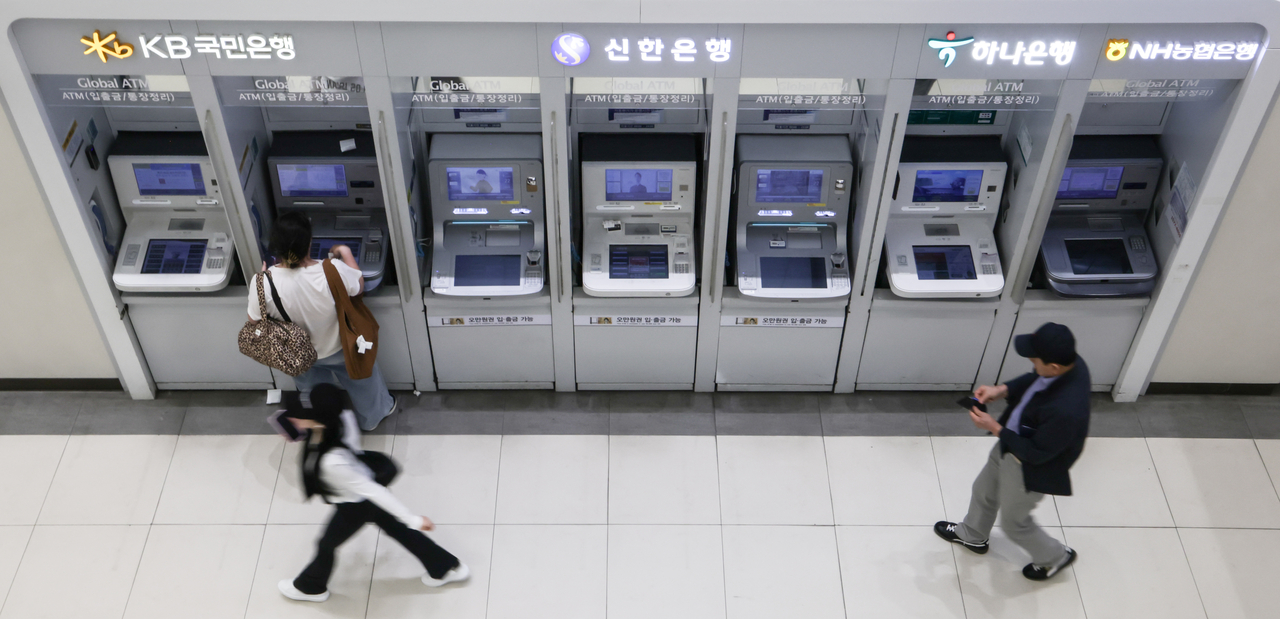
"Given that this is a high-risk product, the difference in customer profiles between banks and securities firms appears to have affected sales performance," a banking industry official said. "The fact that customers with a more aggressive investment appetite tend to use securities firms likely played a role as well."
The fund offers up to 40 percent income deduction on invested amounts and a separate taxation benefit on dividend income, but the five-year lock-up and the possibility of principal loss gave pause to bank customers who primarily use deposits, savings accounts or ISA products.
"From a consumer's perspective, it ultimately comes down to comparing expected returns against other products like deposits," another banking industry official said. "The sales figures reflect whether customers concluded that the returns would justify tying up their money for five years."
Weaker investor sentiment compared with the first round was also cited as a factor slowing overall sales. "Interest in the product has dropped considerably compared with the first round, and stock market volatility has dampened investor appetite significantly," a third banking industry official said. "Because early redemption is not possible for five years, customer demand simply has not been as strong as it was the first time."
There was also an initial difference in non-face-to-face sales limits. During the first five business days, banks could sell up to 40 percent of their allotments online, while securities firms could sell up to 60 percent. The distinction between online and offline quotas was removed from Oct. 8, after which all distributors operated under the same conditions.
As of 5 p.m. Wednesday, the remaining unsold volume stood at about 124.2 billion won — 30.83 billion won at banks and 93.33 billion won at securities firms. Sales closed at 5 p.m. that day.

rim@heraldcorp.com




