
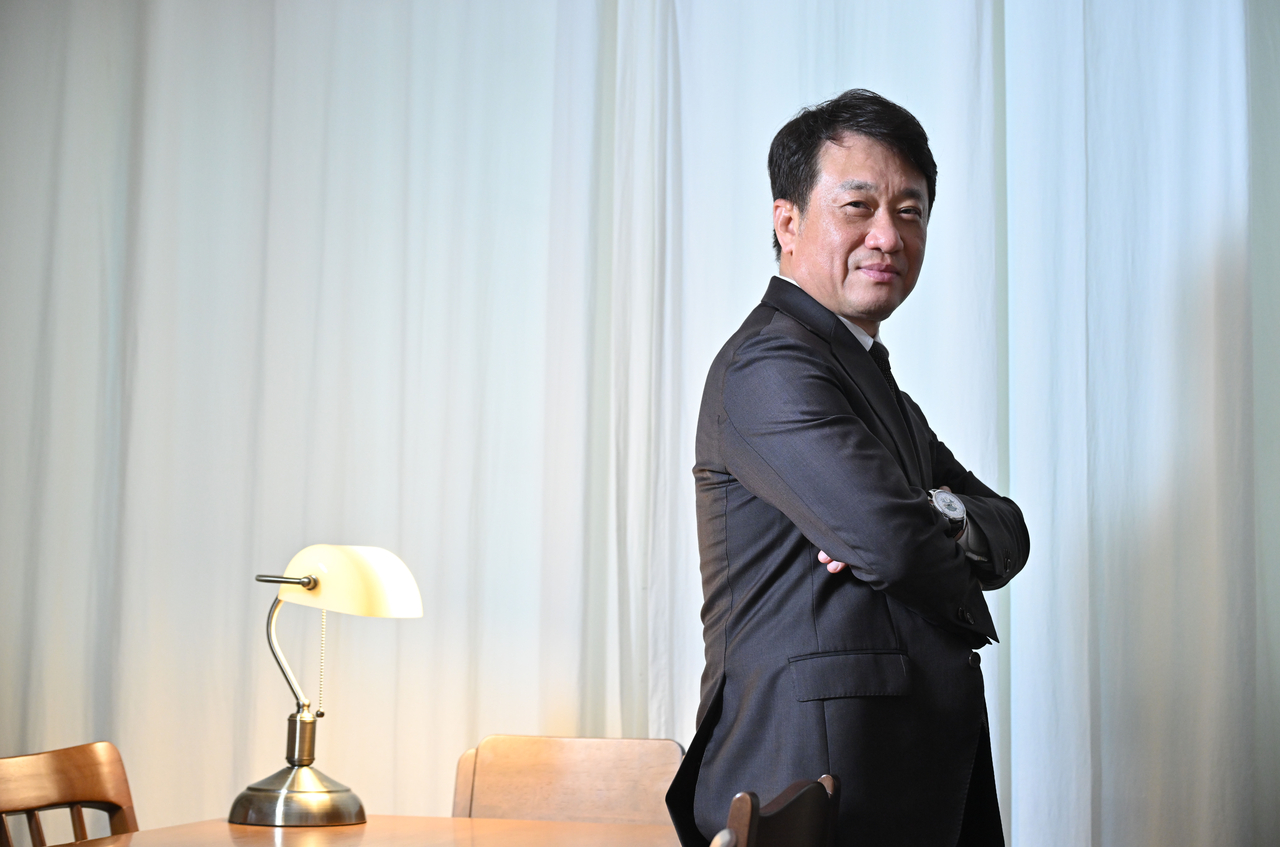
"Korean medicine's standing is similar to that of K-pop."
Every word he spoke carried an unmistakable pride in Korean healthcare. The boy who once walked in the footsteps of his father — the first Korean to serve as chief of internal medicine at Jeonju Jesus Hospital — has grown into the president-elect of the world's hospital federation.
That boy is Lee Wang-jun, incoming president of the International Hospital Federation and chairman of Myongji Healthcare Foundation.
Lee graduated from Seoul National University College of Medicine in 1992 and went on to earn a master's degree from Inha University and a doctorate from Seoul National University, after which he pursued a wide range of activities across multiple fields.
In 1998, at the height of the Asian financial crisis, he took over Incheon Sarang Medical Foundation and reinvented himself as a hospital administrator. Building on that, he acquired Myongji Healthcare Foundation in 2009 and has served as its chairman ever since.
He also contributed to the government's efforts to prevent and respond to infectious diseases, serving as a member of the KDCA's Infectious Disease Crisis Management Expert Committee, a member of the general division and head of the quarantine supplies and equipment division of the pan-government COVID-19 treatment and vaccine support task force, and a member of the pan-government Global Vaccine Hub promotion committee. He currently serves on the KDCA's advisory committee.
His academic engagements have been equally broad. After serving as vice president of the Korean Surgical Society, policy director of the Korean Academy of Medical Sciences, and board member of the Korean Society for Health Administration, he currently chairs the Korean Society for Healthcare Design.
He has been just as active in civic life, serving as a board member of the Seoul Philharmonic Orchestra, a board member of the National Chorus of Korea, vice president of the Korean Association for Migrant Workers' Health, chairman of the Seo Jae-pil Memorial Foundation, and chairman of the organizing committee of the Jeonju World Sori Festival — the latter three positions he still holds.
His awards are as varied as his activities. They include a Russian Order of Health (2011, for contributions to advancing South Korea-Russia health cooperation), an IHF Grand Award (2016, for a MERS response project), an IHF Excellence in COVID-19 Response Award (2020), a Presidential Commendation for Job Creation (2020), a Mecenat Award in the Mecenat Person category (2021, from the Minister of Culture, Sports and Tourism), and an IHF Gold Winner award (2023, in the social responsibility category).
Yet for all his accomplishments, Lee counts his election as IHF president-elect among his proudest achievements — not merely as a personal milestone, but as a validation of Korean medicine on the world stage. "Being elected IHF president-elect carries great significance," he said. "I won against a European candidate from Poland. I believe my election indirectly confirms the level and standing of Korean medicine."
ko@heraldcorp.com




