
Event aims to build deep tech startup ecosystem in mobility and AI
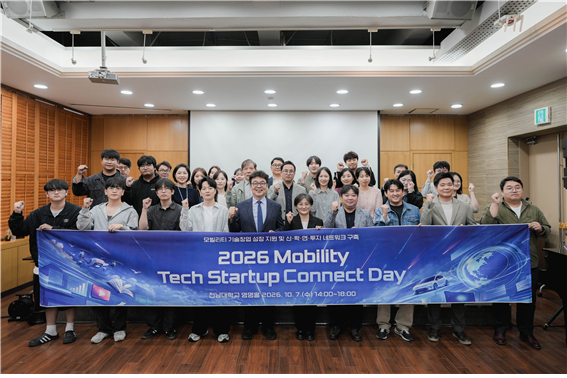
The South Jeolla-Gwangju Integrated Special City and the Gwangju Institute of Industry-Academia Convergence held the "2026 Mobility Tech Startup Connect Day" at Yeongmyeong Hall of Chonnam National University to help prospective entrepreneurs and technology-based startups in the mobility sector build their capabilities, the institute announced Wednesday.
The event was organized as part of the Ministry of SMEs and Startups' "Startup City Development Project," which targets four cities nationwide. It was co-hosted by the South Jeolla-Gwangju Integrated Special City, the Gwangju Creative Economy Innovation Center, the Gwangju Institute of Industry-Academia Convergence, and Chonnam National University's Laboratory-Specialized Startup Leading University project team. About 50 people attended, including prospective entrepreneurs, startup founders, and representatives from universities and investment institutions.
At the event, Lim Hyeon-taek, head of the R&D Innovation Planning Division at the Gwangju Institute of Science and Technology, presented on the "South Jeolla-Gwangju Future Mobility and Manufacturing AI Grand Transformation M.AX Strategy," sharing insights on the regional mobility industry's startup ecosystem and the direction of change in manufacturing AI. Kim Seon-gyeong, director of the Startup Education Center at Chonnam National University, introduced practical strategies for early market entry and commercialization under the theme "A-to-Z Strategy for Startup Survival."
A highlight of the event was a mock investor relations pitching session featuring three mobility technology-based startups and startup-stage companies, which presented their business concepts, technological competitiveness and market potential. Experts evaluated the pitches and conducted simulated investment assessments to examine each company's business model and investment viability.
The Gwangju Institute of Industry-Academia Convergence said it plans to continue identifying promising entrepreneurs and technology-based startups through the Startup City Development Project, while strengthening step-by-step support — including education, investor relations and investment linkages — to help activate the deep tech startup ecosystem in the mobility and AI sectors.
"The competitiveness of a startup city comes from an ecosystem where technology, capital and talent continuously circulate in a virtuous cycle," said Kim Young-man, director of the Gwangju Institute of Industry-Academia Convergence. "It is important to build a startup safety net that supports long-term investment, a free environment for proof-of-concept testing, regulatory improvements, and the ability to try again even after failure."
sij@heraldcorp.com




