
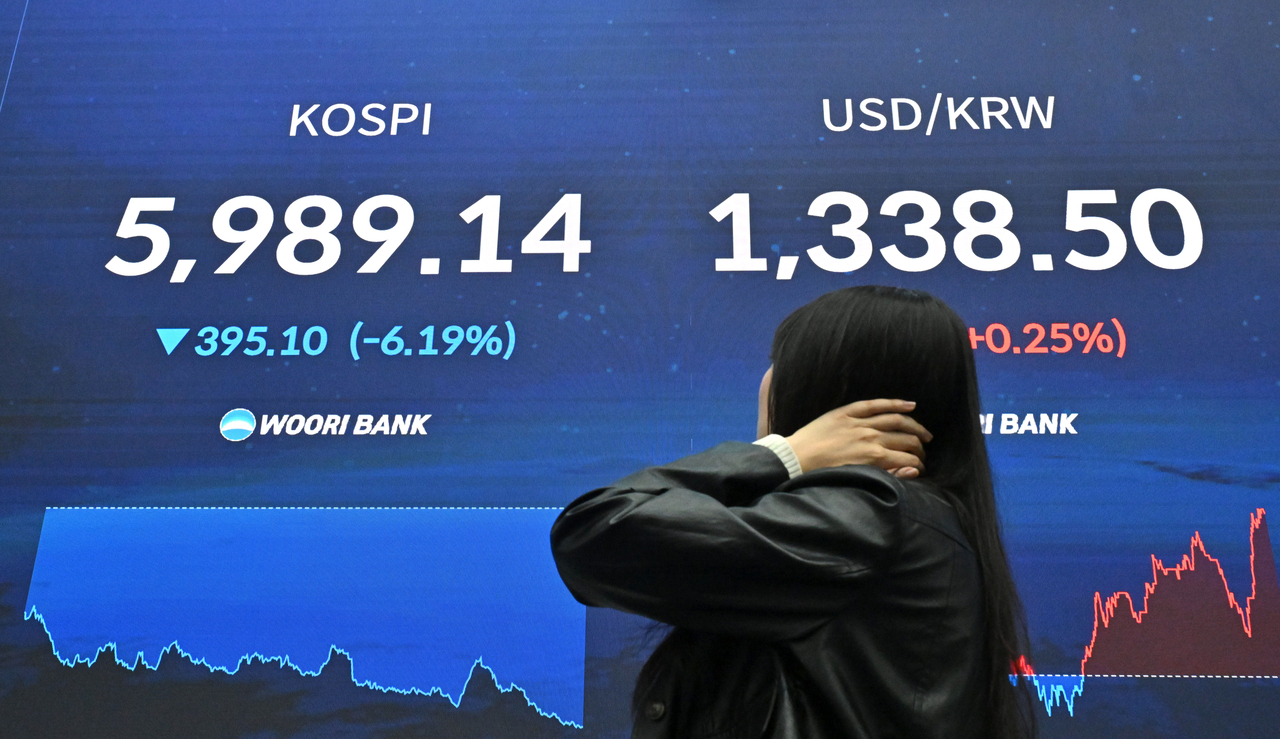
Retail and institutional investors took sharply divergent positions in the ETF market as the Kospi suffered a "Black Tuesday" plunge of more than 5 percent.
Over the past week, retail investors bought nearly 500 billion won ($373 million) worth of leverage ETFs that profit from rising share prices, while institutions concentrated their purchases on inverse ETFs that gain when prices fall. Adding to concerns, the volume of margin-financed investment swelled to its highest level in three months, raising the prospect of steeper losses for retail investors.
According to ETF Check, the ETF most heavily net-purchased by retail investors in the week through Monday — the last trading session before Tuesday's sharp drop — was KODEX Leverage, with net purchases reaching 487 billion won.
KODEX Leverage tracks twice the daily return of the KOSPI 200 index. While it can deliver higher gains than a standard index-tracking product when the index rises, losses are also roughly doubled when it falls. Retail investors appear to have interpreted the recent market pullback as a buying opportunity and bet on an index rebound.
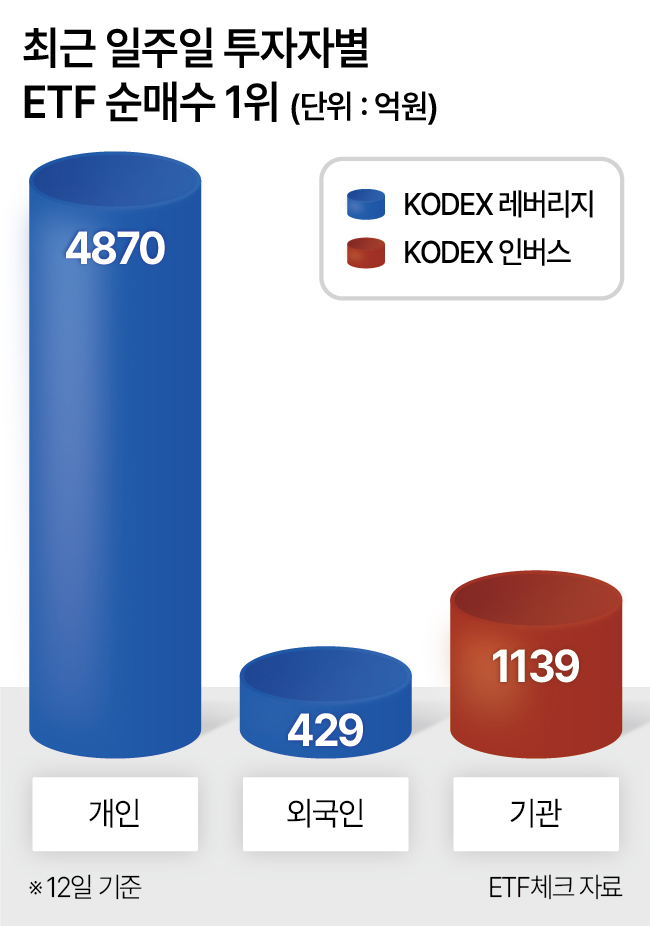
Foreign investors hedged both directions. Their top net-purchased ETF over the same period was also KODEX Leverage, but at 42.9 billion won — less than a tenth of the retail figure. At the same time, KODEX 200 Futures Inverse 2X ranked second among foreign investors, with net purchases of 36.2 billion won.
Commonly known in Korea as "gop-beo-seu" (double inverse), this product tracks twice the daily return of the KOSPI 200 futures index in the opposite direction. Foreign investors thus held top positions in products betting on both a rise and a fall in the index, a positioning that likely helped offset leverage-related losses during Tuesday's selloff.
Institutions went further, tilting their ETF trading decisively toward the downside. Their top net-purchased ETF over the same period was KODEX Inverse, with net purchases of 113.9 billion won, followed by KODEX 200 Futures Inverse 2X at 105 billion won.
Third on the institutional net-purchase list was SOL SK hynix Futures Single-Stock Inverse 2X, with 24.3 billion won in net purchases. The product profits when SK hynix's share price falls, suggesting institutions were hedging not only against a broad index decline but also against a drop in the large-cap semiconductor stocks that had recently led the market higher.
Institutions' bearish bets proved well-timed. On Tuesday, the Kospi closed down 348.89 points, or 5.46 percent, at 6,035.35. At one point during the session it fell as low as 5,911.11, breaching the 6,000 level, and the severity of the drop triggered a sell-side sidecar — a temporary halt on program sell orders.
Semiconductor heavyweights bore the brunt of the selloff. Samsung Electronics fell 7.39 percent to close at 232,000 won, while SK hynix tumbled 10.09 percent to 1.443 million won. Market conditions proved favorable for the index and semiconductor inverse ETFs that institutions had been accumulating.
Retail investors who had loaded up on leverage ETFs, by contrast, faced unavoidable losses. Because leverage ETFs track twice the daily return of their underlying index, losses can mount rapidly during a sharp short-term decline.
A surge in margin-financed investment compounded the risk for retail investors. According to the Korea Financial Investment Association, the balance of credit-financed trading as of Monday stood at 34.29 trillion won, up 477.3 billion won from the previous session — the highest level since July 15, when it reached 34.3701 trillion won. The balance had contracted to around 27 trillion won in early August before resuming its upward trend.
The concern is that a continued market downturn could deepen losses for investors who borrowed to buy. If a sharp drop in share prices causes a portfolio to fall below the required collateral maintenance ratio, brokerages can forcibly liquidate holdings through margin calls. The value of forced liquidations relative to unsettled receivables reached 27 billion won on Monday, more than four times the 6.3 billion won recorded on Tuesday.
Securities analysts have cited growing uncertainty over AI infrastructure investment as a key driver of the recent market rout and are urging a cautious approach. Hwang Su-uk, a researcher at Meritz Securities, said semiconductor fundamentals remain solid but noted that share prices are being driven more by investor sentiment and supply-demand dynamics than by fundamentals.
He added that with retail and institutional flows yet to establish a clear direction, investors need not rush a call on market direction before confirming whether foreign investor flows move in a sustained trend. He recommended a conservative, trading-oriented approach until earnings season kicks off in earnest at the end of October and confirms or dispels current concerns.

th5@heraldcorp.com




