
Exhibition Industry Development Roadmap 2030 targets expansion of large-scale convergence shows from 5% to 20%
With South Korea's exports on track to surpass $1 trillion this year, the government plans to develop at least five flagship national and regional trade shows by 2030 to build a business platform befitting that milestone. It will also raise the share of large-scale convergence exhibitions — combining industry and culture — from the current 5 percent to 20 percent.
South Korea's Ministry of Trade, Industry and Energy unveiled the "Exhibition Industry Development Roadmap 2030," a medium-to-long-term development plan, at an economic ministers' meeting Wednesday chaired by Deputy Prime Minister and Minister of Economy and Finance Lee Hyung-il.
South Korea's exhibition industry is widely seen as lagging far behind global standards. Even SIMTOS — the Seoul International Manufacturing Technology Show, the country's largest trade fair — draws only about 10 percent of the overseas visitors and transaction volume recorded at Germany's Hannover Messe.
The problem is especially acute outside the Greater Seoul area, where inadequate transportation and accommodation infrastructure, combined with a lack of differentiated content, has left seven of 11 exhibition venues operating at below 50 percent capacity as of last year.
In response, the government said it would pursue a qualitative leap by combining South Korea's strengths in advanced manufacturing and K-culture with exhibition infrastructure.
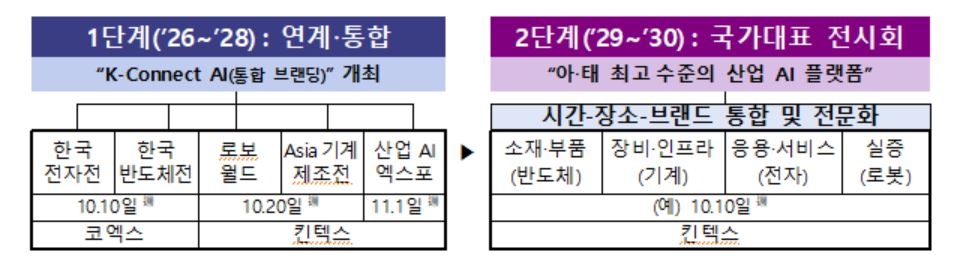
As a first step, major domestic trade shows in electronics, semiconductors and robotics will be consolidated under the single theme of AI to create larger-scale events.
Timed to the completion of KINTEX's third exhibition hall in November 2028, the government plans to merge the Korea Electronics Show, Semiconductor Show, Asia Machinery & Manufacturing Industry Show and Robo World into a single event to be developed into Asia's premier advanced-industry trade show.
Consumer goods exhibitions covering food, cosmetics and similar sectors will incorporate K-pop performances, culinary experiences and other cultural and tourism programs to give overseas visitors a hands-on taste of the K-lifestyle.
The roadmap also includes measures to develop regionally specialized shows and ease the concentration of events in the Greater Seoul area. Starting next year, the government will select and intensively support regional flagship exhibitions that blend local cultural, tourism and commercial programs, drawing on the five-pole, three-special growth engine framework. To fund the effort, the government has increased the related support budget from 7 billion won ($5.24 million) this year to 11.7 billion won next year, an increase of 4.7 billion won.
The government will also provide close support for domestic exhibition venue operators seeking to expand into promising strategic markets, including India, the Middle East and Central Asia.
Amendments to the Exhibition Industry Promotion Act are also planned, including redefining the legal function of trade shows from a trade-transaction focus to an industrial innovation platform.
In addition, the government will support exhibition operators in adopting AI solutions and running eco-friendly exhibition facilities in response to broader industry shifts such as AI transformation and ESG — environmental, social and governance — considerations.
"The exhibition industry is a core, high-value-added sector that drives our companies' export expansion and industrial innovation while injecting vitality into regional economies," Industry Minister Kim Jung-kwan said. "The government, local authorities and the exhibition industry will join forces to help the sector grow into a global business platform worthy of the $1 trillion export era."
oskymoon@heraldcorp.com




