
Kim Dong-eun's AI-based system automates outdoor business permit screening
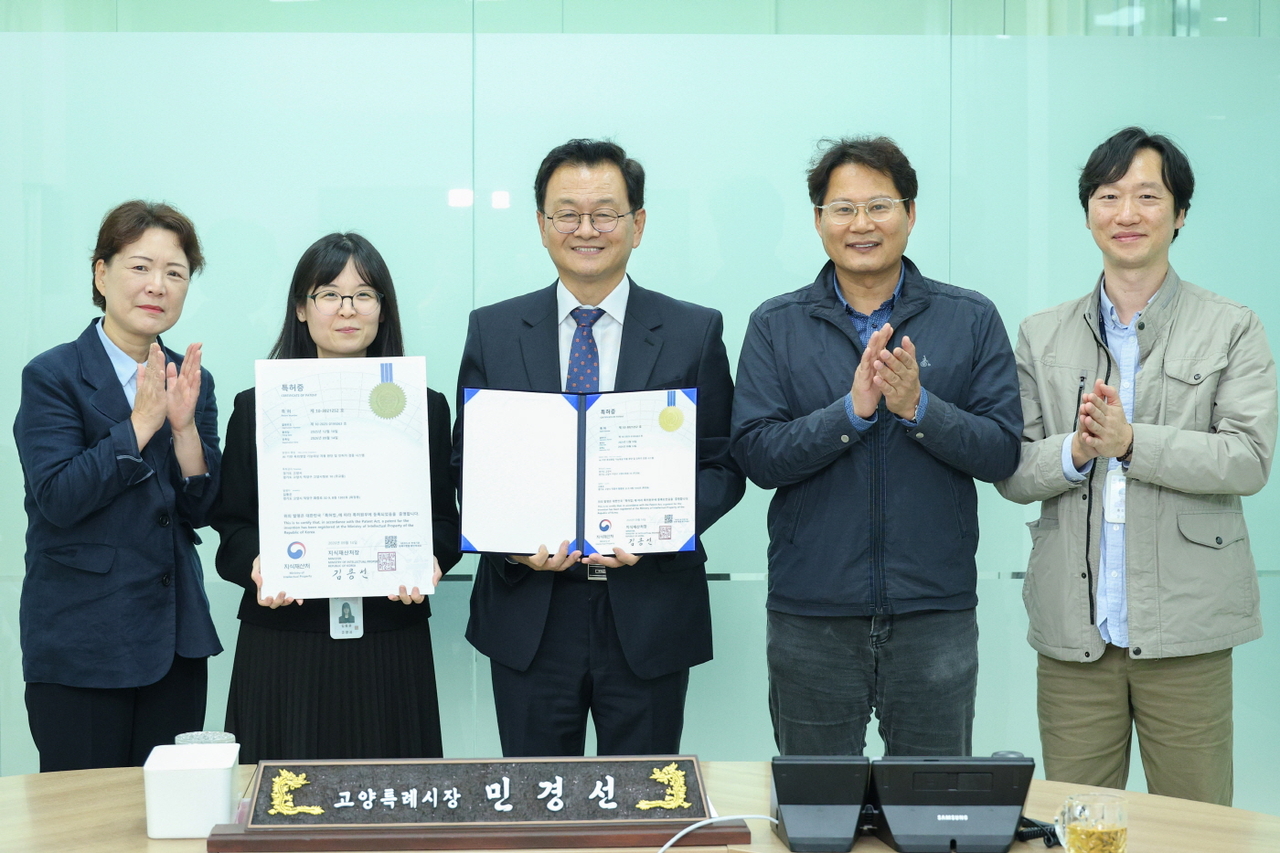
Goyang Special City has become the first local government in South Korea to receive a patent for an AI-based system that automatically determines whether outdoor business permits can be approved — an idea conceived by one of its own civil servants.
According to the city, the "AI-based automatic determination and licensing verification system for outdoor business eligibility" was granted patent registration (No. 10-3021252) by the Korea Intellectual Property Office. The city filed the patent application on Dec. 10 last year and completed registration on Sept. 14, roughly nine months later. Goyang holds the patent rights.
The patent traces back to an idea submitted by Kim Dong-eun, an administrative officer at the Deokyang District Public Health Center's health administration division, who won the top prize at Goyang's 2025 civil servant AI idea competition. After the contest, the city selected the idea for patent filing, with the Smart City Division supporting the entire process — from engaging a patent law firm to drafting the application.
Previously, processing food sanitation permits and outdoor business notifications required staff to manually cross-reference laws and ordinances overseen by multiple departments — including the Building Act, Housing Act, Parking Lot Act, Road Act and Sewerage Act — and review blueprints by hand. The process took an average of more than two weeks, placing a heavy legal review burden on staff and causing delays from inter-departmental consultations.
The patented technology is designed to let AI handle that review process automatically in three stages.
In the first stage, a staff member enters the location, floor plan and checklist information from the application, and the system queries the building register to determine whether the intended use is permitted for the space. In the second stage, AI analyzes the floor plan and photographs, cross-referencing them against the building register and relevant laws and ordinances to assess whether outdoor operations are permissible. The third stage automatically calculates septic tank capacity and developer contribution charges, then generates a results report.
The system's chief advantage is the automation of repetitive tasks. By having AI handle the law-and-ordinance cross-referencing and blueprint reviews that staff previously performed manually, officials can focus on final decisions and handling applicants directly.
The system also features a built-in multi-department collaboration structure. AI-generated determinations are routed through confirmation by the licensing officer and relevant department staff before a final decision is issued, consolidating what had been a fragmented, department-by-department review into a single workflow.
The city expects the system to improve both accuracy and speed. By applying the same legal standards consistently, it aims to reduce review oversights and discrepancies between individual officers, and to significantly cut the average processing time of more than two weeks. Once fully implemented, the system would also be able to automatically flag cases requiring additional review by comparing them against similar past applications.
Goyang Special City Mayor Min Kyung-sun met with Kim at his office on Tuesday to congratulate her on the patent registration. Kim presented the background behind her idea and its potential to improve on-the-ground operations, while the responsible department outlined plans for a proof-of-concept pilot and future applications of the technology.
"A civil servant's awareness of the inconveniences citizens face up close has led to the valuable achievement of patent registration," Min said. "We will actively support employees' creative ideas so they can bring real change to public administration, and we will work to spread this AI-based administrative innovation model across the country."
Min also directed relevant officials to "actively review support measures so that employees who deliver outstanding results — such as significant budget savings or securing national funding — can receive tangible rewards, including performance bonuses and special promotions."
The city plans to actively consider offering personnel incentives and commendations to employees whose creative ideas produce strong results.
Meanwhile, the city will consult with departments that would use the system to draw up a plan for deploying the patented technology and launching a proof-of-concept pilot, and will also discuss potential partnerships with private companies. The city plans to pay the inventor an intellectual property registration reward in November and aims to begin a pilot program in 2027, with a goal of applying the system to actual licensing operations.
pjh@heraldcorp.com




