
Forecast up 0.7 percentage points from July; next year's outlook also revised upward to 2.8%
OECD, ADB, Bank of Korea and KDI had all raised their projections earlier; global growth seen at 3.1%
![Export cargo is stacked at Sinseondae Pier in Busan port. South Korea's current account surplus widened in June, driven by a sharp increase in exports led by semiconductors. [Yonhap]](https://wimg.heraldcorp.com/news/cms/2026/10/13/rcv.YNA.20260806.PYH2026080604660005100_P1.jpg)
The International Monetary Fund has raised its growth forecast for South Korea this year to 3.3%, up 0.7 percentage points from its July projection. The IMF said strong external demand, led by semiconductors, has outweighed the negative effects of the war in the Middle East.
According to the Ministry of Economy and Finance, the IMF raised South Korea's growth forecast for this year from 2.6% to 3.3% in its World Economic Outlook released Tuesday. The fund also revised its projection for next year upward by 0.3 percentage points, from 2.5% to 2.8%.
The upward revision for South Korea — 0.7 percentage points — exceeds both the global average adjustment of 0.1 percentage points and the advanced-economy average of 0.4 percentage points. The IMF identified South Korea and Taiwan as key trading nations in AI hardware, noting that demand from these countries could generate spillover effects for raw-material exporters and manufacturing hubs alike.
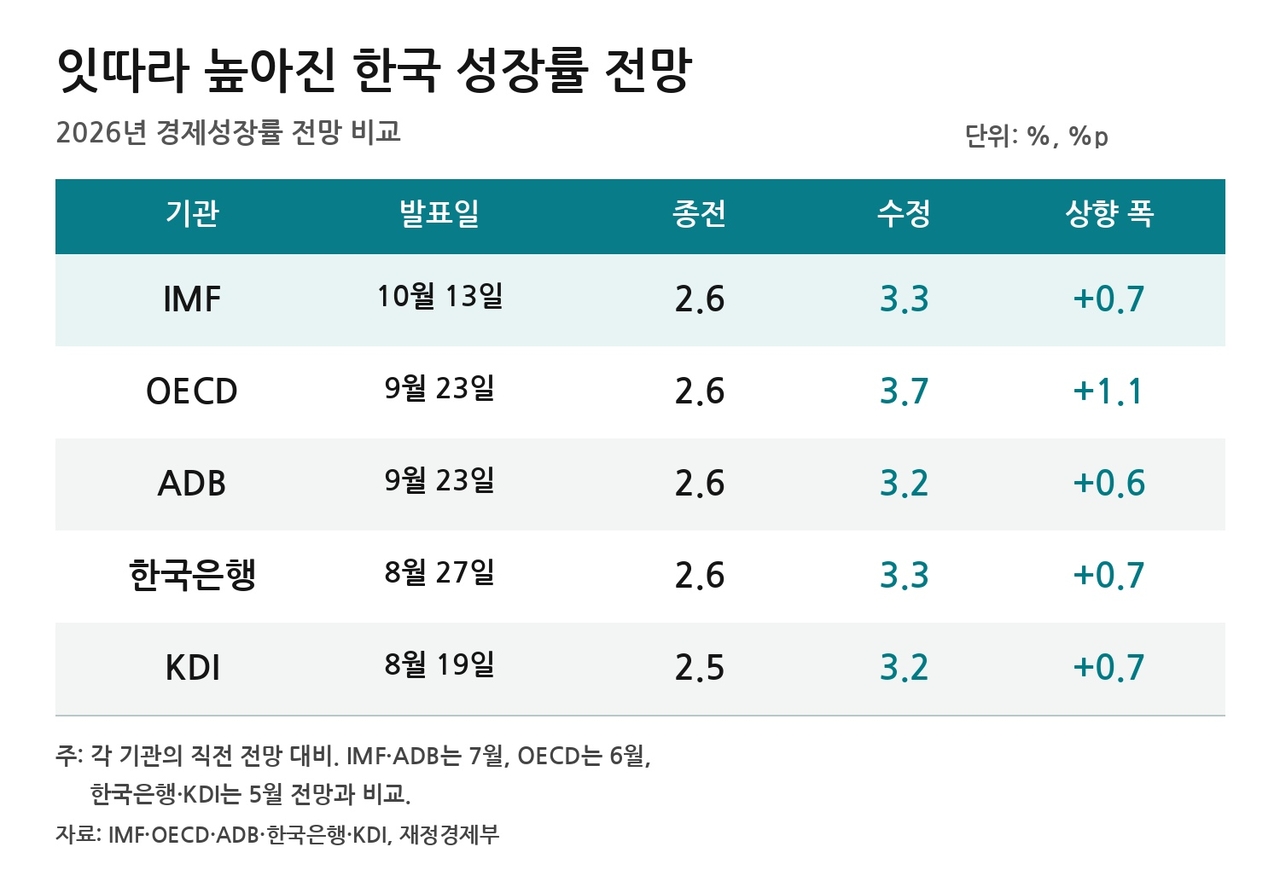
Major domestic and international institutions have also been raising their South Korea growth forecasts in quick succession. The OECD lifted its projection for this year by 1.1 percentage points on Sept. 23, from 2.6% to 3.7% — the largest upward revision among G20 members. The Asian Development Bank raised its forecast on the same day by 0.6 percentage points, from 2.6% to 3.2%.
The Bank of Korea revised its forecast for this year from 2.6% to 3.3% on Aug. 27, while the Korea Development Institute raised its projection from 2.5% to 3.2% on Aug. 19 — each an upward revision of 0.7 percentage points. The IMF's latest figure matches the Bank of Korea's forecast and stands 0.1 percentage points above those of the ADB and KDI, but remains 0.4 percentage points below the OECD's projection.
The IMF said the global economy is also performing better than expected, supported by the spread of AI investment despite the prolonged war in the Middle East and ongoing trade tensions. The fund raised its global growth forecast for this year by 0.1 percentage points to 3.1%, while keeping next year's projection unchanged at 3.4%.
However, the IMF said growth trajectories will vary by country depending on their exposure to the Middle East conflict and the extent of their participation in the AI technology value chain.
The growth forecast for advanced economies this year was revised up 0.4 percentage points to 2.1%. The United States held its projection steady at 2.3%, reflecting strong technology investment and productivity gains alongside limited direct exposure to the war. The eurozone and Japan were revised upward to 1.1% and 0.7%, respectively — gains of 0.2 and 0.1 percentage points. The IMF nonetheless expects growth in advanced economies to slow compared with last year, weighed down by higher energy costs and weakening consumer sentiment.
Emerging and developing economies, by contrast, saw their collective growth forecast trimmed by 0.1 percentage points to 3.7%. China's outlook was lowered from 4.6% to 4.5%, reflecting the impact of rising global oil prices. The Middle East and Central Asia are projected to contract 0.3% this year as energy export disruptions persist, before rebounding to 6.3% growth next year.
The forecasts are based on the assumption that the Strait of Hormuz will reopen in November and that energy supply and logistics conditions will gradually recover, returning to pre-war levels around February next year.
Global inflation this year is projected at 4.7%, unchanged from the July forecast, reflecting higher energy and food prices stemming from the Middle East conflict. The rate is seen at 3.1% for advanced economies and 5.7% for emerging markets. Core inflation in major economies is expected to converge gradually toward target levels after the middle of next year.
The IMF said downside risks to the global economy have eased somewhat since July but remain dominant. It flagged Middle East tensions, trade fragmentation, raw-material price volatility and inflationary pressures as the main risks. The fund said markets should also remain alert to the possibility that expectations for AI-driven productivity gains could be reassessed or that trade frictions could intensify again. On the upside, a prolonged AI technology cycle and a restructuring of energy supply chains could provide a boost to growth.
On policy, the IMF recommended that governments build fiscal buffers and pursue medium-term fiscal consolidation. It said support for vulnerable groups should be targeted and time-limited, and that monetary policy should keep price stability as its top priority. The fund also urged structural reforms — including improving labor mobility and streamlining regulation — and called for international cooperation to restore mutually beneficial trade norms.
The Ministry of Economy and Finance attributed the large upward revision in South Korea's growth forecast primarily to strong exports of AI hardware and semiconductors. It said the government plans to focus on stabilizing livelihoods and reversing the slowdown in potential growth through three core social policy pillars — residential support, job creation and financial services for low-income households — while remaining mindful of lingering structural challenges including the prolonged Middle East conflict, rising prices and interest rates, inequality and slowing potential growth.
fact0514@heraldcorp.com




