
New LFP production investment for BBU batteries
Mass production of cathode plates targeted at Malaysia's second factory from June next year
LFP added to existing NCM lineup
BBU sales forecast to grow more than 70% this year
![An aerial view of Samsung SDI's battery production factory in Seremban, Malaysia. [Samsung SDI]](https://wimg.heraldcorp.com/news/cms/2026/10/13/news-p.v1.20261013.88390f67ec124e6c858efea9bc5131c3_P1.jpg)
Samsung SDI plans to begin mass-producing cylindrical lithium iron phosphate (LFP) batteries for AI servers as early as June next year. The move marks the first time a domestic battery maker has applied LFP chemistry to cylindrical backup batteries, broadening its product lineup beyond its existing nickel-cobalt-manganese (NCM) offerings. The company aims to accelerate its push into the fast-growing data center battery market by leveraging LFP's relative cost competitiveness and thermal stability.
According to industry sources Tuesday, Samsung SDI recently decided to make the new investment and has begun setting up LFP cathode plate production equipment at its second factory in Malaysia for battery backup units (BBUs) used in AI servers. The company is targeting the start of mass production as early as June next year.
Samsung SDI earlier unveiled its cylindrical LFP battery for BBUs for the first time at Data Center World Asia 2026, held in Singapore on Sept. 29.
The investment will allow Samsung SDI to produce both NCM batteries and cylindrical LFP batteries for BBUs at its second Malaysian factory. The company is expected to install new equipment — including mixers and tanks for blending raw materials — to prevent the two battery chemistries from cross-contaminating each other, while making maximum use of existing production lines for the remaining manufacturing processes.
A cathode plate is a component made by coating cathode material — a core battery ingredient — onto a thin aluminum foil. It then goes through an assembly process combining the anode, separator and other components to produce a finished battery cell.
![Cylindrical and prismatic lithium iron phosphate (LFP) batteries unveiled by Samsung SDI at Data Center World Asia 2026 in Singapore. [Samsung SDI]](https://wimg.heraldcorp.com/news/cms/2026/10/13/news-p.v1.20260929.0e56588354534215922fb0f403e0463e_P1.jpg)
Samsung SDI's second factory in Malaysia, where the new equipment will be installed, is one of the company's key cylindrical battery production hubs. Samsung SDI has invested about 1.7 trillion won ($1.27 billion) since 2022 to build the second factory in Seremban. The facility currently produces 21700-format cylindrical batteries used in power tools, e-bikes and electric vehicles.
The company has recently been expanding its production scope to include batteries for AI data centers. It produces the high-output cylindrical battery "40V3," which uses existing NCM materials, to meet BBU demand. The 21700-format product features a higher nickel content and was developed to deliver large amounts of power instantaneously.
Adding LFP to the lineup will give customers a wider range of products to choose from based on price and performance. LFP batteries offer advantages over NCM batteries in that raw material costs are relatively easier to keep low and thermal stability is higher. However, they store less energy for the same physical size.
![Samsung Electronics Chairman Lee Jae-yong inspects the production floor at Samsung SDI's Battery Factory 1 in Seremban, Malaysia, on Feb. 9, 2024. He also checked on the second factory, which was under construction at the time. [Samsung Electronics]](https://wimg.heraldcorp.com/news/cms/2026/10/13/news-p.v1.20261013.7f467cea1c6d4baf93a52434baffaf6e_P1.jpg)
The expansion is also expected to boost utilization rates at existing cylindrical battery production lines. Samsung SDI's small battery facility utilization rate was limited to 50.4 percent last year, as customers cut orders amid weak demand for electric vehicle and power tool batteries. In the first half of this year, however, the rate rebounded to 73 percent, signaling a recovery.
Samsung SDI's push to expand its product lineup comes as demand for BBUs in AI data centers is growing rapidly. A BBU is a device that instantly supplies power to a server when an outage or momentary power disruption occurs. Unlike uninterruptible power supply (UPS) systems that cover an entire data center, BBUs are installed close to individual servers to deliver power where it is needed.
Beyond emergency power supply, BBUs are increasingly playing a role in buffering fluctuations in server power demand. GPUs, which handle AI computation, can experience sudden, sharp spikes in power consumption depending on workload. BBUs help stabilize server operation by rapidly supplying the shortfall. As the number of AI servers grows, demand for batteries with high output and safety is structurally set to increase.
![Samsung SDI's cylindrical battery cells. [Samsung SDI]](https://wimg.heraldcorp.com/news/cms/2026/10/13/news-p.v1.20260917.2f6ead2f54554bf5bcb1162c4f4e45ea_P1.png)
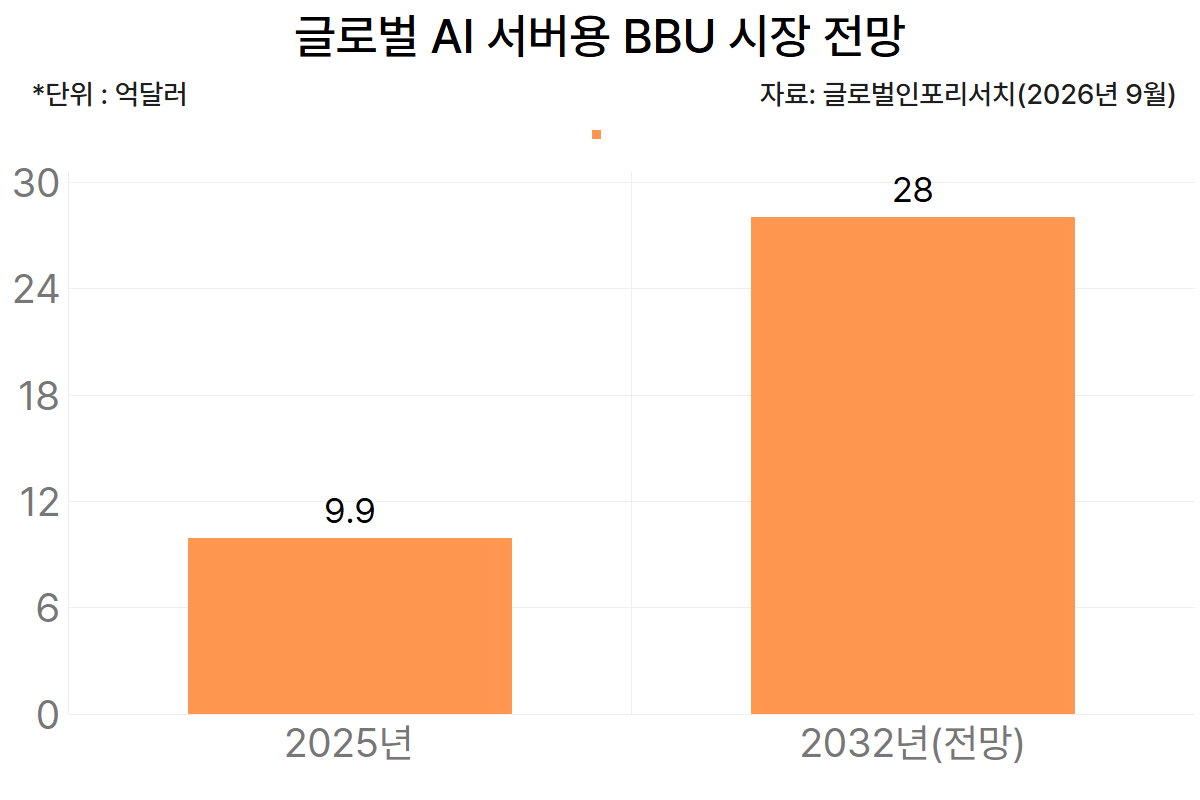
According to market research firm Global Info Research, the global BBU market for AI data center servers is forecast to grow roughly 2.8 times — from $989 million last year to $2.8 billion in 2032.
Samsung SDI is also projecting sharp sales growth. Cho Han-je, executive vice president and head of Samsung SDI's strategy and marketing division, said during the second-quarter earnings conference call that the company holds roughly a 40 to 50 percent share of the BBU battery market and forecast that related sales would grow more than 70 percent this year compared with last year.
Strong BBU battery sales are expected to contribute to a turnaround in Samsung SDI's small battery division. Shinyoung Securities estimated that the division would post an operating profit of 20 billion won in the third quarter of this year, returning to the black for the first time in nine quarters after eight consecutive quarters of losses since the third quarter of 2024. Growing demand for AI data center and power tool batteries is expected to underpin the earnings recovery.
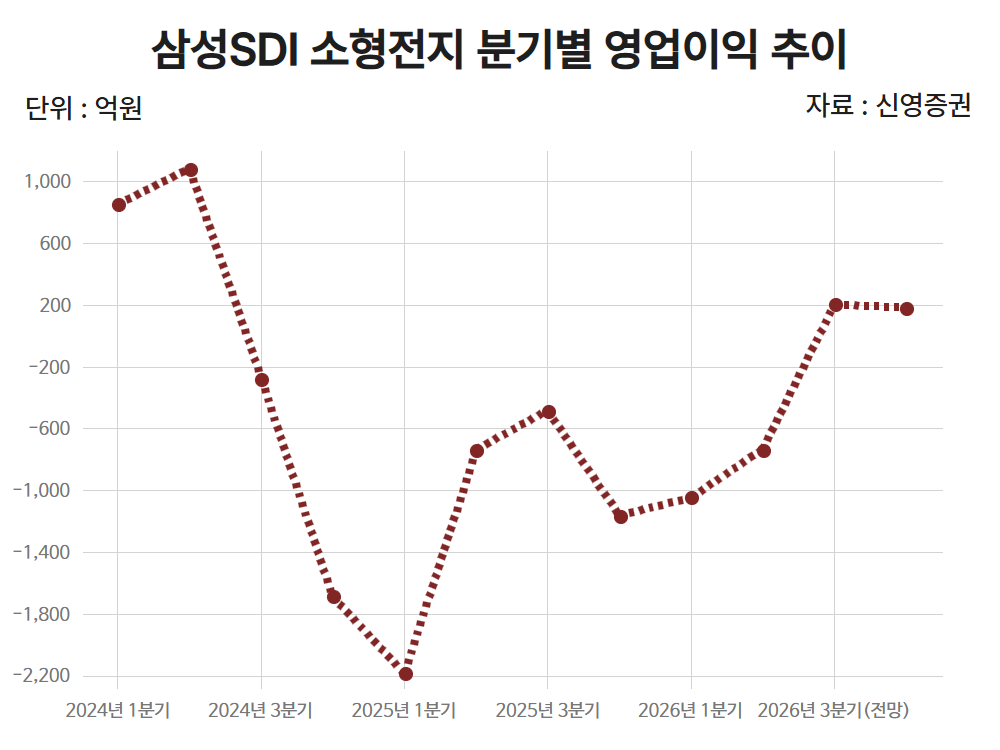
The strong BBU battery sales are expected to drive a broader earnings recovery in Samsung SDI's small battery division. Shinyoung Securities estimated that the division's sales in the third quarter of this year would reach 1.31 trillion won, up 34 percent from a year earlier, with an operating profit of 20 billion won — swinging back to profit for the first time in nine quarters after a 74 billion won operating loss in the previous quarter.
Park Jin-su, a researcher at Shinyoung Securities, said that as North American energy storage system (ESS) battery demand expectations continue to rise, Samsung SDI's prismatic ESS batteries and small-format BBU batteries are likely to see sustained solid sales. Jang Jeong-hun, a researcher at Samsung Securities, also projected that strong sales of BBU and power tool batteries would lead the small battery division's return to profitability, with expanding North American ESS shipments providing an additional boost to earnings.
kwater@heraldcorp.com




