
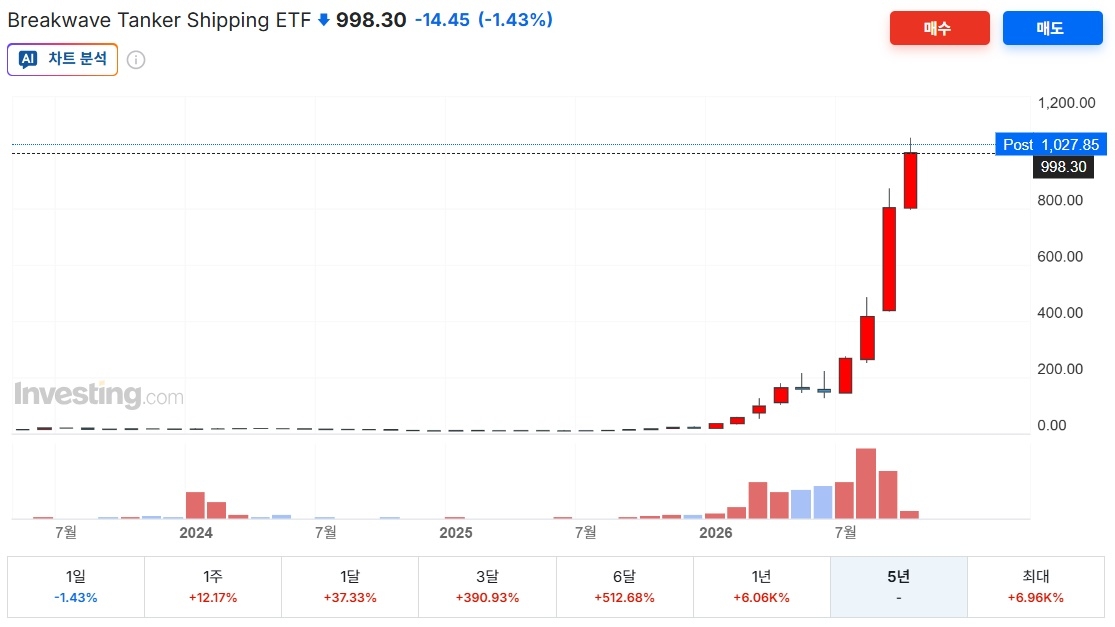
"If you had put in 10 million won, you'd have 500 million won ($374,000) now." "A 100 million won investment would be worth 5 billion won today."
A fund that has posted a remarkable return of more than 5,000 percent this year alone is generating buzz among investors. The product is the Breakwave Tanker Shipping ETF (BWET), which tracks oil tanker freight rates.
According to the financial investment industry, BWET has surged roughly 5,239 percent from the start of the year, making it the top-performing ETF listed on US markets this year by a wide margin. The share price, which stood at $18.73 in January, broke through $1,000 on the New York Stock Exchange on Thursday. Its gain over the past 12 months has reached 6,988 percent.
Managed by US mid-sized asset manager Amplify, the fund does not invest in physical crude oil or shipping company shares — it tracks oil tanker freight futures. Some 90 percent of the portfolio is allocated to VLCC freight futures (TD3C) covering routes from the Middle East Gulf region to China, while the remaining 10 percent goes into Suezmax freight futures (TD20) on routes from West Africa to Europe.
Returns rise when maritime shipping routes become more dangerous, voyages grow longer, or the number of available vessels shrinks — all of which push freight rates higher. Because it invests in freight rate movements rather than oil prices, BWET can surge even when crude prices fall, as long as tanker rates are climbing.
![An oil tanker anchored in the Strait of Hormuz. [AP]](https://wimg.heraldcorp.com/news/cms/2026/10/12/news-p.v1.20261012.b24bc33873134e259daba11c2616fc2a_P1.jpg)
BWET's recent surge is widely attributed to soaring oil tanker freight rates driven by maritime shipping disruptions around the Strait of Hormuz. In a report earlier this month, ING economist Rico Lohmann said geopolitical turmoil in the Middle East had pushed up the cost of transporting crude oil.
He pointed to growing security risks along key shipping lanes — including the Strait of Hormuz, the Gulf of Aden and the Bab el-Mandeb Strait — compounded by rising insurance premiums and sanctions that have reduced the number of vessels available for operation. Lohmann added that ships rerouting to longer passages to avoid attack threats in the Strait of Hormuz had increased the shipping burden, while the expansion of Russia's "shadow fleet" to circumvent sanctions has made it harder to secure compliant vessels.
According to ING, average earnings for crude oil tankers worldwide exceeded $500,000 a day in the first week of October — roughly 10 times the 2025 average. Particularly striking was the rate for VLCCs capable of carrying 2 million barrels: daily freight charges soared from around $30,000 in January to $1.3 million this month.
However, analysts warn that chasing the fund based on returns alone carries significant risk. Experts say BWET's price could fall if vessel availability improves or the Strait of Hormuz reopens permanently. John Murillo, chief commercial officer at B2BROKER, said, "This conflict is unpredictable and could end at any time. If it does, freight rates will drop and the fund's price will follow."
bbo@heraldcorp.com




