The National IP Committee reviewed and confirmed guidelines on AI-assisted invention patent applications to establish a fair intellectual property order
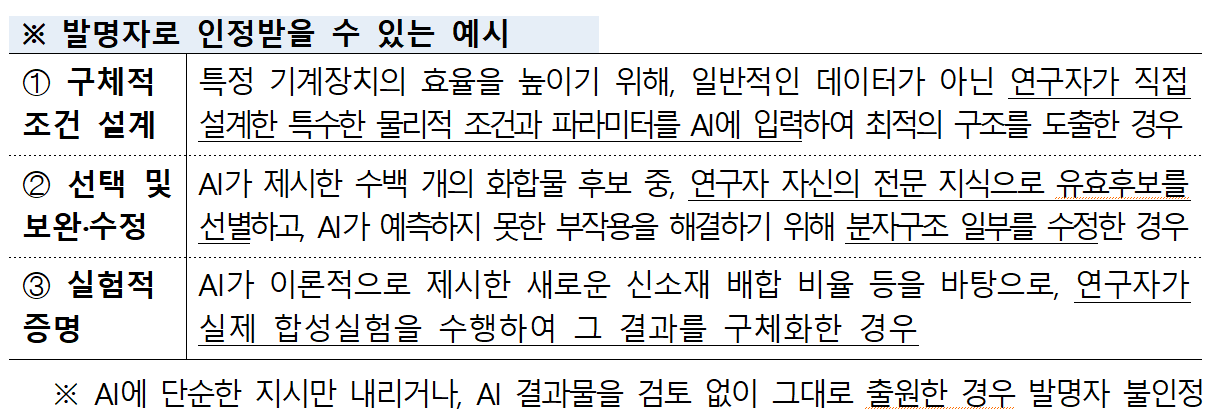
Guidelines clarifying that AI cannot be named as an inventor — and that a patent requires a person's "substantial contribution" — have been reviewed and confirmed, along with a commitment to take strict action against indiscriminate applications generated by AI without meaningful human input.
The National Intellectual Property Committee, chaired by Kye Seung-kyun and operating under the prime minister, held its 42nd plenary session Thursday at Government Complex Seoul. The meeting was convened to review, across the patent, design and copyright fields, the standards for establishing rights over AI-assisted creative works, as generative AI continues to spread rapidly throughout the creative sector.
▶ AI as 'tool,' humans as inventors: patent application standards clarified
The Korean Intellectual Property Office published guidelines on patent applications for AI-assisted inventions in June to actively protect high-quality inventions that use AI while taking firm action against indiscriminate applications generated without substantial human involvement. The guidelines make clear that even when AI is used as a tool, a person must have "substantially contributed" to the inventive process to qualify for a patent. When such contribution is in doubt, an examiner may issue a notice of grounds for rejection and request a signed "inventor confirmation statement."
▶ Copyright issues across the full lifecycle of generative AI — from training to output
The Ministry of Culture, Sports and Tourism presented three sets of copyright guidelines covering the full range of copyright issues arising throughout the generative AI process, from training to the production of outputs.
A guide on copyright registration for works created with generative AI sets out the standard that "AI-assisted works" in which human creative contribution is recognized may be registered. AI-generated outputs themselves cannot be registered, but if a person's creative contribution is evident in the selection, arrangement or composition of those outputs, the result may be registered as a compilation work.
A guide on preventing copyright disputes involving generative AI outputs instructs users to assess potential infringement based on two criteria: whether the AI recognized an existing work and generated its output on that basis (derivation), and whether the creative expression of the AI output is substantially similar to that of the existing work (substantial similarity).
A guide on fair use under copyright law for AI training data addresses the standards for determining whether the fair-use provision applies to AI training. It notes that training for commercial purposes or through web crawling is not automatically excluded from fair use, and that determinations must be made by weighing four factors, including the purpose of use and the nature of the works involved.
▶ AI-assisted designs also require 'substantial human contribution' for registration
The Korean Intellectual Property Office has prepared application guidelines to facilitate the smooth registration of rights in AI-assisted designs, in response to the growing use of AI in the design field. Because AI cannot be a design creator, its name may not be entered in the "creator" field of an application.
However, an AI-assisted design may still be registered if substantial human creative contribution is recognized — specifically, when a person conceives the dominant features that shape the overall aesthetic impression of the design and uses AI as a tool to realize it.
The office plans to accumulate cases involving AI inventions and applications to refine examination standards, establish examination guidelines requiring supporting evidence when a creator's eligibility is in doubt, and introduce legal grounds to reject or invalidate patents for applications that deliberately violate the principle of good faith.
The Ministry of Culture, Sports and Tourism has been operating a dedicated AI-company consultation desk at the Copyright Commission this year. It also plans to distribute standard contract templates for the transfer and licensing of works for AI training purposes before the end of the year, and to introduce a "generative AI usage disclosure statement" requiring applicants to specify the degree of human contribution when registering AI-assisted works.
"AI has now become a universal tool for creation, but human creativity must still remain at the heart of the intellectual property system," said Kye, the committee's civilian chair. "We will ensure that the guidelines discussed today serve as the standard for a fair intellectual property order — one that provides strong protection for legitimate AI-assisted creation while filtering out indiscriminate applications — and South Korea will play a leading role in international norm-setting discussions."
kwonhl@heraldcorp.com